
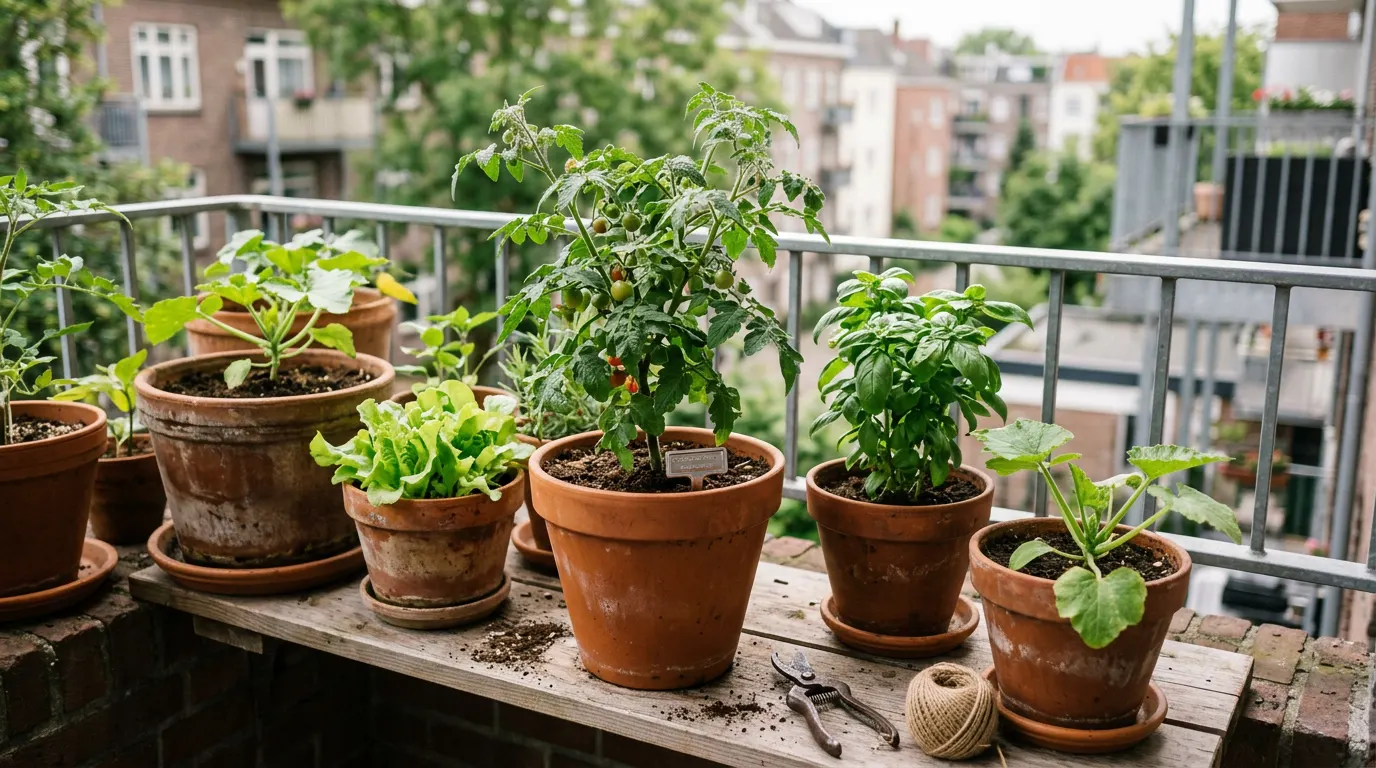
How to Start a Balcony Vegetable Garden: Step-by-Step 🌿
To start a balcony vegetable garden, first assess your sunlight (aiming for 6+ hours for fruiting crops or 3-4 hours for leafy greens) and check your building's weight limits. Choose lightweight containers with drainage holes, fill them with premium organic potting mix, and select compact, high-yield varieties like cherry tomatoes, leafy greens, and bush beans. Water consistently when the top inch of soil feels dry, and feed bi-weekly with a balanced organic liquid fertilizer.
Setting up an edible garden on an apartment balcony is a rewarding way to grow fresh, organic food in a limited urban space. By understanding your balcony's unique microclimate and structural limits, you can transform a small concrete slab into a highly productive vertical farm. Let's dive into the step-by-step process to get your container garden growing successfully.
1. Assess Your Balcony's Microclimate and Weight Limits ☀️
Before planting, track your sunlight (6+ hours for sun-lovers, 3-4 hours for greens) and check your building's rules. Most balconies support 60 lbs per square foot; use lightweight plastic, resin, or fabric grow bags to stay safe.
Understanding your balcony's microclimate is the foundation of urban gardening success. Observe how many hours of direct sunlight your space receives daily. South- and west-facing balconies typically get intense, all-day sun, while north-facing balconies remain mostly shaded.
Additionally, high-rise balconies often experience intense wind tunnels. Wind dries out soil rapidly and can physically damage fragile plants. You can mitigate this by installing a lattice trellis to act as a windbreak.
Finally, always calculate your weight limits. A standard structural safety code limit for balconies is 60 pounds per square foot (lbs/sq ft). Wet soil, heavy terracotta pots, and mature plants add up quickly.
⚠️ Warning: To stay well within safety limits, choose lightweight container materials like fabric grow bags or resin pots, and avoid heavy concrete or ceramic planters.
2. Choose the Best Containers and Potting Soil 🪴
Always use pots with drainage holes to prevent root rot. Select 15-20L pots for large crops like tomatoes, and smaller 2-4L pots for herbs. Fill them with organic potting mix, never heavy garden soil.
Your choice of containers and soil directly impacts plant health. Containers must have adequate drainage holes to allow excess water to escape. Without drainage, water pools at the bottom, suffocating roots and causing root rot.
For soil, never use regular dirt from the ground. Garden soil is too heavy, compacts easily in pots, and prevents oxygen from reaching the roots. Instead, invest in a premium organic potting mix. Potting mixes are specially formulated with peat moss, perlite, and vermiculite to ensure excellent aeration, moisture retention, and drainage.
- Fabric Grow Bags: Excellent for root aeration and temperature regulation.
- Resin or Plastic Pots: Lightweight, affordable, and great at retaining moisture.
- Self-Watering Planters: Ideal for busy gardeners as they feature a built-in water reservoir.
3. Select the Best Vegetables for Balcony Gardening 🍅
Opt for compact, high-yield varieties. Grow cherry tomatoes ('Tiny Tim'), leafy greens (lettuce, spinach), dwarf peppers, bush beans, and culinary herbs like basil and mint, which thrive in confined container spaces.
When space is limited, choosing the right plant varieties is crucial. Look for seeds or starts labeled "dwarf," "determinate," "bush," or "compact." These varieties are genetically bred to produce high yields in confined spaces.
If your balcony receives less than 4 hours of sunlight, focus on shade-tolerant leafy greens and herbs. Spinach, kale, Swiss chard, and mint perform exceptionally well in partial shade. For sunny balconies, maximize your space by using the "Thriller, Spiller, Filler" design method adapted for edibles. Plant a tall rosemary (thriller), surrounded by compact bush beans (filler), and trailing strawberries (spiller) in a single large pot.
- Top Sunny Crops: Cherry tomatoes, dwarf bell peppers, bush cucumbers, and eggplants.
- Top Shady Crops: Loose-leaf lettuce, arugula, spinach, radishes, and chives.
4. Establish a Watering and Fertilizing Routine 💧
Container plants dry out quickly. Water deeply when the top inch of soil feels dry, using saucers to catch runoff. Feed every two weeks with a balanced liquid organic fertilizer to replenish lost nutrients.
Because container soil has a limited volume, it loses moisture and nutrients much faster than in-ground garden beds. During the peak of summer, you may need to water your balcony plants daily. Always check the soil moisture by inserting your finger one inch deep; if it feels dry, it is time to water.
Watering also leaches nutrients out of the potting mix over time. To keep your vegetables productive, feed them every two weeks with a balanced liquid organic fertilizer (such as fish emulsion or seaweed extract). This provides immediate, easily absorbable nutrients to support continuous blooming and fruiting.
💡 Tip: Water your plants early in the morning. This reduces evaporation and ensures the plants have plenty of moisture to withstand the heat of the day.
5. Essential Tools and Supplies for Balcony Gardening 🛠️
Successful balcony gardening requires lightweight, space-saving tools. Equip yourself with fabric grow bags, premium organic potting mix, a narrow-spout watering can, balanced liquid organic fertilizer, a hand trowel, and deep drip saucers.
Having the right tools makes maintaining your urban garden simple and enjoyable. Here is a checklist of the essential supplies you will need to get started:
- Lightweight containers: Fabric grow bags (5-gallon size is perfect for tomatoes) or resin pots.
- Premium organic potting mix: Formulated specifically for container vegetables.
- Watering can: Choose one with a narrow spout to target the soil directly and prevent splashing.
- Balanced liquid organic fertilizer: To replenish nutrients every two weeks.
- Hand trowel and bypass pruners: For planting, harvesting, and trimming dead foliage.
- Deep saucers or drip trays: Essential for managing water runoff and keeping neighbors happy.
6. Troubleshooting Common Balcony Garden Problems ⚠️
Solve balcony issues by using deep saucers to prevent water dripping on neighbors, securing pots or using trellises as windbreaks, and applying organic mulch or using self-watering pots to stop rapid soil drying.
Problem 1: Water dripping onto neighbors' balconies below
- Solution: Place deep saucers or plastic trays under every pot to catch excess water. Empty the saucers 15 minutes after watering to prevent root rot and maintain good neighbor etiquette.
Problem 2: High winds drying out plants and knocking over pots
- Solution: Use heavy-based resin pots or secure lightweight pots to your balcony railings with zip ties. Install a lattice trellis to act as a windbreak, and choose wind-tolerant, low-profile crops like leafy greens.
Problem 3: Soil drying out too quickly in summer heat
- Solution: Use self-watering containers or install a simple, battery-operated drip irrigation system. Apply a one-inch layer of organic mulch (like straw or shredded bark) to the top of the pots to lock in moisture.
7. Frequently Asked Questions About Balcony Gardening 💬
What is the easiest vegetable to grow on a balcony? 🥬
Loose-leaf lettuce and radishes are the easiest vegetables to grow on a balcony. They grow incredibly fast, tolerate partial shade, require shallow containers, and can be harvested just a few weeks after planting.
How do I stop my balcony plants from blowing over in the wind? 💨
To prevent wind damage, secure lightweight pots to your balcony railings using heavy-duty zip ties or brackets. You can also place heavy stones at the bottom of your pots before adding soil, or install a sturdy trellis to act as a windbreak.
Do I need to use saucers under my balcony pots? ☕
Yes, using deep saucers under your balcony pots is highly recommended. Saucers catch excess water runoff, preventing dirty water from dripping onto your neighbors' balconies below or staining your own balcony floor.
Can I use regular dirt from the ground in my balcony containers? 🪱
No, you should never use regular garden dirt in containers. Ground soil is too dense, lacks proper drainage, and easily compacts in pots, which suffocates plant roots. Always use a lightweight, sterile, organic potting mix.
Can you grow tomatoes on a north-facing balcony? 🍅
Tomatoes generally require 6 to 8 hours of direct sunlight to produce fruit, which north-facing balconies rarely receive. If you have a north-facing balcony, you will have much better success growing shade-tolerant leafy greens, herbs, and root vegetables.
Summary and Next Steps 📝
- Assess your space: Check your balcony's sunlight exposure and ensure you stay within the 60 lbs/sq ft weight limit.
- Invest in quality: Use lightweight pots with drainage holes and fill them with premium organic potting mix.
- Choose compact crops: Select dwarf or bush varieties of your favorite vegetables to maximize your limited space.
- Water and feed consistently: Check soil moisture daily and fertilize bi-weekly with an organic liquid fertilizer.
- Manage runoff and wind: Use deep saucers to protect neighbors and secure pots against high winds.