
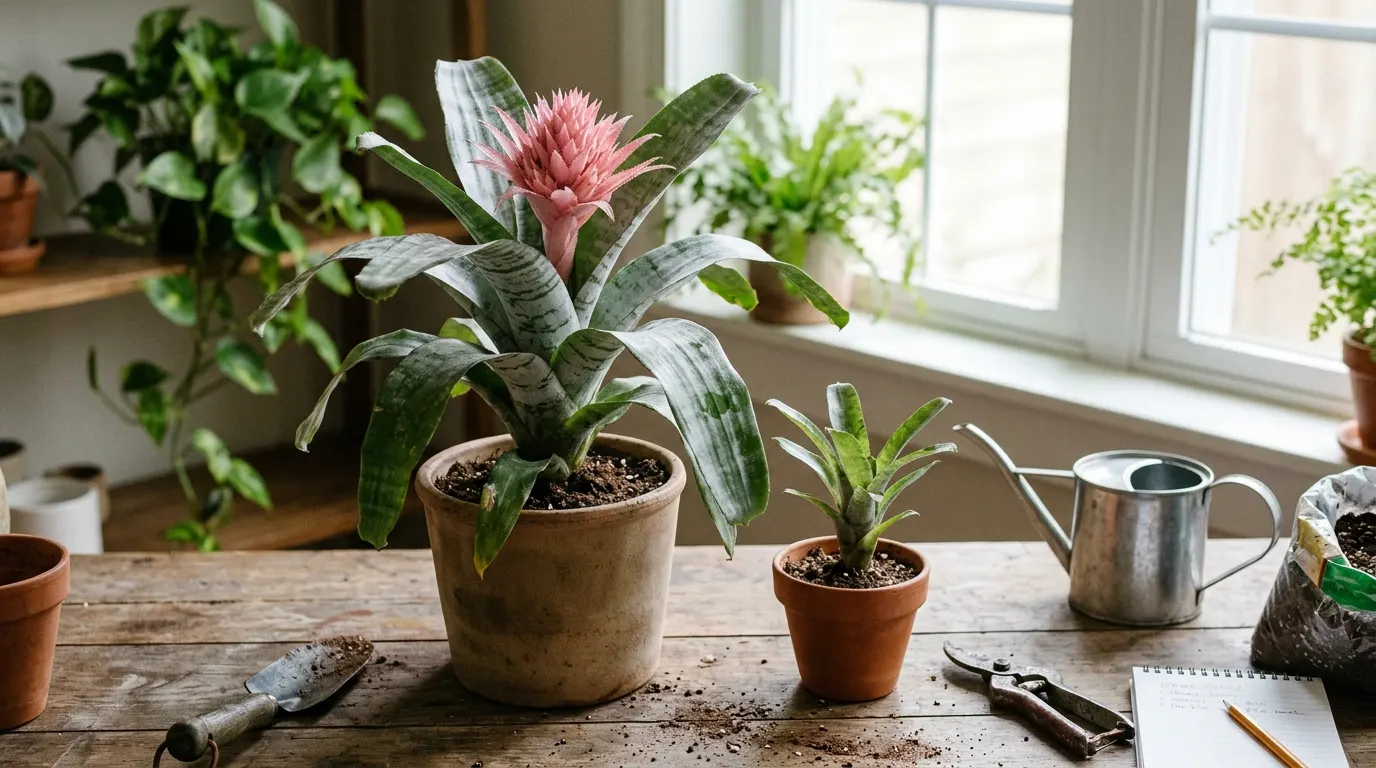
Bromeliads grow best indoors in bright, indirect light, temperatures of 18°C to 27°C (65°F to 80°F) and 50% to 70% humidity. Keep the central cup about one-third to half full of distilled or rainwater and flush it every 1 to 2 weeks. Water the potting mix only when the top 2.5 to 5 cm (1 to 2 inches) is dry.
Most bromeliad problems come from treating them like ordinary pot plants. They are mostly epiphytes, so they drink through their leaves and central cup, and their roots mainly anchor them. This guide covers light by hemisphere, watering, humidity, flowering, pups and pet safety.
What Light Do Indoor Bromeliads Need in Each Hemisphere?
Bromeliads need bright, indirect light for most of the day. In the Northern Hemisphere the sunniest window faces south; in the Southern Hemisphere it faces north. East-facing windows suit both hemispheres year-round because the morning sun is gentle.
The sun sits on opposite sides of the sky in each hemisphere, so window advice flips. Use the table as a starting point.
| Window | Northern Hemisphere | Southern Hemisphere |
|---|---|---|
| East | Best all year, gentle morning sun | Best all year, gentle morning sun |
| South | Brightest; sheer curtain in summer, direct sun fine in winter | Weaker light; good for low-light tolerant types |
| North | Dim; suits only tough types | Brightest; sheer curtain in summer, direct sun fine in winter |
| West | Hot afternoon sun; shade in summer | Hot afternoon sun; shade in summer |
A healthy plant has firm, evenly coloured leaves. Pale, bleached or brown-patched leaves mean too much direct sun. Long, floppy, dull green leaves and no colour mean too little light.
- Northern Hemisphere: move pots back from south and west glass from June to August.
- Southern Hemisphere: do the same from December to February on north and west glass.
- In the cooler months, move pots closer to the brightest window.
- Soft-leaved types such as Guzmania like slightly less light than hard, stiff-leaved Aechmea and Neoregelia.
Tip: If your shadow on the wall is sharp-edged, the light is strong. A soft, blurry shadow is about right for most bromeliads.
How Do You Water a Bromeliad: Cup or Soil?
Water both, but mostly the cup. Keep the central tank one-third to half full, flush it every 1 to 2 weeks, and water the potting mix only when the top 2.5 to 5 cm (1 to 2 inches) feels dry.
The central cup is how the plant catches water in the wild. Stale water breeds bacteria and can rot the crown, so freshness matters more than volume.
- Tip the plant gently over a sink to empty the old water.
- Rinse the cup with about 120 to 240 mL (4 to 8 fl oz) of room-temperature distilled water, rainwater or reverse-osmosis water.
- Refill to one-third to half full, roughly 2.5 to 5 cm (1 to 2 inches) deep in a mature rosette.
- Water the potting mix lightly only when dry, and let it drain fully.
- Empty any saucer or decorative pot after 15 minutes.
Tap water works in a pinch, but minerals can build up and brown the leaf tips over time. If you see this, read our brown leaf tips guide and switch to rainwater or distilled water.
Warning: Never leave the mix soggy. Wet roots and a full, stagnant cup together are the fastest route to crown rot.
In cooler months (September to February in the Northern Hemisphere, March to August in the Southern), keep the cup lower, about a quarter full, and water the mix less. Cool, damp conditions encourage fungus.
What Humidity, Temperature and Potting Mix Suit Bromeliads?
Aim for 50% to 70% humidity and 18°C to 27°C (65°F to 80°F). Use a fast-draining mix of orchid bark, perlite and peat or coco coir in a 10 to 15 cm (4 to 6 inch) pot with drainage holes.
Bromeliads tolerate typical home humidity better than most tropical plants, but dry air from heaters or air conditioning can crisp leaf tips. Group plants together, use a pebble tray that keeps the pot above the water, or run a small humidifier nearby. Keep plants away from cold draughts and heating vents.
A reliable mix is equal parts coarse orchid bark, peat or coco coir, and perlite. Ordinary garden soil is too dense and holds water against the roots.
- Choose a small pot. Bromeliads have shallow root systems and prefer to be snug.
- Terracotta dries faster and suits overwatering-prone growers; plastic holds moisture longer.
- Feed lightly in the growing season with a quarter-strength liquid fertiliser on the leaves or in the mix, never in the cup in high concentration.
Growing season runs March to August in the Northern Hemisphere and September to February in the Southern. Feed once a month in that window and skip it in the cooler months. If fungus gnats appear in the mix, see our guide to fungus gnats in houseplants.
How Do Bromeliads Flower and Can You Make Them Bloom?
Each bromeliad rosette flowers once, and the bloom lasts about 3 to 6 months. A mature plant that refuses to flower can be triggered by sealing it in a clear bag with a ripe apple for 3 to 5 days.
Bromeliads are monocarpic, which means the main rosette flowers once and then slowly declines while producing new plants at its base. The colourful part is often a bract rather than the true flower, which is why it lasts so long.
To trigger flowering in a healthy, mature plant:
- Empty the central cup so the plant is not sitting in water.
- Place the whole pot in a large clear bag with a ripe apple.
- Seal the bag and keep it in bright, indirect light for 3 to 5 days.
- Remove the bag and refill the cup.
- Wait. A flower spike usually appears within about 6 to 14 weeks.
The ripe fruit releases ethylene gas, which signals the plant to start a flower bud. Only try this on plants that look mature and healthy, with a full rosette. Young plants may simply not be ready.
Tip: Remove the spent flower stalk once it turns brown and papery, cutting it close to the base with clean shears.
How Do You Separate and Pot Bromeliad Pups?
Wait until the pup is one-third to one-half the height of the parent. Cut it away at the base with a sterile blade, then pot it upright in a gritty, moist mix and support it with a stake until roots grip.
Pups appear at the base of the plant during or after flowering. Leaving them attached for longer gives them more energy and a better chance of rooting.
You will need:
- Sharp knife or bypass shears
- 70% isopropyl alcohol to sterilise the blade
- 10 to 12.5 cm (4 to 5 inch) pots with drainage
- Coarse bark-based mix
- Thin stakes or chopsticks
Steps:
- Sterilise your blade with alcohol.
- Ease the soil back and find where the pup joins the parent.
- Cut cleanly through the connecting stem as close to the parent as you can.
- Let the cut end dry for a few hours.
- Plant the pup upright in a damp, gritty mix, burying it just deep enough to stay stable.
- Push stakes 2.5 to 5 cm (1 to 2 inches) into the mix to hold it steady.
- Keep it at 21°C to 24°C (70°F to 75°F) with bright, indirect light and light misting.
A pup without roots can still succeed. Keep the mix barely damp rather than wet and be patient. You can also leave pups on the parent and let the clump grow as one. For more ideas on starting cuttings in different media, see rooting mediums beyond soil and water.
Are Bromeliads Safe for Cats and Dogs?
Common indoor bromeliads, including Guzmania, Neoregelia, Aechmea and Cryptanthus, are generally considered non-toxic to cats and dogs. Chewing the stiff leaves can still cause mild stomach upset or mouth irritation.
Some Aechmea leaves have spiny edges that can scratch a curious nose or paw. Place those types out of reach of enthusiastic chewers. If a pet eats a lot of plant material and vomits repeatedly, call your vet. Pet-safe does not mean pet-proof, and fertiliser or standing water in the cup can also upset a pet.
What Are the Common Bromeliad Problems and Fixes?
Most bromeliad trouble is rot, stagnant water or too little light. Fix it by emptying the cup, letting the mix dry, improving drainage and moving the plant to brighter, indirect light.
Why does the cup smell foul? The water is stagnant. Tip it out, flush with fresh water and refill to a lower level. Repeat every 10 to 14 days.
Why are the lower leaves coming away at the base? This is usually crown or root rot. Stop watering the mix, repot into a mix of about 50% coarse bark, 30% perlite and 20% peat, and empty drip trays. Rotted plants may not recover, so save any healthy pups.
Why is my pup not rooting? Support it with stakes, keep it warm and avoid soaking the mix.
What are the white cottony bits on the leaves? Likely mealybugs. Follow our guide to getting rid of mealybugs. Check our pest clinic page for other insects.
Why do the leaves have brown spots? Sunburn or mineral buildup. Move back from glass and switch to cleaner water.
What Expert Tips Keep Bromeliads Healthy Long Term?
Flush the cup on a schedule, use clean water, and match light to the season. Treat the post-bloom decline as normal and put your effort into the pups.
- Set a recurring reminder every second week to flush the cup.
- Wipe dust from leaves with a damp cloth so they can absorb light and moisture.
- Rotate the pot a quarter turn weekly for even growth.
- Keep the plant out of the cup-flooding path of ceiling fans and vents.
- Compare notes with other epiphytes. Orchid growers will find similar habits in our moth orchid guide.
Frequently Asked Questions
Can I use tap water in my bromeliad central cup?
Yes, occasionally, but it is not ideal. Minerals and salts in tap water can build up and brown the leaf tips over time. Distilled water, rainwater or reverse-osmosis water is better. If you must use tap water, let it sit overnight and flush the cup more often.
Why is my bromeliad turning brown and dying after flowering?
This is the natural life cycle. The main rosette flowers once and then slowly fades over months while pups grow at the base. Keep caring for it normally, remove the dead flower stalk and separate the pups when they reach one-third to one-half the parent's size.
Do bromeliad pups need roots before you cut them off?
No. A pup of one-third to one-half the parent's height can be cut free without roots. Pot it in a gritty mix, stake it for support and keep it warm and lightly humid. Roots usually develop within a few weeks to a few months.
How do I prevent mosquitoes or foul smells in the central tank?
Tip out the old water and refill with fresh water every 1 to 2 weeks. Standing water for longer than that lets mosquito larvae and bacteria develop. Keeping the cup only one-third to half full also reduces smell and rot risk.
How often should I water a bromeliad?
Refresh the cup every 1 to 2 weeks and water the potting mix only when the top 2.5 to 5 cm (1 to 2 inches) is dry. In cooler months, water the mix less and keep the cup lower to avoid fungal problems.
How long do bromeliad flowers last indoors?
The colourful bract and flower display usually lasts about 3 to 6 months in good light and moderate warmth. The flower stalk then fades, and the plant puts its energy into pups.
Is a bromeliad toxic to cats and dogs?
Common indoor types such as Guzmania, Neoregelia, Aechmea and Cryptanthus are generally non-toxic to cats and dogs. Chewing may still cause mild stomach upset, and spiny leaf edges on some types can scratch, so keep them out of reach of persistent chewers.
Summary and Next Steps
Key takeaways for how to care for bromeliads indoors:
- Give bright, indirect light and match window choice to your hemisphere: south in the north, north in the south.
- Keep temperatures at 18°C to 27°C (65°F to 80°F) and humidity at 50% to 70%.
- Keep the cup one-third to half full and flush it every 1 to 2 weeks with clean water.
- Water the mix only when the top 2.5 to 5 cm (1 to 2 inches) is dry.
- Each rosette flowers once; remove pups at one-third to one-half the parent's size.
- Common indoor bromeliads are generally safe for cats and dogs.
Immediate actions:
- Tip out and refill your bromeliad's cup with fresh distilled or rainwater today.
- Check the pot has drainage holes and empty any saucer.
- Move the plant to the brightest indirect spot for your hemisphere and season.