
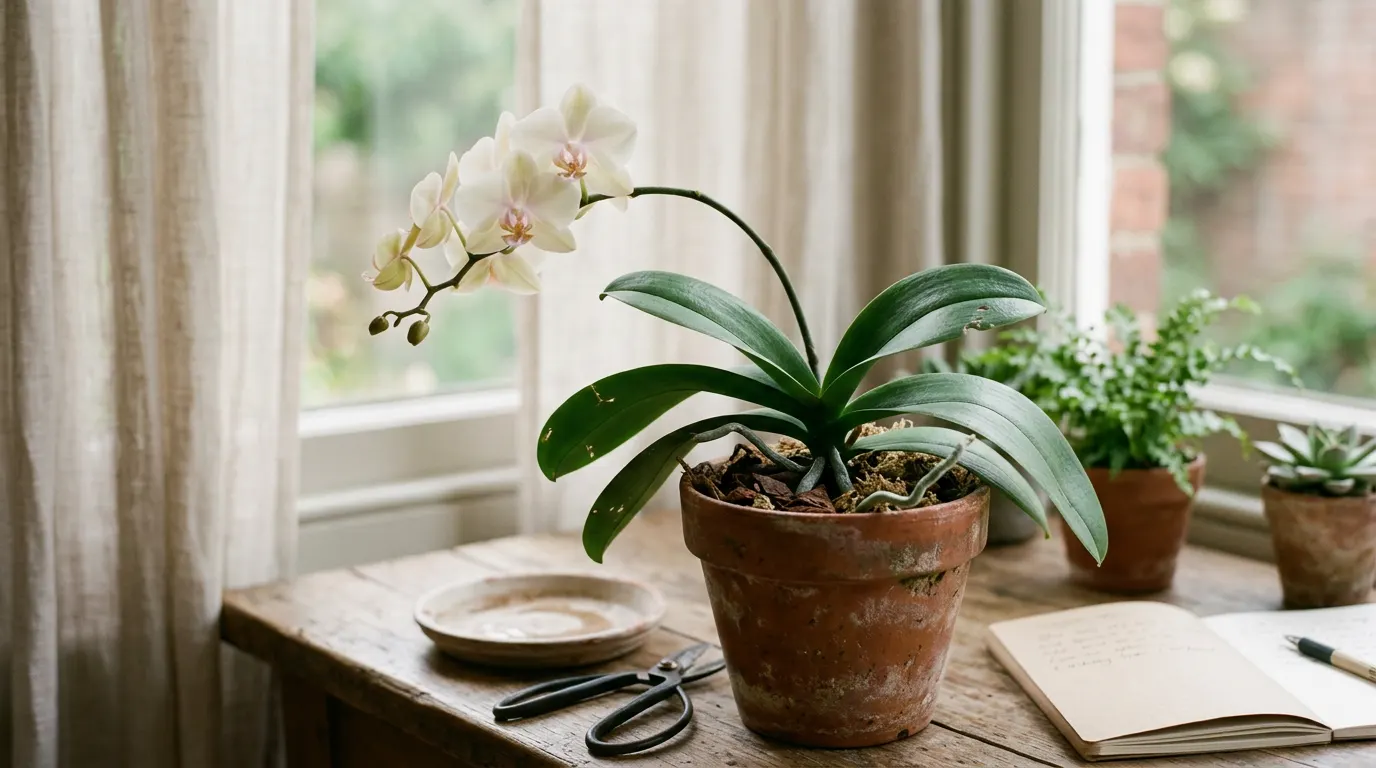
Give a moth orchid (Phalaenopsis) bright, indirect light and water it only when the bark is nearly dry or the roots turn silvery, usually every 7 to 14 days. Soak, drain fully, and keep water out of the crown. Leave aerial roots alone, repot every 1 to 2 years after blooming, and use cooler nights to trigger reblooming.
Most moth orchids are bought in flower, and most are lost within a year to the same few mistakes: too much water, too little light, and panic over normal features like aerial roots. This guide covers moth orchid care from the first watering to the second round of blooms, with symptom checks so you can tell what is normal and what needs fixing.
How Much Light Does a Moth Orchid Need?
Bright, indirect light from an east or west window suits a moth orchid best. Light green leaves mean the light is right. Dark green leaves mean too little light and fewer blooms. Yellowish or red-edged leaves mean too much. Shield it from direct summer sun.
Moth orchids grow on tree trunks in the tropics, under a canopy that filters the sun. Indoors, you are copying that dappled light.
Use the leaf-colour test rather than guessing at light meters:
- Light, grassy green: ideal. Expect blooms.
- Dark, deep green: too dim. The plant survives but rarely flowers.
- Yellow-green with tan or bleached patches: sunburn. Move it back from the glass.
- Reddish edges: too much light, or a cold snap on the leaves.
Low light is the most common reason a healthy orchid will not rebloom. If your best window is too dark, a small grow light placed above the plant for 12 hours a day works well in interior rooms and offices.
In the Northern Hemisphere, a south-facing window is too harsh from April to August but fine in winter when the sun is low. In Australia and New Zealand, swap that: protect the plant from direct sun from October to February, and use a brighter spot in June to August. A sheer curtain softens strong light at any time of year.
Tip: Hold your hand between the plant and the window. A soft, blurry shadow means good light. A sharp, dark shadow means the light is too direct.
How Often Should You Water an Orchid in Bark or Moss?
Water bark-potted orchids about every 7 to 14 days, when the bark is nearly dry or the roots turn silver. Soak thoroughly, drain completely, and water in the morning. Moss holds water longer, so check by touch and water less often. Never let roots sit in water.
There is no single correct number of days, because the schedule depends on conditions. Warm, bright, airy rooms dry the pot faster. Cool, dim rooms slow it down. Clay and slotted pots dry quicker than solid plastic. Fine bark holds more water than chunky bark, and moss holds the most.
That is why advice ranges from weekly to every two weeks. Check the plant, not the calendar.
The soak, drain, wait method
- Check the roots and media first. Silvery-grey roots or dry bark mean it is time to water. Plump green roots mean wait.
- Take the plant to the sink and run lukewarm water through the bark for about a minute, or soak the pot in a bowl for 10 to 15 minutes.
- Let it drain fully. Tip the pot gently so no water pools between the leaves.
- Return it to its spot only once water has stopped dripping.
Water in the morning so any splashes dry before night. Water left in the crown, where the leaves meet, can cause crown rot.
Bark versus moss
| Feature | Bark | Sphagnum moss |
|---|---|---|
| Typical interval | Every 7 to 14 days | Every 10 to 21 days, by touch |
| How to check | Chopstick, root colour, pot weight | Squeeze the moss; it should feel barely damp |
| Drying speed | Fast | Slow |
| Main risk | Drying out in warm rooms | Staying soggy and rotting roots |
| Best for | Beginners, humid or cool homes | Dry homes, experienced growers |
For a simple check, push a wooden chopstick into the media for ten minutes. If it comes out dark and damp, wait. If it is mostly dry, water. The general principles in our houseplant watering guide apply here too, with the difference that orchids prefer a full soak followed by a proper dry-down.
In cooler months, stretch the interval to every 10 to 14 days and cut back fertilizer.
Warning: Ice cubes are not a good watering method. Orchids are tropical, and a small, cold dose of water wets only part of the roots. Use lukewarm water and a full soak instead.
Are Aerial Roots Growing Out of the Pot Normal?
Yes. Orchids are epiphytes, and aerial roots absorb moisture and air from the surrounding atmosphere. Don't trim healthy ones or force them into the pot. Only remove roots that are mushy, papery or hollow, using sterilized scissors.
In the wild, moth orchids cling to bark with roots exposed to the air. A thick, spongy outer layer called velamen soaks up water, which is why healthy roots look silvery when dry and green when wet.
Use this root colour guide:
- Green and plump: recently watered and healthy.
- Silver or grey, firm: healthy and ready for water.
- Brown, mushy, or squishy: rotted. Cut away.
- Papery, flat, or hollow: dead. Cut away.
A few roots reaching over the pot rim are a sign of a happy plant. If the roots have outgrown the pot and are bunched up, that is a signal to repot, not to cut. When you water, soak the aerial roots too, and they will turn green.
If you are unsure whether a root is alive, squeeze it gently. A living root is firm. A dead root collapses.
Why Are My Orchid's Leaves Turning Yellow?
One slowly yellowing bottom leaf is normal aging. Several leaves yellowing at once usually means overwatering or root rot. Yellow-green leaves with tan patches indicate too much sun. Check the roots first, then adjust watering and light.
Use this triage table:
| What you see | Likely cause | Fix |
|---|---|---|
| One bottom leaf yellows slowly, others healthy | Natural aging | Let it fade and drop, then remove |
| Several leaves yellow, limp, roots mushy | Overwatering or root rot | Unpot, trim dead roots, repot in fresh bark, water less |
| Yellow-green leaves with tan or bleached patches | Sunburn | Move away from direct sun |
| Yellow leaves, wrinkled, roots dry and papery | Underwatering | Soak thoroughly, then water on a regular check |
| Yellowing with no flowers for a long time | Low light or poor feeding | Brighten the spot, feed lightly |
The quick rule: one slow yellow leaf is normal, several at once means overwatering until proven otherwise. Lift the plant out of its pot to look at the roots. Our guides to root rot in houseplants and yellow leaves on houseplants walk through the same diagnosis for other plants.
Do not pull a yellowing leaf off early. Wait until it comes away with a light tug, since the plant is pulling nutrients back from it.
When and How Do You Repot a Phalaenopsis Orchid?
Repot every 1 to 2 years after the last flower drops, never mid-bloom. Remove the old media and the moss plug, trim dead roots with sterile snips, and set the plant in fresh orchid bark in a pot with drainage.
Bark breaks down over time, holds too much water, and starts to suffocate the roots. Repot sooner if the bark looks mushy, smells sour, or the plant is wobbly in its pot.
Supplies
- Fresh orchid bark mix (fir bark, optionally with perlite or charcoal)
- Clear or slotted pot with drainage holes, only slightly bigger than the root mass
- Sterilized scissors or snips
- A little sphagnum moss (optional)
A clear pot lets you see root colour at a glance. For more on pot choice, see our guide to the best pots for indoor plants.
Steps
- Soak the old media for a few minutes so the roots loosen.
- Slide the plant out and pick away all old bark and any moss plug that came in the original pot. Grocery-store orchids are often packed in dense moss that stays wet.
- Cut off mushy, papery or hollow roots with sterilized snips. Keep all firm roots.
- Hold the plant in the pot with the base of the lowest leaf at the rim.
- Pour bark around the roots, tapping the pot to settle it. Do not pack it hard.
- Wait about a week before the first watering so cut roots can heal.
Tip: Sterilize your snips between plants and after cutting any rotted root, either by flame or by wiping with rubbing alcohol. This prevents spreading disease.
How Do You Get an Orchid to Bloom Again?
Keep it in bright light and cut the spike above a node or at the base. Give 4 to 6 weeks of cooler nights (55 to 60°F, or 13 to 16°C) in autumn and avoid overfeeding. A new spike usually appears within weeks to a few months.
Sources vary on reblooming timing, from a few weeks to several months. The variables are how bright the plant's spot is, how cool the nights get, and how healthy the roots are. Treat any timeline as a range, not a promise.
What to do with the old spike
- Spike still green: cut it about an inch above a node (a small bump on the stem) two or three nodes up from the base. A side spike sometimes grows from there.
- Spike turning brown or yellow: cut it off at the base.
Rebloom steps
- Cut the spike as above once the last flower has dropped.
- Put the plant in the brightest indirect light you can offer. Low light is the most common reason for no flowers.
- Give 4 to 6 weeks of nights at 55 to 60°F. In the Northern Hemisphere, this is usually September to November near a cool window. In Australia and New Zealand, it is March to May.
- Keep watering by the root-colour check, and feed with a diluted balanced orchid fertilizer, about quarter strength, during active growth. Cut back in winter.
- When a new spike appears, support it with a bamboo stake and clips once it is a few inches long.
Keep the plant away from drafts, vents and ripening fruit. Ethylene gas from fruit and sudden temperature swings can cause buds to drop before they open.
Is my orchid dead or just resting?
After flowering, an orchid often looks bare and dull, but it is resting. If the leaves are firm and the roots are green or silver, it is alive. If the leaves are limp and the roots are all brown and mushy, it is probably dying. A single healthy root and a firm leaf are enough to save it.
What Tools and Supplies Do You Need?
You need very little: a pot with drainage, bark mix, clean snips and a chopstick for checking moisture. A clear pot, a bamboo stake and a grow light are useful extras.
- Orchid bark mix (fir bark with optional perlite or charcoal)
- Clear or slotted pot with drainage
- Sterilized scissors or snips
- Wooden chopstick or skewer
- Balanced orchid fertilizer, diluted
- Bamboo stake and clips
- Pebble tray or humidifier for dry rooms
- Grow light for dim rooms
- Sphagnum moss (optional)
Common Problems and Quick Fixes
Most orchid problems trace back to water, light or roots. Check those three first before trying anything else.
Why is my orchid wrinkled or limp?
Wrinkled leaves usually mean the roots are not delivering water, either because they are dry or because they have rotted. Check the roots. If they are dry and silver, soak the pot. If they are mushy, repot.
Why did the buds drop before opening?
Common causes are drafts, heating vents, sudden temperature changes and ethylene from ripening fruit. Move the plant to a stable spot away from the fruit bowl.
What if I see white fluffy spots or sticky residue?
These can be mealybugs or scale. Wipe them off with a damp cloth, and see our guide to identifying houseplant pests and diseases.
Expert Tips for Long-Term Success
- Watch the roots more than the leaves. Roots tell you when to water.
- Use lukewarm water, and rain or filtered water if your tap water is very hard.
- Rotate the pot a quarter turn each week so the plant grows evenly toward the light.
- Humidity around 50 percent is ideal, but good airflow matters more than misting.
- Keep a simple care calendar: repot after blooming, cool nights in autumn, lighter feeding in winter.
Frequently Asked Questions
Do ice cubes work for watering orchids?
Ice cubes are not recommended. Moth orchids are tropical, and cold water on the roots can stress them. A few cubes also wet only a small patch of media. A lukewarm soak and full drain wets every root evenly and is easier to judge.
Should I mist my orchid?
Misting does little for the roots and can leave water in the crown, which encourages rot. If your home is dry, use a pebble tray or humidifier instead, and make sure air moves gently around the plant.
How often should I fertilize my orchid?
Feed with a balanced orchid fertilizer diluted to about quarter strength, roughly every second watering while the plant is actively growing. Cut back or stop in winter. Overfeeding can burn roots and discourage blooming.
Should I cut the flower spike after the blooms drop?
Yes, but how you cut depends on its colour. If the spike is still green, cut just above a node a few nodes up from the base. If it is brown or yellow, cut it off at the base so the plant can put energy into new growth.
Can I grow an orchid in an office with only artificial light?
Yes, with a grow light. Place it above the plant for about 12 hours a day. Check the leaf colour to adjust: light green is right, dark green means the light is too weak, and bleached patches mean it is too close.
Is tap water okay for orchids?
Usually yes, if it is lukewarm and not very hard or heavily treated. If you see white crust on the bark or leaf tips browning, switch to rain or filtered water, and flush the pot with plain water regularly.
Can orchids grow in only sphagnum moss?
Yes, but it needs careful watering because moss stays wet far longer than bark. It suits dry homes and experienced growers. Beginners usually do better with bark, which drains faster and forgives overwatering.
How long do orchid blooms last?
Moth orchid flowers commonly last two to three months when the plant is kept in stable, cool conditions out of drafts. Heat, dryness and ethylene from ripening fruit can shorten that.
Summary and Next Steps
Good moth orchid care comes down to reading the plant rather than following a fixed schedule.
Key takeaways
- Bright, indirect light is essential. Light green leaves mean it is right.
- Water when bark is nearly dry or roots are silver, usually every 7 to 14 days. Soak, drain, and keep the crown dry.
- Aerial roots are normal. Trim only dead, mushy or papery ones.
- One yellow bottom leaf is aging; several yellow leaves point to overwatering.
- Repot every 1 to 2 years after blooming in fresh bark and a pot with drainage.
- For reblooming, cut the spike, give bright light and 4 to 6 weeks of 55 to 60°F nights.
Do these next
- Lift your orchid's pot and check the root colour today. Water only if the roots are silver.
- Move the plant to a brighter, indirect spot if the leaves are dark green.
- If the flowers have dropped, trim the spike and plan your cool-night period for autumn.
With steady light, careful watering and a little patience, your moth orchid care routine will bring flowers back year after year.