To get rid of scale insects, isolate the plant, then dab each adult scale with a cotton swab dipped in 70% isopropyl rubbing alcohol. Wash off sticky honeydew, then spray stems and leaf undersides with insecticidal soap or a 1% to 2% horticultural oil mix. Repeat every 7 to 10 days for 3 to 4 rounds.
Scale insects look like small brown bumps stuck to stems and leaves, and they are easy to mistake for part of the plant. Meanwhile they drain sap, leave sticky residue and can slowly weaken a plant. This guide shows you how to tell the two main types apart, clear the sticky film and black mould, treat the plant step by step with natural products, time outdoor sprays for both hemispheres, and keep pets safe.
How to Identify Soft Scale vs. Armoured Scale
Soft scales have a waxy body fused to their covering and produce sticky honeydew. Armoured scales hide under a hard, separate shield, feed on plant cells rather than sap, and do not produce honeydew. Knowing which you have tells you whether sticky leaves point to scale.
Both groups sit still as adults, which is why they look like bumps rather than bugs. Only the tiny first stage, called a crawler, moves around. That crawler stage is the weak point you aim for with sprays.
Soft scale (family Coccidae)
- Rounded or flat oval bumps, often tan, brown or greenish
- Usually along stems and on leaf midribs
- Sticky leaves, and often black mould below the infestation
- Ants may visit to feed on the honeydew
Armoured scale (family Diaspididae)
- Tiny, hard, disc-like or oyster-shaped shields, often grey, white or brown
- Found on bark, leaves and sometimes fruit
- No sticky residue
- Heavy infestations cause yellow spots and dieback
The lift test
Gently slide a fingernail or a needle under one bump. If the cover pops off and leaves a soft insect body behind, it is armoured scale. If the shell and body are one inseparable piece, it is soft scale. Check a few bumps, because dead scales stay glued on and look the same as live ones.
Tip: A live scale is plump and squishes with moist contents. A dead one is dry, hollow or flaky.
Understanding Honeydew and Sooty Mould
Honeydew is the sugary liquid soft scales excrete as they feed on sap. Airborne fungal spores settle on it and grow into black sooty mould. The mould does not infect the plant, but it blocks light and reduces photosynthesis.
This is why sticky leaves are such a useful clue. If you see a shiny, tacky film or black soot on a leaf, look directly above it on the plant for the source. Scale on a higher stem or leaf will drip onto everything below, including furniture and floors.
Treating the mould alone never works. Once the scale is gone, the honeydew stops, the mould loses its food and the black crust gradually flakes away. To speed things up, wipe leaves clean as part of the treatment below.
Similar sticky residue can come from mealybugs, which are cottony rather than shell-like. If you see white fluff instead of bumps, see how to get rid of mealybugs.
Step-by-Step Natural Scale Treatment Protocol
Isolate the plant, remove adult scales by hand with rubbing alcohol, wash off honeydew, then spray with insecticidal soap or horticultural oil every 7 to 10 days. Adults are protected by their coverings, so physical removal matters as much as the spray.
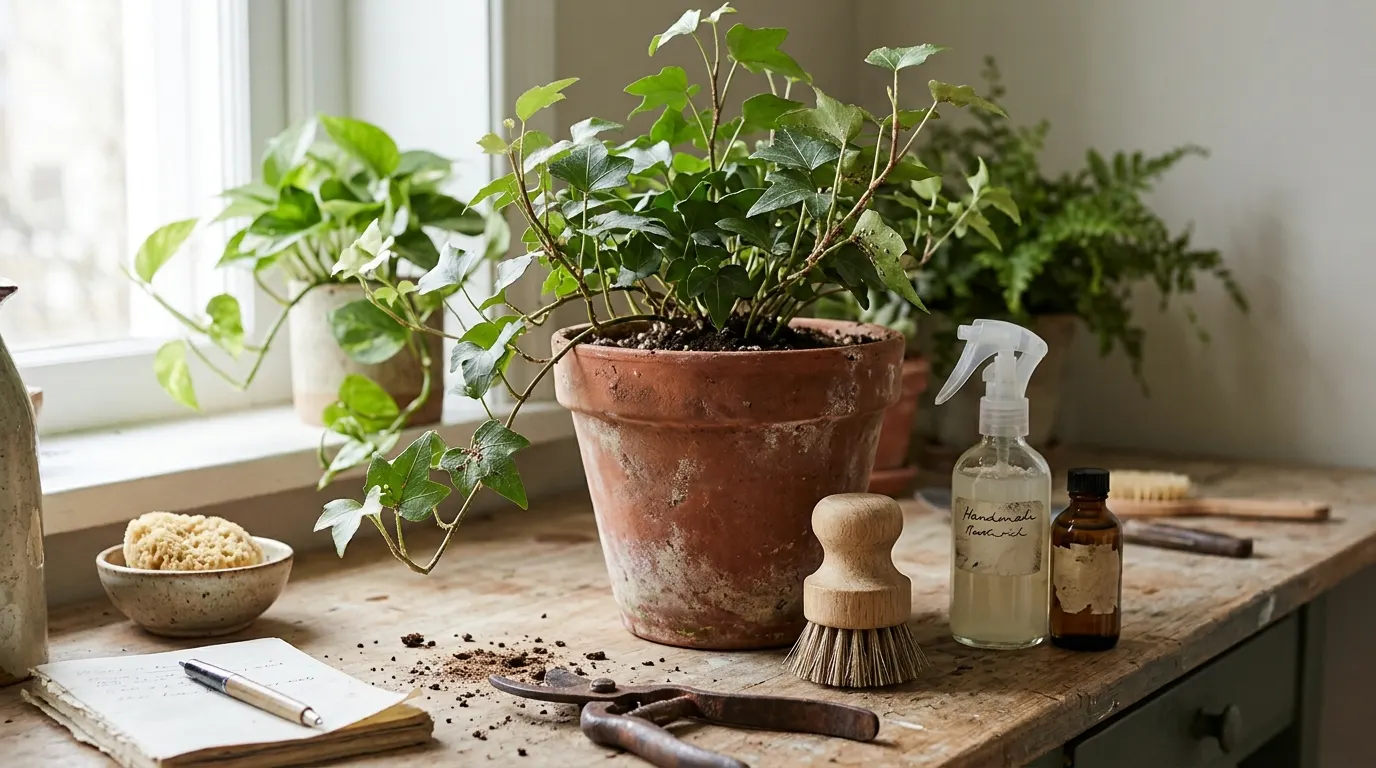
What you need
- 70% isopropyl rubbing alcohol
- Cotton swabs and a soft brush or old toothbrush
- Insecticidal soap (potassium salts of fatty acids)
- Horticultural oil (paraffinic or mineral oil, labelled for plants)
- Fine-mist spray bottle or small hand sprayer
- Microfiber cloth or soft sponge
- Pruning shears
- A 10x hand lens for checking leaf undersides
Steps
- Isolate the plant. Move it away from other plants, ideally into a separate room, and keep it there until treatment ends.
- Prune the worst parts. Cut off heavily encrusted stems or badly damaged leaves and bag them for the bin.
- Spot-treat adults. Dip a cotton swab in 70% rubbing alcohol and dab each scale. Rub gently with a soft brush to dislodge the shells.
- Wash the foliage. Wipe leaves and stems with a cloth and lukewarm water mixed with 5 mL (1 tsp) of mild liquid soap per 1 L (1 qt). This removes honeydew and loosens sooty mould.
- Spray thoroughly. Mix insecticidal soap as the label directs, or mix horticultural oil at 1% to 2%, which is 10 to 20 mL per 1 L of water, or about 2.5 to 5 tbsp per US gallon. Coat stems, leaf undersides and leaf joints until dripping.
- Rinse and dry. Keep the plant out of strong sun while wet, and let it dry fully.
- Repeat. Re-treat every 7 to 10 days for 3 to 4 rounds, because new crawlers keep hatching from eggs and survivors you missed.
Warning: Test any spray on one leaf and wait 24 to 48 hours. Oils can burn leaves in hot sun or above roughly 30 C (86 F), and plants under drought stress are more sensitive.
Why alcohol first
Sprays alone struggle against adults because of their wax or hard shield. Alcohol on a swab dissolves the coating and kills the insect directly. Oil and soap then handle the crawlers by smothering them, as both work on contact only and leave no lasting residue.
For mixing home sprays and other options, our guide to DIY organic pest sprays covers more recipes. If you suspect other pests too, the Plant Clinic pest page can help narrow it down.
Treatment Timing: Northern vs. Southern Hemispheres
Indoors, treat as soon as you spot scale in any month. Outdoors, spray dormant oil in late winter and crawler sprays in late spring to summer. The calendar flips between hemispheres, so match the season, not the month name.
Indoor plants live in steady temperatures, so scale breeds continuously and waiting does no good. Outdoor scale follows the seasons, and crawlers hatch in a limited window when you can hit them hardest.
| Stage | Northern Hemisphere | Southern Hemisphere |
|---|---|---|
| Dormant oil (bare or dormant woody plants) | February to March | August to September |
| Crawler sprays (soap or summer-weight oil) | May to July | November to January |
| Follow-up checks | Late summer | Late summer to autumn (February to April) |
Timing varies with local climate, and warm regions see crawlers earlier. Rather than trusting dates alone, look for the signs:
- Check for tiny, pale, moving specks with your hand lens
- Wrap double-sided sticky tape around an infested stem and see when crawlers get stuck on it
- Start spraying as soon as crawlers appear, then repeat in 7 to 10 days
Dormant oil rates
Dormant oil is used stronger than summer oil, around 2% to 4% (20 to 40 mL per 1 L, or 5 to 10 tbsp per US gallon). Only use it on tolerant, dormant outdoor plants, and follow the product label. Do not use dormant-strength oil on indoor houseplants.
Tip: Avoid spraying in the heat of the day, in strong wind, or just before frost. Early morning or evening is best.
Pet Safety and Indoor Plant Precautions
Alcohol, insecticidal soap and horticultural oil have low toxicity to pets once dry, but wet foliage can upset the stomach of a cat or dog that chews or licks it. Keep pets away during treatment and until the plant is fully dry.
It helps to separate two ideas. Plant toxicity is whether the plant itself harms pets, and treatment safety is whether your spray does. Many common houseplants are mildly toxic on their own, so check your plant too.
- Treat in a closed room or outdoors, away from pets
- Let alcohol evaporate and sprays dry completely before the plant returns
- Never spray pets or leave open bottles within reach
- Store all products in a high cupboard
- Cats groom themselves, so wet leaves they brush against are a risk
- Call a vet if your pet chews a treated plant and shows drooling, vomiting or lethargy
How to Prevent Scale Insects from Returning
Quarantine new plants for 14 to 21 days, inspect leaf undersides and stem joints regularly, wash dusty foliage, and avoid heavy nitrogen feeding. Catching a few scales early saves weeks of repeat treatment.
- Quarantine new plants. Keep them apart and check weekly before adding them to your collection.
- Inspect often. Use a 10x hand lens on stem nodes, leaf midribs and undersides, especially on citrus, fiddle leaf figs, ferns and orchids.
- Wash foliage monthly. Dust hides pests and a wipe keeps leaves clear.
- Go easy on nitrogen. Lush, soft growth feeds soft scale.
- Prune and tidy. Remove dead wood and badly infested branches outdoors.
- Check ants. Ants farm soft scale for honeydew, so tackle both.
Plants with thick, glossy leaves are common targets. If you grow a fiddle leaf fig or a moth orchid, make leaf inspection part of your regular watering routine.
Common Problems and Troubleshooting
Scales are still there after treatment. Dead scales stay stuck to stems. Wipe or scrape them off and check for moist, plump bodies. If new ones appear, crawlers are still hatching, so keep going on the 7 to 10 day schedule.
Leaves look burned after spraying. The mix was too strong, or the plant was in sun or heat. Rinse with water, move it to shade and use a lower rate next time.
Sticky leaves keep returning. Scale or mealybugs are still feeding, possibly higher in the plant or in leaf joints. Inspect every stem.
Plant is dropping leaves. Heavy infestations weaken plants. Prune badly hit stems, treat consistently, and keep watering steady.
Expert Tips and Advanced Techniques
- Work from the top of the plant downward so you do not miss drips of honeydew sources
- Use a soft brush on ridged stems where swabs miss
- Rotate between soap and oil across rounds rather than repeating one product
- For large outdoor shrubs, spray thoroughly enough that undersides and bark crevices are wet
- Keep a simple note of treatment dates so you do not lose count of rounds
- For hanging or trailing plants such as hoyas, lay the vines out to reach every node
Frequently Asked Questions
Can scale insects spread to other indoor plants?
Yes. Crawlers walk or get carried on hands, clothing and pets, and they can move to nearby plants whose leaves touch. Isolate affected plants, wash your hands after handling them, and check neighbouring plants closely for 3 to 4 weeks.
Does rubbing alcohol damage plant leaves?
It can on delicate or thin-leaved plants if used in large amounts. Use 70% isopropyl alcohol on a swab, dab only the scales, and test one leaf first. Avoid soaking foliage or spraying alcohol across the whole plant.
Why are scale insects still on my plant after spraying oil?
Adult scales are protected by wax or hard shields, so sprays often miss them. Remove adults by hand with alcohol first, then spray to catch crawlers. Dead shells also stay attached, so check whether the insects underneath are still alive.
Can dormant oil be used on indoor houseplants?
No. Dormant oil is mixed stronger and designed for leafless, dormant outdoor woody plants. Indoors, use a summer-weight horticultural oil at 1% to 2% or an insecticidal soap, and test on one leaf first.
How do I clean sooty mould off leaves without harming the plant?
Wipe leaves with a soft cloth and lukewarm water containing 5 mL (1 tsp) of mild liquid soap per 1 L (1 qt). Rinse with clean water and dry. Then control the scale, because mould returns while honeydew keeps dripping.
Is insecticidal soap safe for cats and dogs?
Once dry, it has low toxicity, but wet residue can cause stomach upset if pets lick or chew treated plants. Keep animals away until the plant is completely dry, and call a vet if symptoms appear.
How long does it take to get rid of scale?
Most infestations need 3 to 4 weeks of repeat treatments. Heavy or long-standing outbreaks may need 6 to 8 weeks, and severely encrusted stems are often best pruned away.
Summary and Next Steps
Key takeaways
- Soft scale makes sticky honeydew and sooty mould, while armoured scale does not
- Use the lift test to tell them apart
- Remove adults by hand with 70% rubbing alcohol first
- Follow with insecticidal soap or 1% to 2% horticultural oil (10 to 20 mL per 1 L, or 2.5 to 5 tbsp per US gallon)
- Repeat every 7 to 10 days for 3 to 4 rounds
- Time outdoor sprays to the season: February to March and May to July in the north, August to September and November to January in the south
Do these next
- Isolate any plant with brown bumps or sticky leaves and inspect it with a hand lens today.
- Dab visible scales with alcohol, wash the leaves, and spray every undersurface.
- Set a reminder to re-treat in 7 to 10 days, and quarantine every new plant from now on.
This routine is the most reliable way to get rid of scale insects without harsh chemicals. If problems continue, browse the Plant Clinic pest page to rule out other causes.