
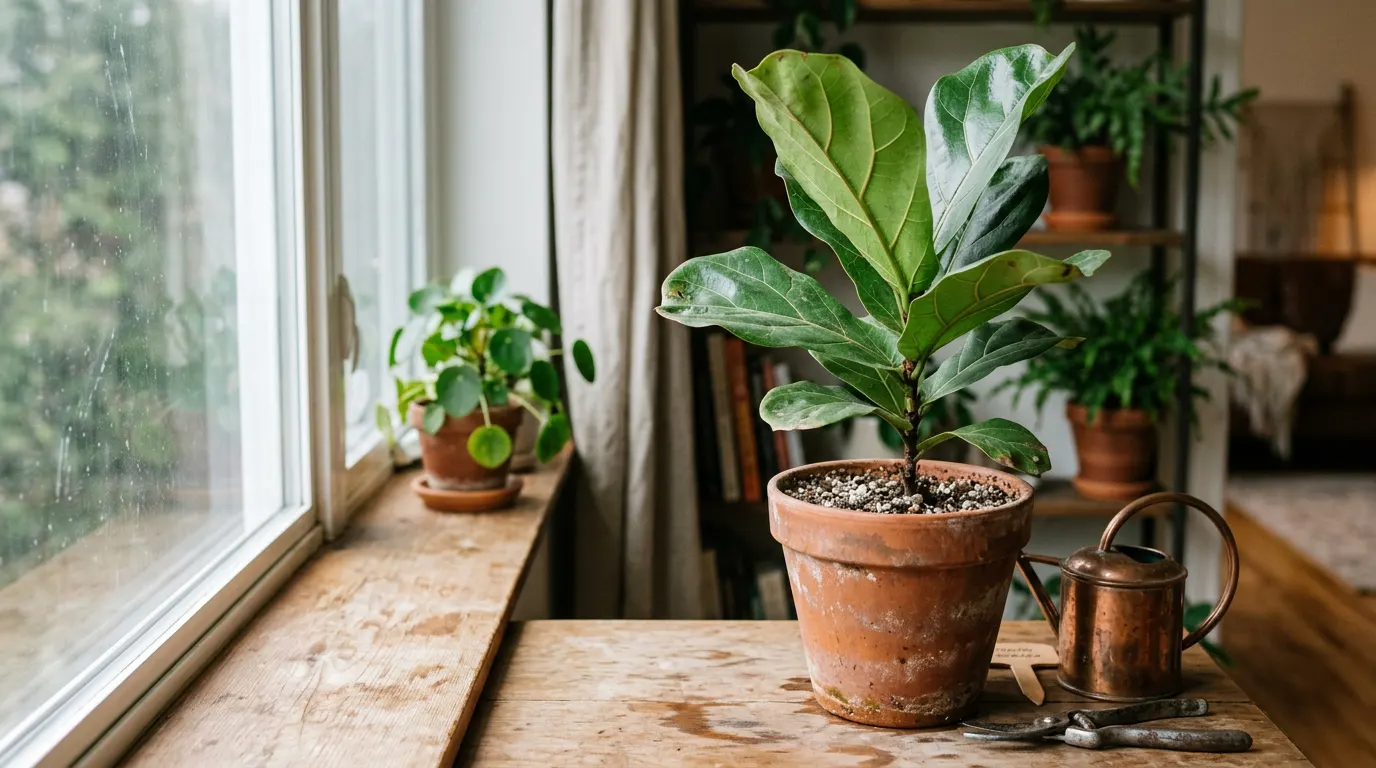
Give a fiddle leaf fig bright, indirect light, water deeply only when the top 2 inches of soil are dry, and keep it in a steady spot at 65-75°F. Use a pot with drainage holes and free-draining soil. Brown or dropping leaves usually come from uneven watering, poor light or a recent move. Repot every 1-3 years.
Fiddle leaf fig care (Ficus lyrata) has a reputation for being fussy, and that is fair. The plant comes from West African rainforest and reacts to change by dropping leaves or browning. The good news is that it reacts to a short list of things: light, water, stability and root space. This guide covers each one, with a diagnosis table for brown spots and a checklist for leaf drop.
How Much Light Does a Fiddle Leaf Fig Need?
It needs bright, consistent indirect light near a large window. Aim for at least 400 foot-candles (about 4,300 lux) and ideally 800-1,000 or more. One to two hours of gentle morning sun is fine, but strong afternoon sun can scorch the leaves.
Light is the biggest lever you have. A fig in dim light uses water slowly, grows leggy and drops lower leaves. A fig in harsh sun burns. Most homes fall short on light, so measure rather than guess.
Best window for a fiddle leaf fig
The best spot depends on your hemisphere. In the Northern Hemisphere, south and east windows are brightest. In Australia and New Zealand, north-facing windows get the strongest light and east-facing ones give the gentle morning sun the plant likes.
- East-facing: gentle morning sun, usually the easiest placement.
- West-facing: bright but hot in the afternoon. Add a sheer curtain or sit the plant a metre back.
- Sun-facing (south in the north, north in the south): very bright. Pull the plant back from the glass or filter the light.
- Shaded-facing (north in the north, south in the south): often too dim without a grow light.
Tip: Download a free light meter app and test the leaves' position at midday. Light drops sharply with distance, so a spot 1 metre from the window can be half as bright as one at the glass.
The direct sun question
Advice differs here. Some growers say to avoid direct sun entirely, while others say 1-2 hours of morning sun helps. Both are right in their own way. Morning sun is mild and can boost growth. Afternoon sun through glass is intense and causes the brown, papery patches that do not recover.
Using a grow light
If your home is dim, a full-spectrum LED grow light placed above the plant for 10-12 hours a day can make up the difference. Winter days are short, so this helps most in the cooler months.
How Often Should You Water a Fiddle Leaf Fig?
Water when the top 2 inches of soil are dry, usually every 7-10 days, then soak until water drains out. Empty the saucer afterward. Sticking to a consistent routine matters more than following a fixed calendar.
Watering advice ranges from "top inch dry" to "every 7-10 days". The soil check is the more reliable guide because pot size, light and season all change how fast the soil dries. For a broader look at technique, see our houseplant watering guide.
A simple watering decision framework
- Push a finger or moisture meter 2 inches into the soil.
- If it feels damp, wait and check again in 2-3 days.
- If it is dry, water slowly until water runs from the drainage holes.
- Let it drain for 10-15 minutes, then empty the saucer.
- Lift the pot after watering so you learn how heavy it feels when wet and dry.
In summer, in bright light, you may water weekly. In winter, or in a dim room, the gap may stretch to two weeks or more. Large pots stay wet longer than small ones.
Warning: Small sips of water every few days keep the top damp while the lower roots stay dry or rot. Water deeply and less often.
Why Are My Fiddle Leaf Fig's Leaves Turning Brown?
Brown leaves usually come from dry air, inconsistent watering, sunburn or root stress. Crispy edges point to dryness. Soft, dark, mushy patches point to overwatering or root rot. Brown patches in the center of sun-facing leaves point to sunburn.
The pattern of the browning tells you the cause. Use this table to match what you see.
| Appearance | Likely cause | Fix |
|---|---|---|
| Dry, crispy brown edges | Underwatering or dry air | Water deeply and consistently, raise humidity |
| Dry, papery patches in the leaf center facing the window | Sunburn | Move back or add a sheer curtain |
| Dark brown or black, soft spots, sometimes with a yellow halo | Overwatering or bacterial leaf spot | Stop watering, check drainage and roots |
| Brown spots starting on lower leaves with wet soil | Root rot | Unpot, trim mushy roots, repot |
| Small brown specks scattered across leaves | Pests or edema | Inspect leaf undersides, keep watering steady |
Damaged tissue does not turn green again. Trim it off with clean shears if it bothers you, or leave it if only a small area is affected. For a wider view of the problem, see why indoor plant leaves go brown and crispy, or use the Plant Clinic leaf spots page.
Why Is My Fiddle Leaf Fig Dropping Leaves?
Leaf drop is a stress response. The common triggers are a recent move, drafts, temperatures below 50°F, uneven watering, or too little light. Find what changed recently, stabilize the plant's conditions, and avoid fertilizing a stressed plant.
Fiddle leaf figs dislike change. A plant moved from a bright nursery to a dim living room often sheds leaves within a few weeks as it adjusts.
What changed in the last two weeks?
Work through this checklist:
- Did you move the plant or buy it recently?
- Is it near a vent, heater, air conditioner or an opening door?
- Did nights drop below 50°F near a window?
- Did you change how often or how much you water?
- Has the light dropped as seasons changed?
- Did you repot or fertilize heavily?
Lower leaves dropping slowly while the top grows can be normal aging. Sudden loss of many leaves, or leaves dropping from the top, signals a real problem. Once you fix the cause, expect the plant to stabilize over several weeks, and new leaves may take longer. The Plant Clinic wilting page can help if the plant also looks limp.
How and When to Repot a Fiddle Leaf Fig
Repot in spring when roots show at the drainage holes, the soil dries out too fast, or new growth shrinks. Move up one pot size, use free-draining soil, and keep the plant in its usual spot to limit shock.
Young, fast-growing plants may need repotting yearly, while mature ones may go closer to three years. Spring is the right time in either hemisphere: March to May in the north, September to November in Australia and New Zealand. Our guide to the best pots for indoor plants covers pot materials.
Repotting steps
- Water the plant a day or two before so the root ball slides out.
- Choose a pot 2 inches wider than the current one, with drainage holes.
- Mix potting soil with perlite or bark, about one part amendment to three parts soil.
- Slide the plant out and loosen circling roots gently.
- Place it at the same depth as before, fill around the roots and firm lightly.
- Water thoroughly, drain, and return it to its usual spot.
Tip: A heavy pot such as terracotta helps keep a tall fig from toppling.
Wait 4-6 weeks before fertilizing.
How to Fix an Overwatered Fiddle Leaf Fig
Stop watering and let the soil dry out. Check that the pot drains and remove badly damaged leaves. If the soil stays wet or smells sour, unpot the plant, trim brown, mushy roots, and repot in fresh, well-draining soil.
Overwatered figs show dark, soft spots, yellowing, dropping leaves and soil that stays wet for days. Underwatered plants have crispy edges and dry, shrunken soil that pulls from the pot edge.
- Empty any standing water from the saucer or decorative pot.
- Check the soil 2 inches down and hold off until it dries.
- If the smell is sour, slide the plant out and inspect the roots.
- Healthy roots are firm and pale. Cut away brown, mushy ones with clean shears.
- Repot in fresh mix in a pot with drainage.
See our guide to root rot in houseplants for severe cases.
Temperature, Humidity and Fertilizer Basics
Keep the plant at 65-75°F, and avoid anything below 50-55°F. Aim for 40-65% humidity. Feed monthly with balanced liquid fertilizer from spring to late summer, and only when the plant is healthy.
Heating and air conditioning dry the air in the cooler and hotter months. A humidifier works better than a pebble tray, which adds little. Keep the plant away from vents and cold glass at night.
Feed at half the label strength and stop in autumn and winter. Do not feed a plant that is stressed, newly repotted or dropping leaves.
Tools and Supplies
- Moisture meter or your finger
- Light meter app
- Pot with drainage holes and a saucer
- Well-draining potting mix with perlite or bark
- Clean pruning shears
- Sheer curtain for hot windows
- Full-spectrum LED grow light for dim rooms
- Humidifier
- Balanced liquid fertilizer
- Gloves, since the sap can irritate skin
Expert Tips
- Rotate the pot a quarter turn every week or two so growth stays even.
- Wipe leaves with a damp cloth to remove dust and help them absorb light.
- Prune the top in spring to encourage branching on a leggy plant.
- Move the plant gradually if you must relocate it, and then leave it be.
- Check leaf undersides regularly for pests. See how to identify houseplant pests and diseases.
Frequently Asked Questions
Can a fiddle leaf fig live in low light?
It can survive for a while but will not thrive. In low light it grows slowly, becomes leggy and drops lower leaves. It also uses water slowly, so root rot becomes a risk. Move it closer to a window or add a full-spectrum grow light for 10-12 hours daily.
Should I mist my fiddle leaf fig?
Misting adds humidity only for a few minutes and does little for the plant. Wet leaves can encourage spotting in poor airflow. A humidifier nearby is more effective, and wiping the leaves occasionally keeps them clean and able to absorb light.
How do I know if my fiddle leaf fig is overwatered or underwatered?
Check the soil first. Overwatered plants have wet soil, dark soft spots and sometimes a sour smell. Underwatered plants have bone-dry soil, crispy edges and soil pulling from the pot sides. Lifting the pot helps, since wet soil is much heavier.
Will brown spots on fiddle leaf fig leaves go away?
No. Damaged tissue stays brown. What matters is that new spots stop forming once you fix the cause. You can trim off badly damaged areas with clean shears, or leave small spots alone, since the leaf still photosynthesizes around them.
Should I cut off brown leaves?
Remove leaves that are mostly brown or mushy, as they no longer help the plant. For partly damaged leaves, trim just the brown edge or leave it. Avoid removing many leaves at once, since the plant needs them to recover.
How often should I rotate a fiddle leaf fig?
Turn it a quarter turn every one to two weeks. This keeps growth balanced and stops it leaning toward the window. Rotate gently, and avoid moving the plant to a new spot, since it dislikes sudden changes.
What kind of pot and soil is best for a fiddle leaf fig?
Use a pot with drainage holes and a free-draining mix, such as potting soil blended with perlite or bark. Terracotta dries faster and adds weight for stability. Choose a pot only one size larger than the current one.
Is a fiddle leaf fig toxic to pets?
Yes. The sap can irritate the mouth and skin of cats and dogs, and chewing leaves may cause drooling or vomiting. Keep it out of reach and contact a vet if your pet eats any. Wear gloves when pruning.
Summary and Next Steps
Fiddle leaf fig care comes down to steady conditions and good drainage. Most problems trace back to light, watering or a recent change.
- Give bright, indirect light, with at most 1-2 hours of gentle morning sun.
- Water deeply when the top 2 inches of soil are dry, and empty the saucer.
- Match brown spots to their pattern before changing anything.
- Use the "what changed" checklist for leaf drop.
- Repot in spring, one pot size up, in free-draining soil.
- Keep it at 65-75°F, away from drafts, and avoid feeding a stressed plant.
Do these three things now
- Check the soil 2 inches down and water only if it is dry.
- Measure the light where the plant sits and adjust the position or add a sheer curtain or grow light.
- Look at the drainage holes and roots to decide if repotting is due.