
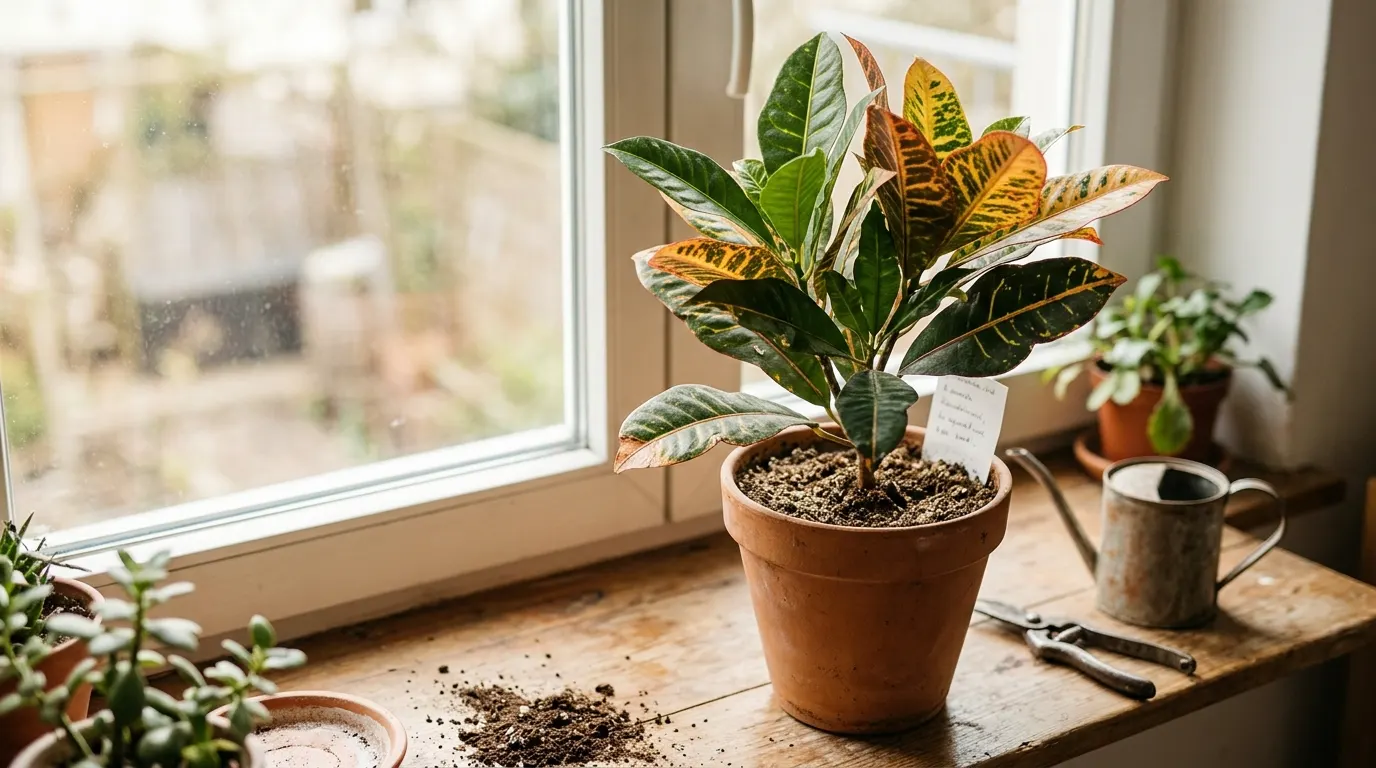
Care for an indoor croton (Codiaeum variegatum) by giving it 4 to 6 hours of bright light with some direct sun, steady warmth between 18°C and 27°C (65°F-80°F), and humidity above 50%. Water when the top 2.5 cm (1 inch) of soil feels dry, and avoid moving the pot or exposing it to drafts.
Crotons have a reputation as dramatic plants. They drop leaves when moved, fade to green in dim rooms, and sulk in cold air. Most of that comes down to a few predictable causes, and this guide covers light, watering, humidity, leaf drop, colour, repotting and pet safety so you can fix each one.
Where should you put a croton for the best light?
In the Northern Hemisphere, use a south- or east-facing window, and shift to a west window if the light is weak in winter. In the Southern Hemisphere, use a north- or east-facing window. Crotons need 4 to 6 hours of bright light, or their leaves fade to dull green.
The sun sits in a different part of the sky depending on where you live, so the "sunny window" is reversed between hemispheres. Use this as a quick reference:
| Window | Northern Hemisphere | Southern Hemisphere |
|---|---|---|
| Brightest, longest light | South | North |
| Gentle morning sun | East | East |
| Strong afternoon sun | West | West |
| Weakest light | North | South |
An east window is the safest starting point in both hemispheres. It gives bright morning sun without the scorching heat of mid-afternoon. A bright south window (Northern Hemisphere) or north window (Southern Hemisphere) works well too, but in midsummer pull the plant 30 to 60 cm (1 to 2 feet) back from the glass or add a sheer curtain. Bleached patches or crisp brown spots on the upper leaves mean the sun is too harsh.
In winter the sun is lower and days are shorter in both hemispheres. That is roughly December to February in the north and June to August in the south. Move the croton closer to the window during these months, and clean the glass so more light gets through.
Tip: A north-facing window in the Northern Hemisphere, or a south-facing one in the Southern Hemisphere, rarely gives a croton enough light to hold its colour. Pair it with a grow light if that is your only option.
How often should you water a croton?
Water a croton when the top 2.5 cm (1 inch) of soil feels dry, which usually means every 4 to 7 days in summer and every 7 to 12 days in winter. Use room-temperature water, soak the soil thoroughly, and always empty the saucer afterwards.
The finger test beats any fixed schedule. Push a finger into the soil to the first knuckle. If it feels dry, water slowly until it runs from the drainage holes. If it still feels damp, wait a day or two and check again. In winter, let the top 3 to 5 cm (1.5 to 2 inches) dry out before watering.
Crotons dislike both extremes. Soil that dries completely makes the leaves droop and then drop. Soil that stays soggy rots the roots, and the leaves yellow and fall as well. The difference shows in the stem. A plant that is too dry has limp leaves but a firm stem, while a rotting plant has a soft, dark base and a sour smell from the pot.
For more on judging moisture, see our houseplant watering guide. If you keep finding tiny flies around the pot, that is a sign the soil is staying too wet, and our guide on fungus gnats in houseplants explains how to deal with them.
What temperature and humidity does a croton need?
Keep daytime temperatures between 20°C and 27°C (68°F-80°F), with nights no lower than 16°C to 18°C (60°F-65°F). Aim for 50% to 70% relative humidity. Crotons are tropical and react badly to cold air and dry, heated rooms.
Anything below about 15°C (59°F) can cause leaf drop, and a cold draught from a window or door can do the damage in a single night. Keep the plant away from:
- Heating and air conditioning vents
- Doors that open to the outside in winter
- Glass that gets icy cold overnight
- Radiators and heaters that dry the air
Humidity is the other half of the picture. Crisp brown leaf tips and edges usually mean dry air, especially in winter when heating runs. To raise humidity:
- Run a cool-mist humidifier near the plant.
- Stand the pot on a tray of pebbles with water just below the pot base.
- Group it with other plants so they share moisture.
- Check the level with a digital hygrometer rather than guessing.
Misting gives only a brief lift and is not a reliable fix. If brown tips are your main problem, our brown leaf tips clinic page walks through other possible causes.
Why is my croton dropping leaves?
Croton leaf drop is usually a stress reaction to being moved, cold drafts, dry soil, soggy roots or low light. Keep the plant in one warm, bright spot, water evenly, and wait 2 to 4 weeks for new growth to appear.
Crotons adjust their leaves to the light level where they sit. When you bring one home from a bright nursery into a dimmer room, it sheds the older leaves that no longer suit the conditions. Lower and middle leaves go first. This is acclimation shock, and it is normal.
Work through these checks:
- Was it recently moved or bought? If yes, stop moving it and give it time.
- Is it near a draught or cold glass? Move it to a stable spot above 18°C (65°F).
- Is the soil bone dry? Water thoroughly and keep it evenly moist.
- Is the soil wet and the stem soft? Suspect root rot. Tip the plant out, trim black or mushy roots, and repot into fresh mix.
- Is the light weak? Move it to a brighter window.
A croton can recover even after losing most of its leaves, as long as the stem is firm and green beneath the bark. Scratch the stem gently. Green tissue means it is alive.
Warning: Do not respond to leaf drop by repotting, pruning hard or fertilising. Stressed plants need stability first.
For general wilting and drop issues, see our wilting clinic page.
How do you keep croton leaf colours bright?
Bright red, orange and yellow leaves depend on strong light. If a croton turns green, move it to a sunnier window or add a full-spectrum LED grow light. Give it 4 to 6 hours of bright light with some direct sun, and hold it steady in one place.
Colour is the plant's response to light. In low light, croton leaves make more green pigment to capture what little energy is available, and the reds and yellows fade. New leaves emerging in a bright spot will show richer colour than the older ones, so judge progress by new growth over several weeks.
To bring colour back:
- Move the plant to the brightest suitable window for your hemisphere (see the table above).
- Introduce direct sun gradually over a week to avoid scorching.
- In winter or dark rooms, add a 20 to 30 watt full-spectrum LED about 30 cm (12 inches) above the leaves for 8 to 10 hours a day.
- Rotate the pot a quarter turn each week so all sides get light, but do not shift its position otherwise.
- Dust the leaves with a damp cloth so they can absorb more light.
Varieties differ. Narrow-leaved and heavily variegated types such as 'Petra' and 'Gold Dust' generally want bright light to keep their patterns. In the growing season (spring and summer), feed every 4 weeks with a balanced liquid fertiliser at half strength. Stop feeding in autumn and winter.
How do you repot a croton step by step?
Repot a croton every 2 to 3 years, in spring (March to May in the north, September to November in the south), into a pot 2.5 to 5 cm (1 to 2 inches) wider with drainage holes. Use a peat- or coir-based mix with perlite, then water well.
Only repot when the plant needs it. Signs include roots pushing out of the drainage holes, water running straight through the pot, or growth that has stalled in the growing season. A stressed or newly bought croton should wait.
What you need: a slightly larger pot with drainage, well-draining potting mix with perlite and bark, nitrile gloves, and clean pruning shears.
- Put on gloves, because the sap irritates skin.
- Water the plant a day beforehand so the rootball slides out easily.
- Tip the pot sideways and ease the plant out, supporting the base of the stem.
- Loosen circling roots gently and trim any that are black or mushy.
- Add a layer of fresh mix to the new pot so the top of the rootball sits about 2.5 cm (1 inch) below the rim.
- Fill around the roots, press lightly, and water until it drains.
- Return it to the same spot and keep conditions steady for a few weeks.
Choose a pot that does not hold water around the roots. Our guide to the best pots for indoor plants compares materials. Some leaf drop after repotting can happen, so keep care consistent and avoid fertiliser for about a month.
Are crotons toxic to cats and dogs?
Yes. Crotons are toxic to cats, dogs and other small pets. The milky sap can cause drooling, vomiting, mouth pain and skin irritation. Keep the plant out of reach and wear gloves when pruning or repotting.
All parts of the plant can irritate. Chewing a leaf or stem releases sap that may cause:
- Drooling and pawing at the mouth
- Vomiting or diarrhoea
- Reduced appetite
- Red, itchy skin where sap touched fur or skin
If a pet has chewed or touched a croton, act quickly:
- Remove any plant material from the mouth.
- Rinse the mouth gently with water.
- Wash sap from skin or fur with mild soap.
- Contact a veterinarian for advice, and bring a leaf or photo of the plant.
Place the pot on a high shelf or in a room pets cannot enter, and sweep up fallen leaves promptly, since dropped leaves are just as irritating. If you want a safer alternative with colourful foliage, check the plant before buying. Our Boston fern guide covers a popular option.
What tools and supplies do you need?
A croton needs few supplies: a pot with drainage holes, well-draining mix, a moisture meter or your finger, a humidity source, and gloves for handling sap. A grow light is useful in dim rooms.
- Well-draining potting mix with peat or coir, perlite and bark
- Pot with drainage holes, 2.5 to 5 cm (1 to 2 inches) wider than the rootball
- Nitrile gloves to protect against sap
- Clean, sharp pruning shears
- Digital hygrometer and a humidifier or pebble tray
- Moisture meter or a simple soil probe
- Full-spectrum LED grow light for winter
Expert tips for a healthier croton
- Pick the spot first, then leave the plant there. Stability matters more than perfection.
- Check for pests under the leaves each month. Spider mites love dry air and crotons. Our guide to identifying houseplant pests shows what to look for.
- Prune in spring to shape the plant and encourage branching, using clean shears and gloves.
- Wash dusty leaves in the shower or with a damp cloth to keep them efficient at absorbing light.
- Use water at room temperature, since cold water can shock the roots.
Frequently asked questions
Why are my croton leaves turning completely green?
The plant is not getting enough light. In dim conditions, crotons produce more green pigment and lose their reds and yellows. Move it to a bright east window or a sunny window for your hemisphere, increase direct sun gradually, or add a grow light. New leaves should show better colour within a few weeks.
Can a croton recover after losing all its leaves?
Often yes, if the stem is still firm and green inside. Keep it warm above 18°C (65°F), in bright light, with soil that is lightly moist but never soggy. New growth can take several weeks. If the stem is soft, brown and dry, the plant is unlikely to recover.
How often should I mist my croton plant?
Misting is optional and gives only a short boost in humidity. A humidifier, pebble tray or grouping plants works better. If you do mist, do it in the morning so leaves dry quickly. Aim for steady humidity of 50% to 70% rather than relying on spray bottles.
What are the symptoms of croton poisoning in pets?
Common signs are drooling, pawing at the mouth, vomiting, diarrhoea, and skin redness where sap touched. Rinse the mouth with water, wash affected skin with mild soap, and call a veterinarian promptly for advice. Keep the plant well out of reach afterwards.
When is the best time of year to repot a croton?
Repot in spring, when growth is starting. That means March to May in the Northern Hemisphere and September to November in the Southern Hemisphere. Avoid repotting in winter, or when the plant is already stressed from a move or leaf drop. Every 2 to 3 years is usually enough.
Can I grow a croton in a north-facing window?
In the Southern Hemisphere, a north-facing window is the brightest and works well. In the Northern Hemisphere, a north window is the dimmest, and colour will fade. Add a full-spectrum grow light or choose an east, south or west window instead.
Why does my croton have crispy brown leaf tips?
Dry air is the most common cause, especially near heaters in winter. Inconsistent watering can also contribute. Raise humidity to 50% to 70%, keep the soil evenly moist, and move the plant away from vents. Trim damaged tips with clean shears if you like.
Summary and next steps
Caring for a croton plant indoors comes down to bright light, steady warmth, even moisture and no unnecessary moves.
Key takeaways
- Give 4 to 6 hours of bright light, using south or east windows in the north and north or east windows in the south.
- Keep temperatures at 18°C to 27°C (65°F-80°F) and humidity at 50% to 70%.
- Water when the top 2.5 cm (1 inch) of soil is dry, and always drain the saucer.
- Leaf drop is usually shock, cold or watering stress, so stay patient and keep conditions stable.
- Repot every 2 to 3 years in spring, wearing gloves, and keep the plant away from pets.
Do these next
- Check which window your croton sits near and move it, once, to the brightest suitable spot for your hemisphere.
- Test the soil with your finger and water only if the top 2.5 cm (1 inch) is dry.
- Place a hygrometer nearby and add a humidifier or pebble tray if humidity is below 50%.
With consistent light and a steady spot, your croton should reward you with bold new foliage.