
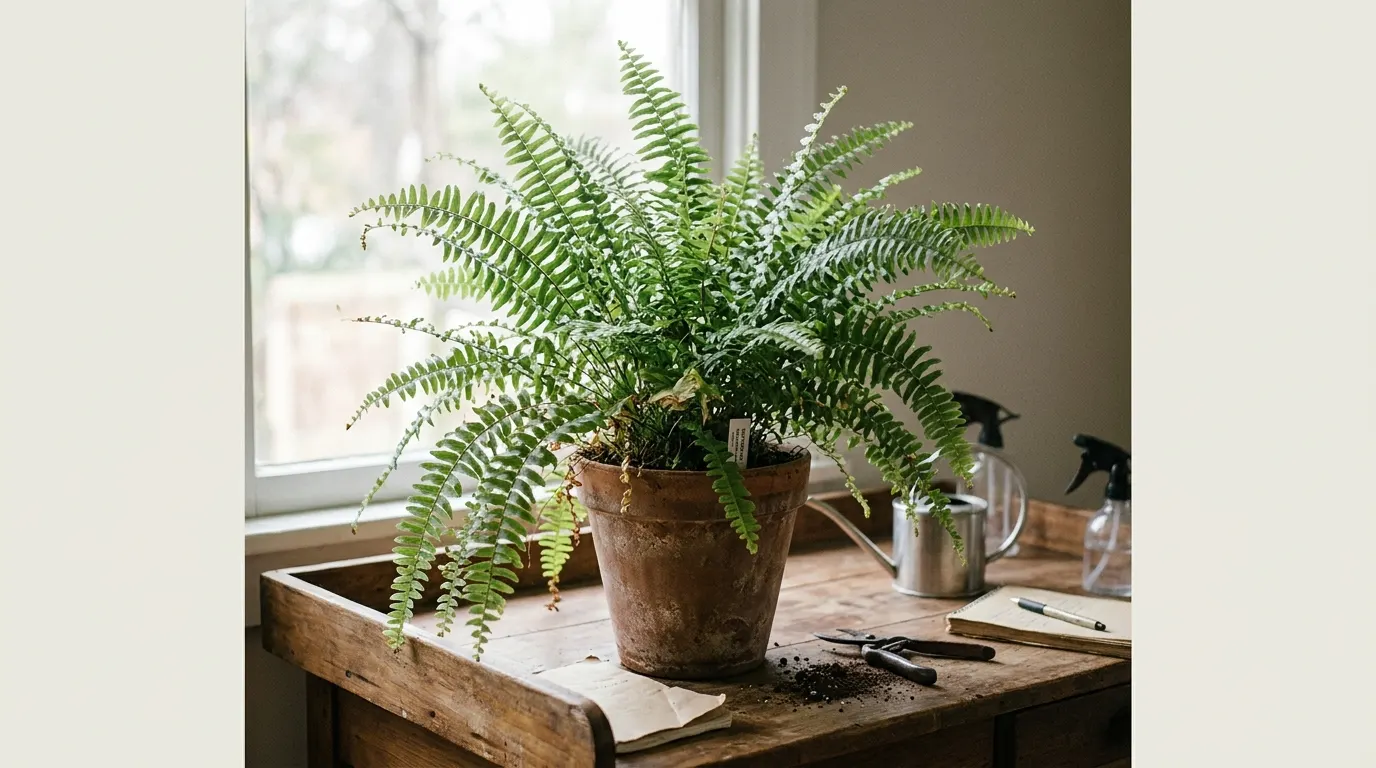
To care for a Boston fern indoors, give it bright, indirect light, keep the potting mix evenly moist but never soggy, and hold humidity at 50% to 80%. East-facing windows suit it in both hemispheres. Keep it away from heaters, vents and drafts, and cut back watering slightly in winter while keeping the air humid.
Boston ferns (Nephrolepis exaltata) have a reputation for dropping leaves the moment they come inside. The cause is usually one of three things: dry roots, dry air or harsh light. This guide covers each one, with fixes for brown crispy fronds, shedding leaflets and winter care.
Which Window and Light Suit a Boston Fern Indoors?
Boston ferns want bright, indirect light. An east-facing window is the best spot in both hemispheres because it gives gentle morning sun. The sunniest aspect needs filtering: south-facing in the Northern Hemisphere, north-facing in the Southern Hemisphere.
The sun's path is the reason hemispheres differ. In the Northern Hemisphere the sun tracks across the southern sky, so south-facing windows get the strongest light. In the Southern Hemisphere it tracks across the northern sky, so north-facing windows get the strongest light.
Use this as a quick guide:
- East-facing (both hemispheres): ideal. Soft morning light, cooler afternoons.
- West-facing (both hemispheres): workable if the fern sits back from the glass or behind a sheer curtain, as afternoon sun is hot.
- Sunniest aspect (south in the North, north in the South): place the fern 1 to 2 metres (3 to 6 feet) back or behind a sheer curtain.
- Shadiest aspect (north in the North, south in the South): often too dim. Growth slows and fronds thin out.
Signs of too much light are bleached, pale or scorched fronds. Signs of too little are sparse, floppy growth and slow new fronds.
Tip: If you can comfortably read a book at the fern's spot without a lamp for most of the day, the light is usually about right.
How Often Should You Water an Indoor Boston Fern?
Water thoroughly whenever the top 1 to 2 cm (about half an inch) of mix feels dry, then let the excess drain away. The root ball should stay evenly moist, never bone dry and never sitting in water.
Boston ferns have fine, fibrous roots with no way to store water, so they react fast to drying out. In a warm room that may mean watering every 3 to 5 days. In a cool room it may stretch to a week or more. Check the soil rather than following a calendar.
A reliable routine:
- Push a finger into the mix to about 2 cm deep.
- If it feels dry, water slowly until it runs from the drainage holes.
- Empty the saucer after 15 minutes.
- Check again in a couple of days, as pot size, light and heat all change the pace.
If the mix has pulled away from the pot edge or water runs straight through, it has become hydrophobic. Stand the pot in room-temperature water for 20 to 30 minutes so the root ball can soak up moisture from below, then drain fully.
Use a pot with drainage holes. Constantly wet, airless mix leads to rot, which looks similar to drought: yellowing and drooping fronds. Our root rot guide shows how to tell the difference, and the houseplant watering guide covers general technique.
What Humidity Does a Boston Fern Need?
Boston ferns do best at 50% to 80% relative humidity. Most heated or air-conditioned homes sit well below that. A cool-mist humidifier is the most dependable fix, with grouping plants and a bathroom position as helpful extras.
Misting only raises humidity for a few minutes, so treat it as a minor extra at best. These options work better:
- Humidifier: run an ultrasonic cool-mist unit near the plant. This is the most effective option.
- Grouping plants: several plants together create a slightly more humid pocket through transpiration.
- Pebble tray: a tray of pebbles with water just below the pebble tops gives a small local boost. Keep the pot base above the water line.
- Bathroom or laundry: useful if there is a bright window, since shower steam helps.
A digital hygrometer costs little and removes the guesswork. Place it at frond height, not across the room.
Warning: Do not stand a fern directly in front of a heater, split-system air conditioner or heating vent. Moving hot or cold air strips moisture from fronds faster than any humidifier can replace it.
Why Is My Boston Fern Turning Brown, Crispy or Shedding?
Brown, crispy frond edges point to dry air, underwatering or hot drafts. Green leaflets dropping in quantity usually point to the roots drying out, a sudden move or too little light. Match the symptom to the cause, then fix that cause.
The two problems look alike from across the room but have different causes.
Brown, crispy tips and edges
This is the result of low humidity or hot, moving air. The tissue dries out at the margins first.
- Move the fern away from vents, radiators and sunny glass.
- Raise humidity above 50% with a humidifier.
- Check that the mix has not been drying out between waterings.
Browned tissue will not turn green again. Trim damaged fronds at the base with clean snips, and new growth should come through once conditions improve. See also our guide to brown and crispy indoor plant leaves and the brown leaf tips clinic.
Green leaflets dropping all over the floor
A fern sheds green leaflets when the roots dry out, even briefly, or when it has been moved to a very different spot. Low light can cause it too.
- Test the mix. If it is dry, bottom-soak the pot for 20 to 30 minutes.
- Keep the mix evenly damp from now on.
- Leave the fern in one spot for a few weeks while it adjusts.
- Check light. If the spot is dim, shift it closer to an east-facing window.
Pale, yellow or scorched fronds
Bleached or scorched fronds mean too much direct sun. Move the plant back from the glass or add a sheer curtain. Yellowing with a soggy pot suggests overwatering, so also check drainage. For other causes, see the yellow leaves clinic.
Fine webbing or sticky residue
These point to pests such as spider mites or scale, which thrive in dry air. Our houseplant pest identification guide explains what to look for.
How Do You Revive a Crispy Boston Fern?
Cut off the dead fronds at soil level, rehydrate the root ball, and raise the humidity. A fern with healthy, living roots can regrow from the base within a few weeks to a couple of months.
- Prune: use clean, sharp snips to remove fully brown fronds right at the soil line. Leave any frond that still has green.
- Soak: stand the pot in room-temperature water for 20 to 30 minutes, then let it drain completely.
- Reposition: put it in bright, indirect light, away from vents and drafts.
- Humidify: run a humidifier nearby and confirm with a hygrometer.
- Keep moist: water as soon as the top 2 cm of mix begins to dry.
- Be patient: look for small, tightly curled new fronds at the crown.
If the crown is mushy or the roots are black and smell sour, the plant has rotted and is unlikely to recover. If the roots are white or tan and firm, there is hope.
How Do You Care for a Boston Fern in Winter?
In winter, reduce watering slightly because growth slows, stop fertilising, and keep the fern away from heaters and cold glass. Humidity matters most at this time, since heated air is often very dry.
Winter runs from December to February in the Northern Hemisphere and June to August in the Southern Hemisphere. Shorter days slow growth, so the plant uses less water, but the mix must still never dry out completely.
Winter checklist:
- Watering: check the soil before every watering. It may take longer to dry, so water less often but still thoroughly.
- Fertiliser: pause until growth resumes in spring.
- Location: keep it clear of heating vents, fireplaces, split-system outlets and cold window glass at night.
- Humidity: run a humidifier and monitor with a hygrometer. Aim for at least 50%.
- Temperature: normal room temperatures suit it. Avoid sharp swings between day and night.
- Light: the sun is weaker, so an east-facing or even the sunniest window is often fine in winter. Watch for scorching if the sun is strong.
Tip: Dry winter air also invites pests. Wipe fronds gently and inspect the undersides every couple of weeks.
What Tools and Supplies Help Most?
A few inexpensive items make Boston fern care far easier. The most useful are a hygrometer, a humidifier and a free-draining pot with a peat-based or coir-based mix.
- Digital hygrometer to track humidity
- Cool-mist humidifier
- Pebble tray (optional extra)
- Moisture meter or simply your finger
- Clean pruning snips
- Well-draining mix with perlite, in a pot with drainage holes
- Hanging basket or pedestal planter
Repot when roots fill the pot, usually every two years or so, ideally in spring. Pick a pot only one size larger. Our indoor pot guide helps with choosing materials.
Expert Tips for a Fuller Fern
Small habits make the biggest difference to a Boston fern's shape and health.
- Rotate the pot a quarter turn weekly so growth stays even.
- Use water at room temperature, as cold water can shock roots.
- Feed lightly during active growth (spring and summer) with a diluted liquid fertiliser at half strength, about once a month.
- Divide an overgrown plant in spring by cutting the root ball into sections and potting each separately.
- Hang it where it can be seen, since daily checks catch dry soil early.
- Keep humidity-loving companions nearby. A calathea has similar needs and shares the benefit of a humidifier.
FAQ
Why is my Boston fern shedding tiny green leaflets everywhere?
Most often the root ball has dried out, even briefly. Other causes are a recent move, a cold or hot draft, or low light. Bottom-soak the pot for 20 to 30 minutes, keep the mix evenly damp, and leave the plant in one bright, draft-free spot while it settles.
Can a Boston fern recover after turning brown and crispy?
Yes, if the roots and crown are still alive. Cut the dead fronds to the soil line, rehydrate the root ball, and raise humidity above 50%. New fronds usually appear from the base within weeks to a couple of months. Browned fronds will not turn green again.
Which window is best for a Boston fern in the Southern Hemisphere?
An east-facing window is best, as it gives gentle morning light. In the Southern Hemisphere, north-facing windows get the strongest sun, so keep the fern back from the glass or behind a sheer curtain. South-facing windows are often too dim.
Which window is best for a Boston fern in the Northern Hemisphere?
East-facing windows are ideal. In the Northern Hemisphere, south-facing windows receive the strongest light, so diffuse it with a sheer curtain or place the fern well back from the glass. North-facing windows are usually too shaded for full, lush growth.
How do I keep my Boston fern alive in winter with central heating?
Run a cool-mist humidifier nearby, keep the fern away from vents and radiators, and check the soil before watering since growth slows. Stop fertilising until spring. Aim for at least 50% humidity, and use a hygrometer to confirm it.
Is misting enough for a Boston fern?
No. Misting raises humidity for only a few minutes. A humidifier gives steady moisture in the air. Misting can be a small extra, but it should not replace a humidifier, grouping plants or a humid room.
Are Boston ferns safe around cats and dogs?
Boston ferns are generally regarded as non-toxic to cats and dogs, but chewing any plant can upset a pet's stomach. Keep the fern in a hanging basket or out of reach, and contact a vet if your pet shows symptoms after eating it.
Summary and Next Steps
Boston fern care indoors comes down to steady moisture, high humidity and gentle light. Most problems trace back to dry roots or dry air.
Key takeaways:
- Bright, indirect light is best. East-facing suits both hemispheres.
- Filter strong light from south-facing windows in the Northern Hemisphere and north-facing windows in the Southern Hemisphere.
- Water when the top 2 cm of mix feels dry and never let the root ball dry out completely.
- Hold humidity at 50% to 80%, ideally with a humidifier.
- Brown crispy edges mean dry air or drafts. Shedding green leaflets mean dry roots, stress or low light.
- In winter, water less, stop fertilising, and keep the fern away from vents.
Immediate actions:
- Check the soil today and bottom-soak the pot if the mix is dry.
- Move the fern away from heaters, vents and harsh midday sun.
- Place a hygrometer near it and add a humidifier if the reading is below 50%.
With those basics in place, your Boston fern care indoors routine should keep fronds full and green through every season.