
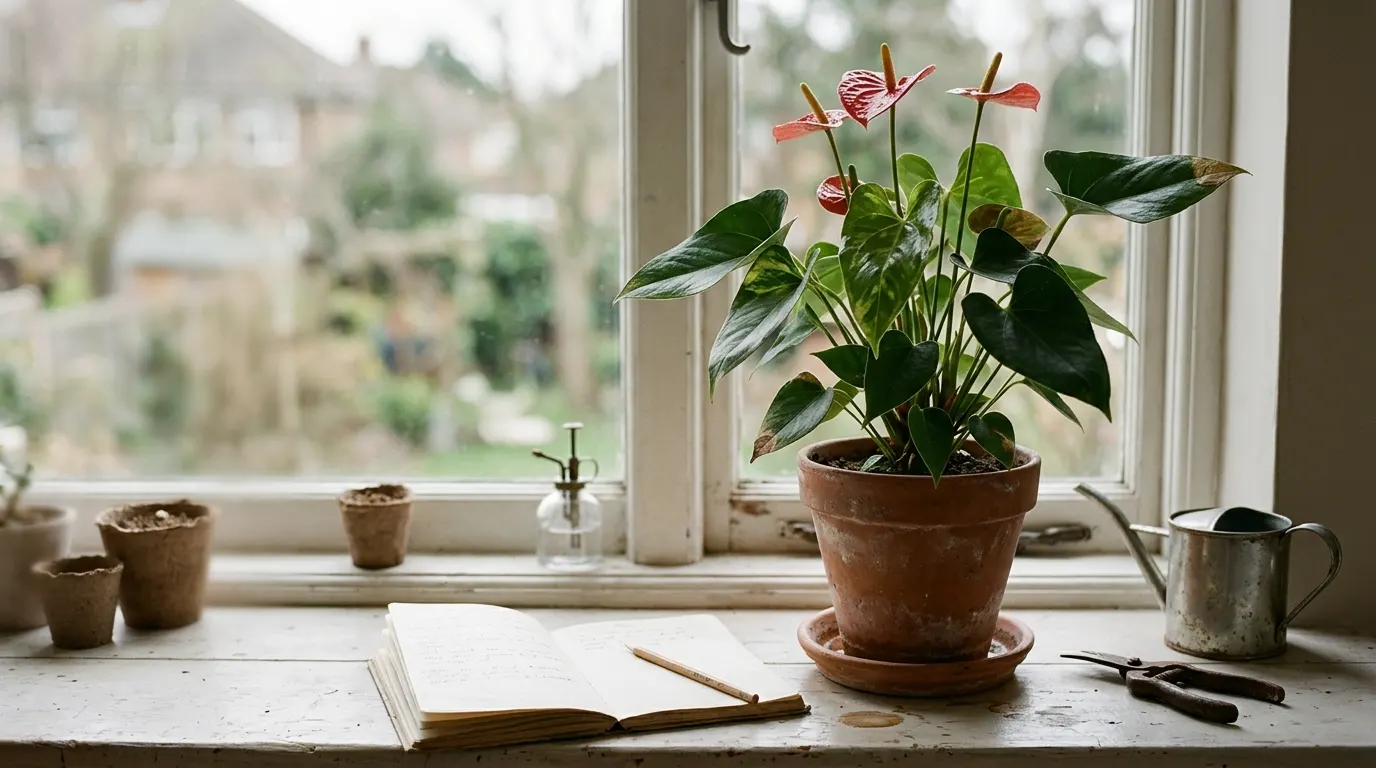
To care for an anthurium indoors, give it bright, indirect light, water thoroughly only when the top half of the potting mix has dried out, and keep humidity near 60% or higher. Plant it in a chunky, airy aroid mix, feed lightly during active growth, and keep it out of harsh direct sun and cold drafts.
Anthuriums look tough, but their roots grow like those of an epiphyte, clinging to trees in the wild, so they punish heavy soil and soggy pots. Most problems, from yellow leaves to green, tired-looking flowers, trace back to light, water or air moisture. This guide covers each of those, plus repotting and a leaf-by-leaf troubleshooting section.
Light and Window Direction: Northern vs. Southern Hemisphere
Anthuriums thrive in bright, filtered light. An east-facing window is a gentle, bright spot in either hemisphere. The sunniest windows are south and west in the Northern Hemisphere, and north and west in the Southern Hemisphere, and these need a sheer curtain.
The sun's path flips between hemispheres, so a window that is gentle in London can be harsh in Sydney. Match the window to your location rather than following generic advice.
- East-facing (both hemispheres): Soft morning sun, then bright shade. The easiest placement for flowering.
- Northern Hemisphere, south and west windows: The strongest light. Place the plant 1 to 2 metres back or behind a sheer curtain.
- Southern Hemisphere, north and west windows: The strongest light. Filter it the same way.
- Shadier windows (north-facing in the Northern Hemisphere, south-facing in the Southern Hemisphere): Gentler light. Place the plant right at the glass, and expect fewer blooms.
A useful target is bright light with no hard-edged shadow falling across the leaves at midday. If you hold your hand over the leaf and the shadow is soft and fuzzy, the light is about right. A sharp, dark shadow means the light is too direct.
Warning: Pale, bleached patches or brown scorched spots on the side facing the glass mean the sun is too strong. Move the plant back or add a sheer curtain.
Rotate the pot a quarter turn every week or two so growth stays even.
Watering Anthuriums: Frequency, Technique, and Drainage
Water an anthurium thoroughly until water runs from the drainage holes, but only when the top 1 to 2 inches (2.5 to 5 cm) of mix is dry. Empty the saucer within 15 minutes. Water less often in winter, when growth slows.
There is no fixed schedule. In a warm, bright room you might water weekly, while in a cool room it could be every two to three weeks. Test the mix instead of following the calendar.
- Push a finger or a wooden skewer 2 inches (5 cm) into the mix.
- If it comes out clean and dry, water. If damp mix clings to it, wait a few days.
- Water slowly around the pot until it drains freely from the base.
- Let it drain fully in a sink, then return it to its saucer or cachepot.
Use room-temperature water. Cold water straight from the tap can shock the roots. If your tap water is hard, rainwater or filtered water helps prevent salt build-up. For a broader overview of technique, see the houseplant watering guide.
Tip: Anthurium roots are thick and fleshy and hold moisture well. A pot that is slightly too dry is far easier to recover from than one that is too wet.
Humidity and Temperature Requirements for Healthy Leaves
Anthuriums grow best at 60% to 80% relative humidity and temperatures of 18 to 27°C (65 to 80°F). If your room drops below 50% humidity, use a cool-mist humidifier or group tropical plants together, and keep the pot away from cold glass, air-conditioning vents and radiators.
These are tropical plants, so they dislike sudden swings. Temperatures below about 15°C (59°F) slow growth and can damage leaves.
Ways to raise humidity:
- Run an ultrasonic cool-mist humidifier near the plant, especially in heated winter rooms or air-conditioned summer rooms.
- Group several plants together so they share moisture.
- Place the pot on a tray of pebbles with water below the pebble tops, so the pot base never sits in water.
- Keep the plant in a bright bathroom or kitchen if light is good.
Misting gives only a brief boost and can leave marks on leaves. A humidifier is more reliable. Cold drafts from opening doors and windows in winter are a common cause of leaf damage, so move the plant if you feel moving air.
How to Encourage Repeat Anthurium Blooms Indoors
To get an anthurium flowering again, give it 8 to 10 hours of bright, indirect light each day and feed it with a diluted, phosphorus-rich houseplant fertilizer monthly during the growing season. Too little light is the most common reason a healthy plant stops blooming.
The colourful part of an anthurium is a modified leaf called the spathe, which surrounds the spike, or spadix. Each one lasts for weeks to months, and then the plant needs energy to make another.
To trigger new flowers:
- Increase light gradually. Move the plant closer to an east-facing window, or to a filtered sunny window for your hemisphere. A sudden jump can scorch leaves, so shift it over a week or two.
- Feed lightly. Use a balanced or slightly phosphorus-leaning fertilizer at half the label strength, monthly from spring to late summer. Skip feeding in winter. For gentle options, see DIY natural fertilizers.
- Keep humidity up. Dry air makes buds abort or spathes brown at the edges.
- Remove spent blooms. Cut the old flower stem at the base once the spathe fades or turns green.
Spathes turning green with age is natural, not a sign of illness. If they turn green very early on a young bloom, the light is usually too low or the plant is overfed.
How to Repot an Anthurium: Soil Mix and Pot Selection
Repot an anthurium every 2 to 3 years, in spring or early summer, into a pot only 1 to 2 inches (2.5 to 5 cm) wider with large drainage holes. Use a chunky aroid mix of roughly 40% orchid bark, 30% peat or coco coir, 20% perlite and 10% horticultural charcoal.
Standard potting mix compacts and suffocates epiphytic roots. A coarse mix lets air reach the roots while still holding enough moisture. Spring is early March to May in the Northern Hemisphere and September to November in the Southern Hemisphere.
Signs it needs repotting include roots circling the surface or pushing from the drainage holes, mix that dries within a day or two, and a plant that looks top-heavy.
You will need: a slightly larger pot with drainage holes, the aroid mix, clean shears, and a tray or newspaper.
- Water lightly the day before so the root ball slides out easily.
- Tip the pot sideways and ease the plant out, supporting the base of the stems.
- Shake away old mix and check the roots. Trim any black, mushy or hollow roots with clean shears. Healthy roots are firm and pale.
- Add a few inches of fresh mix to the new pot, set the plant at the same depth as before, and fill around the roots.
- Press gently, water well, and let it drain fully.
Pot choice matters, and the best pots for indoor plants guide explains how materials affect drying time. Keep the plant out of strong sun for a week or so afterwards.
Fixing Yellow and Brown Leaves: Diagnostic Troubleshooting
Yellow leaves usually point to overwatering, root rot or too little light. Brown, crispy tips usually point to low humidity, dry mix or fertilizer salt build-up. Check the roots and mix first, then adjust water, humidity and feeding.
Use this quick guide to match the symptom to the fix.
Entire leaves turning pale yellow with limp stems
This is the classic sign of root rot from soggy mix. Stop watering and slide the plant out of its pot. Cut away mushy black roots with clean shears, then repot in fresh, chunky mix with plenty of bark. Our guide to root rot in houseplants covers the process in detail.
One or two older leaves yellowing at the base
This is normal ageing if the plant is otherwise growing. Remove the leaf once it has fully yellowed. If many leaves yellow at once, look at watering and light.
Crispy brown tips and edges
Raise humidity to 60% or more and keep the plant away from heaters and vents. If you feed regularly, flush the pot by running plain water through it for a couple of minutes and let it drain completely. White crust on the mix surface suggests salt build-up. See why indoor plant leaves go brown and crispy for more causes.
Brown spots with yellow halos
This can indicate a bacterial or fungal leaf problem, often linked to wet foliage and poor airflow. Remove affected leaves, keep water off the foliage and improve air circulation.
Healthy leaves but no flowers
This nearly always means light is too low. Move the plant to a brighter, filtered spot and feed lightly in the growing season.
Tip: Check the undersides of leaves for tiny pests if yellowing comes with sticky residue or fine webbing. Early detection makes treatment far easier.
Tools and Supplies
- Wooden skewer or moisture meter for checking mix depth
- Ultrasonic cool-mist humidifier
- Orchid bark, perlite, coco coir or peat, and horticultural charcoal for the mix
- Clean, sharp shears
- Pot with drainage holes and a saucer
- Diluted houseplant fertilizer
Expert Tips for Better Anthuriums
- Wipe leaves with a damp cloth every month or two. Clean leaves absorb light more efficiently.
- Seasonal care differs. In spring and summer, water more often and feed monthly. In autumn and winter, let the mix dry a little more between waterings and stop feeding.
- Flowering types such as Anthurium andraeanum need more light than velvety-leaved types such as Anthurium clarinervium, which grow for their foliage and tolerate slightly shadier spots.
- Use a pot with a drainage hole, and lift the plant to feel its weight after watering so you learn what "wet" and "dry" feel like.
- If you enjoy similar tropical plants, the philodendron care guide shares many aroid habits.
FAQ
Why is my anthurium turning yellow after watering?
Yellowing after watering usually means the mix stays wet too long, so roots are short of oxygen. Check that the pot drains freely, the mix is chunky, and you only water when the top 1 to 2 inches (2.5 to 5 cm) is dry. If stems are soft, inspect the roots for rot.
Can an anthurium survive in low-light rooms?
An anthurium can survive in low light, but it will grow slowly and rarely flower. Leaves may become dark and stretched. For regular blooms, place it in bright, indirect light, such as near an east-facing window, or a filtered sunny window for your hemisphere.
Why are the tips of my anthurium leaves turning brown and crunchy?
Brown, crunchy tips usually come from dry air, irregular watering or fertilizer salt build-up. Raise humidity toward 60%, water thoroughly when the top half of the mix is dry, and flush the pot with plain water occasionally. Trim the brown edges with clean scissors if you like.
How do I know when my anthurium needs repotting?
Repot when roots circle the surface or poke from the drainage holes, when the mix dries out within a day or two, or when the plant looks too big for the pot. This usually happens every 2 to 3 years. Choose a pot only slightly larger.
Do anthurium flowers last forever or do they die off naturally?
Anthurium flowers do not last forever, but each spathe often lasts several weeks to a few months. Over time it fades or turns green. Cut the old stem near the base, and with good light and feeding the plant can produce new blooms through the year.
How often should I water an anthurium inside?
Water when the top 1 to 2 inches (2.5 to 5 cm) of mix is dry, which is often every 7 to 14 days in warm months and less often in winter. Check the mix with a finger or skewer instead of watering on a fixed schedule.
Is an anthurium safe for pets?
Anthuriums are generally considered toxic if chewed, and can irritate the mouth of pets and children. Keep the plant out of reach, and contact a vet if your pet has chewed on it.
Summary and Next Steps
Key takeaways for how to care for an anthurium indoors:
- Give bright, indirect light, and match window choice to your hemisphere.
- Water thoroughly only when the top 1 to 2 inches (2.5 to 5 cm) of mix is dry, and empty the saucer.
- Keep humidity around 60% to 80% and temperatures at 18 to 27°C (65 to 80°F).
- Use a chunky aroid mix and repot every 2 to 3 years in spring.
- Feed lightly monthly in the growing season to support flowering.
- Yellow leaves point to water or roots, brown tips point to dry air or salts.
Immediate actions:
- Test the mix with a skewer today and adjust your watering to match.
- Check where your plant sits against the window guide above and move it if needed.
- Look at the roots through the drainage holes, and plan a repot if they are crowded or the mix is dense.
For symptoms you cannot place, the Plant Clinic for yellow leaves can help narrow down the cause.