
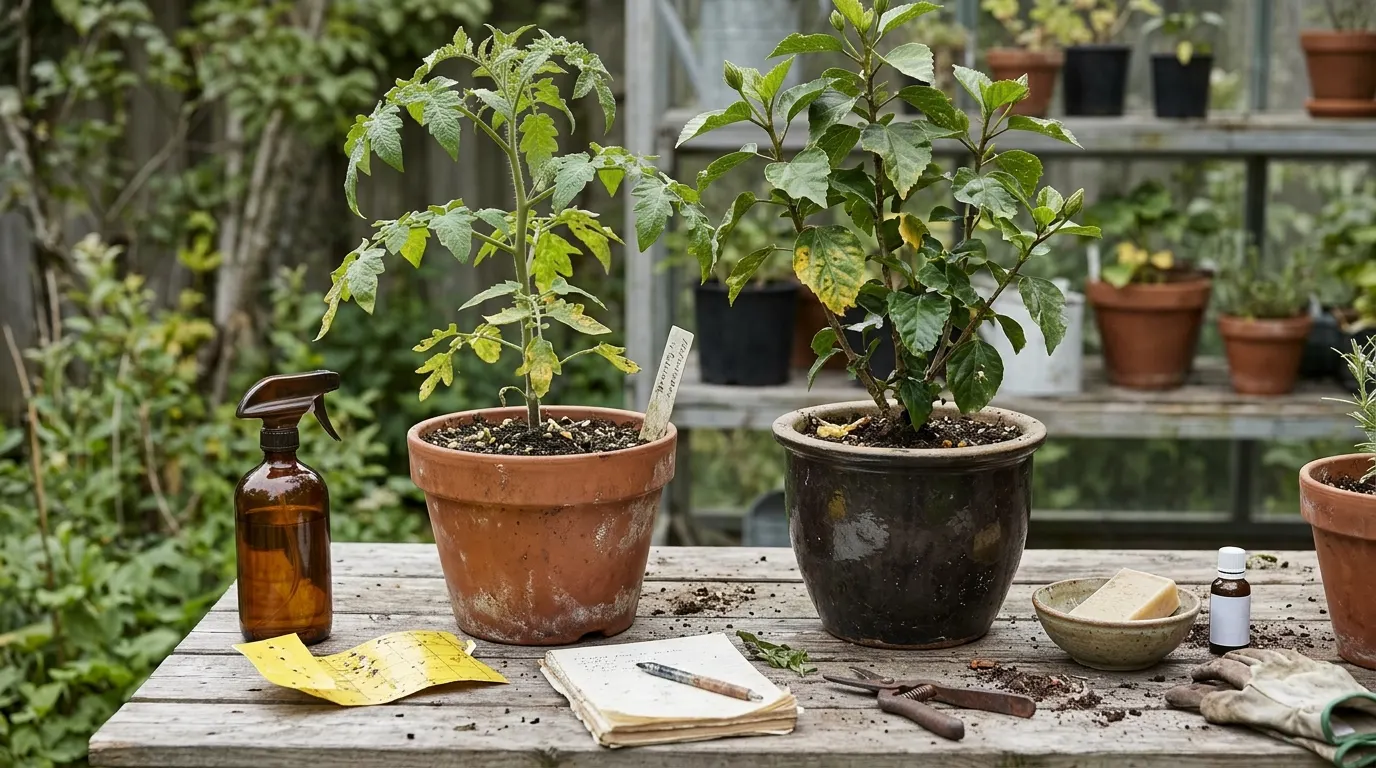
To get rid of whiteflies naturally, hang yellow sticky traps at canopy level, blast leaf undersides with water, then spray insecticidal soap (2 tbsp per 1 gallon, or 30 ml per 3.8 L) or neem oil every 3 to 5 days for 3 to 4 weeks. The repeat sprays are what break the life cycle.
Whiteflies are stubborn because the adults fly off, the eggs and pupae shrug off sprays, and the population rebuilds within days. This guide covers how to identify them, exact dilutions in metric and US units, a treatment schedule, special care for tomatoes, hibiscus and greenhouse plants, hemisphere-specific timing, prevention and pet safety.
How to Identify Whiteflies vs. Other Common Garden Pests
Whiteflies are tiny, moth-like winged insects about 1 to 2 mm long that lift off in a cloud when you shake a plant. Aphids stay put, mealybugs look cottony, and fungus gnats hover around soil rather than feeding under leaves.
Check the undersides of the newest leaves first. Adults sit in clusters, while nymphs look like flat, pale, scale-like ovals that do not move. Sticky honeydew and black sooty mould on the leaves below are classic signs.
Use this quick comparison:
- Whiteflies: white, powdery, flutter up when disturbed, found under leaves, leave sticky residue.
- Fungus gnats: dark, slow flyers, found around damp potting mix. See how to get rid of fungus gnats in houseplants.
- Mealybugs: white cottony tufts in leaf joints that crawl rather than fly. See how to get rid of mealybugs on plants.
- Aphids: soft, pear-shaped, green, black or yellow, clustered on shoot tips. See how to get rid of aphids.
Tip: Gently tap a branch over a sheet of white paper. If tiny white insects flutter up and settle again, you have whiteflies.
Mechanical Controls: Yellow Sticky Traps and Water Sprays
Yellow sticky traps catch flying adults, and a firm water spray knocks off nymphs and adults before you apply any soap or oil. Together they cut the population quickly and show you whether your treatment is working.
Hang one yellow trap per plant indoors, or one every 1 to 2 metres (3 to 6 feet) in a garden bed or greenhouse. Place traps just above or level with the canopy, because adults fly upward from the foliage.
- Shake the plant gently and let adults fly up toward the traps.
- Spray the undersides of leaves with a firm stream of water in the morning so foliage dries during the day.
- For indoor plants, use the shower or sink, and cover the pot surface so the soil does not become waterlogged.
- Wipe honeydew and sooty mould off leaves with a damp microfibre cloth.
- Replace traps when they are covered in insects or dust.
Traps will not eliminate an infestation alone, since they only catch adults. Treat them as a monitoring tool: fewer catches each week means the schedule is working.
Warning: Yellow traps can also catch small beneficial insects and hoverflies. Outdoors, keep them near infested plants and away from open flowers.
Exact Dilutions: Natural Insecticidal Soap and Neem Oil
For insecticidal soap, mix 2 tablespoons of pure liquid castile soap into 1 gallon of water (30 ml per 3.8 L). For neem oil, blend 1 to 2 tablespoons of cold-pressed neem oil (15 to 30 ml) plus 1 teaspoon of mild soap (5 ml) into 1 gallon (3.8 L) of warm water.
Here are the quick-reference mixes:
| Spray | US measure | Metric |
|---|---|---|
| Insecticidal soap, 1 gallon | 2 tbsp soap | 30 ml soap per 3.8 L water |
| Insecticidal soap, 1 quart | 1.5 tsp soap | 7 ml soap per 1 L water |
| Neem oil, 1 gallon | 1 to 2 tbsp neem plus 1 tsp soap | 15 to 30 ml neem plus 5 ml soap per 3.8 L warm water |
| Neem oil, 1 quart | 1 to 1.5 tsp neem plus 1/4 tsp soap | 5 to 7 ml neem plus 1 ml soap per 1 L warm water |
How to mix neem oil so it does not separate:
- Warm the water so the oil stays liquid.
- Add the soap first, then the neem oil.
- Shake or stir thoroughly.
- Use the mix straight away, because neem separates and loses effectiveness as it sits.
Soap and oil only work on contact, so coat leaf undersides until they drip. Always patch test one leaf and wait 24 hours before spraying the whole plant. Use mild soap without degreasers or bleach; see our DIY organic pest sprays guide for more recipes.
Tip: Soft water gives the best results. Hard water can reduce how well soap sprays work.
Eradication Schedule: Breaking the Whitefly Life Cycle
Spray every 3 to 5 days for at least 3 to 4 weeks, which means 4 to 6 applications. Eggs hatch in roughly 6 to 10 days and pupae resist sprays, so repeat treatments catch newly hatched nymphs before they mature and lay more eggs.
A simple schedule:
- Day 1: Water blast, wipe leaves, hang traps, then spray soap or neem on all leaf surfaces, especially undersides.
- Day 4: Spray again and check traps.
- Day 8: Spray again, removing badly infested leaves first.
- Day 12: Spray again.
- Day 16 to 21: Spray once or twice more, then keep traps up.
- Week 4 onward: Inspect weekly for a month. If traps catch nothing, stop spraying.
Alternate between soap and neem if you like. Soap knocks down soft-bodied stages quickly, while neem disrupts feeding and growth over time.
Warning: Skipping sprays is the most common reason whiteflies return. A plant that looks clean on day 7 usually still has eggs on it.
Treating Sensitive Hosts: Tomatoes, Hibiscus, and Greenhouse Plants
Tomatoes, hibiscus and greenhouse crops all need the same spray schedule, but with extra care. Spray only at dawn or dusk when temperatures are below 85°F (29°C), patch test first, and improve airflow so foliage dries quickly.
Tomatoes: Whiteflies cluster on lower and middle leaves. Remove the worst leaves, spray undersides thoroughly, and rinse fruit before eating. Neem and soap residues wash off with plain water. Planting basil or marigolds nearby can help; see companion planting to deter pests.
Hibiscus: Whiteflies hide in dense tip growth and fly up when you brush the plant. Prune crowded shoots to let sprays reach the undersides. Hibiscus buds and flowers can mark, so aim at foliage and avoid open blooms.
Greenhouse plants: Warm, still air lets whiteflies breed year-round. Keep vents and fans running, install yellow traps at canopy height, and remove weeds that harbour them. A tiny parasitic wasp that attacks whitefly nymphs can be released in enclosed greenhouses, but stop using soap and oil sprays around them, since sprays can harm them too.
Tip: If you have a vegetable patch struggling in hot weather, read how to protect your vegie garden in a heatwave so stressed plants do not become easy targets.
Hemispheric Timing and Seasonal Pressure Windows
In the Northern Hemisphere, outdoor whitefly pressure peaks from May to September, so start checking in late spring. In the Southern Hemisphere, it peaks from November to March, lingering into April in warm subtropical areas. Indoors and in greenhouses, it can happen all year.
- Northern Hemisphere (US, Canada, UK, Europe): Hang traps in late May, spray through summer, and inspect any potted plants before bringing them indoors in September or October.
- Southern Hemisphere (Australia, NZ): Begin monitoring in late October to November, treat through summer, and inspect plants before moving them inside in March to April.
- Mild, frost-free regions: Whiteflies may survive outdoors all winter, so check plants monthly.
- Cold-winter regions: Frost kills most outdoor adults, but they can overwinter on indoor plants, in greenhouses and on sheltered weeds.
Treat when temperatures are mild. In hot weather, spray at first light or after sunset to avoid leaf burn.
Prevention Strategies and Pet Safety Precautions
Quarantine new plants for 14 days, avoid heavy nitrogen feeding that creates soft new growth, and inspect leaf undersides weekly. Soap and neem are generally low risk to pets once dry, but keep dogs and cats away while wet and prevent them from chewing treated leaves.
Prevention checklist:
- Quarantine new plants away from your collection for two weeks.
- Check the undersides of leaves every week during peak season.
- Remove weeds and yellowing lower leaves that shelter adults.
- Feed moderately; lush, over-fertilised growth attracts sap-feeders.
- Keep one or two yellow traps up permanently as an early warning.
- Check heavily affected plants against other pests, such as spider mites or scale insects.
Pet safety steps:
- Spray plants outdoors or in a separate room away from pets.
- Keep animals out until leaves are completely dry.
- Store neem oil and soap concentrates out of reach.
- Place sticky traps where pets and children cannot touch them.
- Contact a vet if a pet eats a significant amount of any plant or spray.
Warning: Neem oil concentrate can upset the stomach if swallowed. Treat it like any household product and keep it stored securely.
Tools and Supplies
- Yellow sticky traps
- Cold-pressed neem oil
- Pure liquid castile soap or a mild soap without degreasers
- A clean spray bottle with an adjustable nozzle that reaches under leaves
- A hose with a spray attachment for outdoor plants
- Microfibre cloths for removing honeydew and sooty mould
- Measuring spoons or a small measuring jug
- Pruning snips
Common Problems and Troubleshooting
Why are the leaf edges brown after spraying? This is usually spray burn from heat or sun. Spray at dawn or dusk, below 85°F (29°C), and patch test first. Rinse the plant with plain water if you see scorching.
Why did whiteflies come back within a week? Eggs and pupae survived. Keep spraying every 3 to 5 days for 3 to 4 weeks.
Why are the leaves sticky and black? Sooty mould grows on whitefly honeydew. Wipe leaves with warm water and a little mild soap (1 tsp per quart, or 5 ml per litre), then control the whiteflies so it does not return. See also the plant clinic pest page.
Why is the spray not working at all? Check you are reaching leaf undersides and mixing fresh batches each time.
Expert Tips and Advanced Techniques
- Vacuum adult whiteflies off plants early in the morning, when they are slow, using a handheld vacuum on low suction. Empty it outdoors.
- Treat the worst plant first, and isolate it if it is in a pot.
- Rotate between soap and neem, rather than relying on one product.
- Wipe your traps' sticky sides with a tissue to count catches each week and track progress.
- Prune off heavily infested leaves into a sealed bag, rather than composting them.
FAQ
Can dishwashing detergent be substituted for insecticidal soap?
It is risky. Many detergents contain degreasers, fragrances and additives that burn leaves. If you have no castile soap, use a very mild, plain liquid soap at a low concentration, patch test one leaf for 24 hours, and rinse after a few hours.
Why did my plant leaves burn after spraying neem oil?
Leaf burn usually comes from spraying in strong sun or heat above 85°F (29°C), or mixing the oil too strongly. Spray at dawn or dusk, measure carefully, and always patch test a single leaf before treating the whole plant.
Will whiteflies survive winter outdoors?
It depends on your climate. In cold regions, frost kills most outdoor whiteflies, but they survive on indoor plants and in greenhouses. In mild, frost-free areas they can persist all year, so keep checking plants through winter.
How do yellow sticky traps affect beneficial pollinators?
Yellow traps can catch bees, hoverflies and other small beneficial insects. Hang them close to the infested foliage, keep them away from flowers, and remove them once whitefly numbers fall. Indoors, this is rarely an issue.
Are tomatoes safe to eat after being sprayed with neem oil?
Yes, once you wash the fruit thoroughly. Avoid spraying open flowers and young fruit where possible, and leave a few days between the last spray and harvest. Rinse tomatoes under running water before eating.
How often should I spray insecticidal soap for whiteflies?
Spray every 3 to 5 days for 3 to 4 weeks. Soap only kills what it touches, so repeat applications catch nymphs as they hatch. Stop when traps remain empty for two weeks.
Can whiteflies spread from outdoor plants to houseplants?
Yes. Adults fly in through open windows or arrive on plants you bring indoors. Check plants before moving them inside, and keep a yellow trap near sunny windows during peak season.
Summary and Next Steps
To get rid of whiteflies naturally, combine traps, water, soap or neem, and a patient repeat schedule.
Key takeaways:
- Identify whiteflies by the cloud of tiny white insects that flutter up when you shake the plant.
- Use yellow traps at canopy level and water blasts to cut numbers first.
- Mix soap at 2 tbsp per gallon (30 ml per 3.8 L) and neem at 1 to 2 tbsp per gallon (15 to 30 ml per 3.8 L) plus 1 tsp (5 ml) of soap.
- Spray every 3 to 5 days for 3 to 4 weeks.
- Spray at dawn or dusk below 85°F (29°C), and patch test first.
- Quarantine new plants and monitor weekly to stop whiteflies returning.
Immediate actions:
- Hang yellow traps today and check leaf undersides on your most affected plant.
- Wash the plant, then spray with soap or neem, and mark your next four spray dates.
- Quarantine any new or affected plants away from the rest of your collection.