
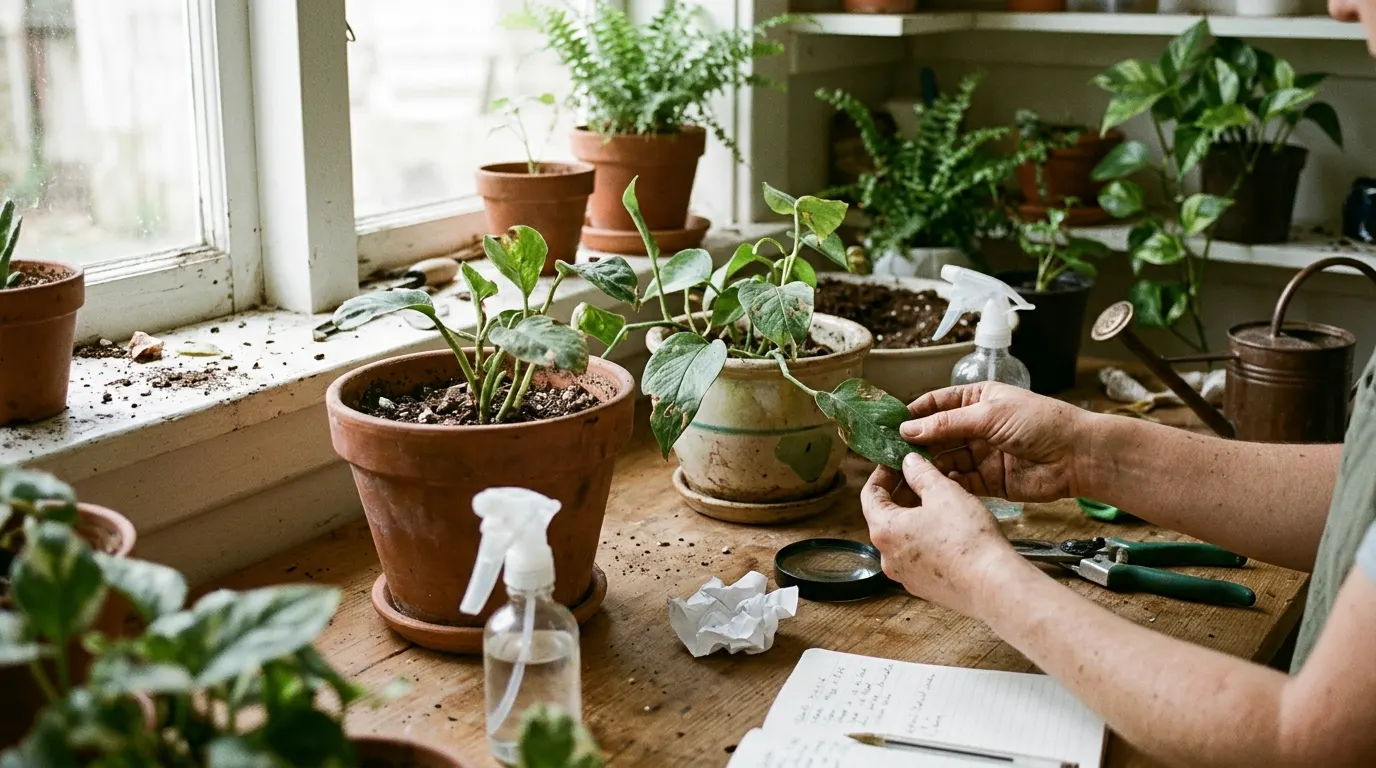
To get rid of spider mites on plants, isolate the plant, wash all leaf surfaces with lukewarm water, then spray insecticidal soap or horticultural oil every 5 to 7 days for 2 to 3 weeks. Raise humidity, and release predatory mites in greenhouses or sheltered garden beds.
Spider mites are tiny, hard to see, and breed quickly in warm, dry conditions. By the time you notice fine webbing, a colony is usually well established. This guide shows you how to confirm them, treat houseplants and outdoor crops, and stop them returning.
How to Spot Spider Mites: Signs and Symptoms
Spider mites cause fine yellow or bronze stippling on leaves, followed by curling, dull colour and leaf drop. Check leaf undersides and where stems meet, because colonies start there. Tomatoes, citrus, roses, beans and tender houseplants are common targets.
The mites themselves are about the size of a grain of pepper or smaller. They feed by piercing leaf cells and sucking out the contents, which leaves the pale speckling. Heavy infestations make leaves look dusty and dry.
Look for these signs:
- Tiny pale dots (stippling) across the leaf surface
- Fine silk on leaf undersides, growing tips and flower buds
- Leaves turning yellow, bronze or silvery, then dropping
- Slowed growth and few new shoots
- Tiny moving specks, sometimes red, orange, green or pale
On outdoor crops, tomatoes and beans often show it first on lower, dustier leaves. Roses and citrus tend to show stippling on the sunniest, driest side of the plant. If you are unsure whether the damage is a pest or a care problem, the guide to identifying houseplant pests and diseases helps you compare symptoms.
Spider Mite Webbing vs Spider Webs: How to Tell Them Apart
Spider mite webbing is a fine, dense, untidy silk sheet over leaf undersides, shoot tips and buds, always with stippled leaves. True spider webs are structured, with radial, funnel or sheet patterns, and the spiders that make them do not damage the plant.
The quickest comparison:
- Mite webbing: very fine, clustered on the plant, often dusty, with speckled leaves beneath it
- Spider webs: larger, geometric or funnel-shaped, stretched between leaves or to nearby objects, with healthy foliage
- Mite webbing often holds tiny moving dots; spider webs usually hold insects or debris
If you see webs but the leaves are clean and green, leave the spider alone. It is catching other pests. If the leaves are stippled, treat for mites.
How to Perform the White Paper Test
Hold a sheet of white paper under a suspect leaf and tap the branch sharply two or three times. If specks that look like ground pepper fall and start to crawl, you have spider mites. Smearing one leaves a faint yellow or green streak.
Follow these steps:
- Choose a leaf with stippling, ideally one with a little webbing.
- Hold plain white paper directly underneath.
- Tap or shake the branch firmly two or three times.
- Wait 10 to 20 seconds and watch the paper.
- Use a 10x hand lens to check whether the specks have eight legs and are moving.
Dust and soil particles fall too but do not move. Only the crawling specks count. Repeat on two or three leaves from different parts of the plant.
Isolating and Washing: The First Treatment Steps
Move the infested plant away from other plants, then wash every leaf, top and underside, with lukewarm water. Wipe leaves with a soft cloth to remove webbing and eggs. This physical step removes a large share of the colony before you spray anything.
For houseplants:
- Carry the plant to a shower, sink or laundry tub.
- Rinse the foliage with lukewarm water, directing the spray at leaf undersides.
- Wipe each leaf with a damp microfiber cloth or soft sponge.
- Remove and bag badly infested leaves. Do not compost them.
- Keep the plant in a separate room for at least 3 weeks.
For outdoor plants, use a hose with an adjustable nozzle and a firm but not damaging spray. Hit the undersides of tomato, bean, rose and citrus leaves. Do this in the morning so foliage dries before night.
Tip: Wash your hands and clean the cloth between plants. Mites hitch rides on hands, clothing and tools.
Stressed, dusty plants are more prone to infestation. Plants with naturally dry-air preferences, like those in the Dracaena care guide, still need regular leaf cleaning.
Insecticidal Soap and Horticultural Oil: Rates and Safety
A typical label rate for insecticidal soap or horticultural oil is 1 to 2 tablespoons per US gallon, which equals about 4 to 8 ml per litre, or about 3/4 to 1 1/2 teaspoons per US quart. Always follow your product label, test one leaf first, and avoid hot sun.
Apply like this:
- Read the label and confirm the plant is listed or not excluded.
- Mix the product in clean water at the label rate. Start at the lower end for sensitive plants.
- Spray one leaf and wait 24 to 48 hours to check for spotting or burn.
- If the leaf looks fine, spray the whole plant, covering leaf undersides until just dripping.
- Spray in the evening, early morning or on an overcast day.
Warning: Do not spray in hot direct sun or when temperatures are above 32°C (90°F). Leaves can scorch. Some plants, such as ferns and plants with waxy or hairy leaves, are more sensitive.
Soap and oil work only on contact, so coverage matters. Mites hidden under leaves, in shoot tips and in flower buds must be wetted directly. Mix a fresh batch each time. If you prefer home-mixed options, the DIY organic pest sprays guide covers alternatives, though label-rate commercial products give more predictable results.
Pet and child safety
Soaps and oils are generally lower risk than many synthetic sprays, but they are not harmless. Keep pets and children away during spraying and until leaves are fully dry. Store concentrates out of reach, and do not let pets chew treated foliage. Follow the label for re-entry and edible crop waiting periods, and wash harvested tomatoes, beans and citrus before eating.
Why You Need a 2 to 3 Week Repeat Schedule
Soap and oil kill active mites on contact but do not reliably reach eggs. Eggs hatch in a few days in warm weather, so repeat sprays every 5 to 7 days for 2 to 3 weeks to catch each new generation before it matures and lays eggs.
Temperature controls speed. At about 30°C (86°F), mites can go from egg to egg-laying adult in roughly 5 to 7 days. At about 15°C (59°F), the cycle takes over 20 days. That means hot weather needs the shorter 5-day gap, and cool weather can stretch to 7 days.
A simple schedule:
- Day 1: wash, wipe and spray.
- Day 5 to 7: wash lightly and spray again.
- Day 10 to 14: spray a third time.
- Day 17 to 21: spray a fourth time if you still see mites.
- Recheck with the white paper test one week after the last spray.
Using Predatory Mites in Greenhouses and Gardens
Predatory mites such as Phytoseiulus persimilis and Neoseiulus californicus eat spider mite eggs, nymphs and adults. They work best in greenhouses and sheltered beds at 20°C to 27°C (68°F to 81°F) with humidity above 60%. Avoid chemical sprays before and during release.
Use them this way:
- Release at the first sign of mites, when pest numbers are still low
- Follow the supplier's rate and release instructions
- Hold off on soaps and oils until you know how the predators are doing, since sprays can harm them
- Keep conditions humid; in dry rooms predator eggs can shrivel and fail
Phytoseiulus persimilis is a strong choice for humid greenhouses, but it struggles in dry indoor rooms unless you raise humidity. Neoseiulus californicus tolerates drier conditions better. Predators need prey to survive, so they will decline once mites are gone.
Prevention: Humidity, Airflow and Seasonal Timing
Spider mites favour hot, dry conditions. Keep humidity around indoor plants above 60% where the plant suits it, avoid drought stress outdoors, and check plants regularly in peak seasons. Dust-free leaves and good airflow make colonies harder to establish.
Practical steps:
- Use a humidifier or pebble tray for tropical houseplants
- Group plants to raise local humidity, but leave space for airflow
- Mulch garden soil and water deeply to avoid stress on tomatoes, beans, roses and citrus
- Rinse leaves regularly
- Inspect new plants and quarantine them for 2 to 3 weeks
Humidity-loving plants such as the Calathea and prayer plant are classic mite targets when indoor air is dry, so they are good early-warning plants.
Peak seasons
- Northern Hemisphere: outdoor outbreaks peak June to August; indoor outbreaks rise from November to February when heating dries the air.
- Southern Hemisphere: outdoor outbreaks peak December to February; indoor outbreaks rise from June to August with winter heating.
During a heatwave, vegetable crops are especially vulnerable. See the guide to protecting your vegie garden in a heatwave for shade and watering tactics.
Troubleshooting: Common Problems
Why do spider mites keep coming back after spraying?
Usually because eggs survived or the spray missed hidden colonies. Stick to the 2 to 3 week repeat schedule and soak leaf undersides and shoot tips each time.
Why did my leaves burn after spraying?
Common causes are hot sun, temperatures above 32°C (90°F), a mix that is too strong, or skipping the leaf test. Rinse the plant, move it to shade and use the lower label rate next time.
Why did the predatory mites not work?
Usually humidity was too low or sprays were used too soon. Keep humidity above 60% and temperatures between 20°C and 27°C (68°F to 81°F).
Expert Tips
- Check plants weekly with a hand lens, focusing on leaf undersides
- Treat the whole plant and the pot rim, saucer and nearby shelf
- Clean sprayers between plants
- Rotate between soap and oil if one seems less effective
- Do not fertilise heavily during an outbreak, since lush new growth feeds mites
Tools and Supplies
- Plain white paper and a 10x hand lens
- Spray bottle or hose with adjustable nozzle
- Microfiber cloth or soft sponge
- Insecticidal soap or horticultural oil
- Measuring spoons and a clean container
- Humidifier or humidity tray
Frequently Asked Questions
Are insecticidal soaps and horticultural oils safe around pets and children?
They are generally lower risk than many synthetic sprays, but they are not safe to eat or lick. Keep pets and children away during application until leaves dry, store concentrates securely, and follow label directions. If a pet chews treated plants or shows symptoms, contact a vet.
What are the peak seasons for spider mite infestations?
In the Northern Hemisphere, outdoor peaks run June to August and indoor peaks November to February. In the Southern Hemisphere, outdoor peaks run December to February and indoor peaks June to August. Hot, dry weather outdoors and heated, dry air indoors drive both.
Can spider mites travel from outdoor gardens to indoor houseplants?
Yes. They can arrive on clothing, pets, cut flowers, new plants or houseplants moved outdoors for summer. Check plants before bringing them in, quarantine them for 2 to 3 weeks, and rinse foliage first.
Will spraying cold water alone get rid of spider mites permanently?
No. Water removes many mites and webbing but leaves some eggs and hidden mites. Use lukewarm water for washing and follow with soap or oil sprays on the 5 to 7 day schedule for 2 to 3 weeks.
Why did my plant get leaf burn after applying horticultural oil?
Leaf burn usually comes from spraying in hot sun, above 32°C (90°F), using too strong a mix, or applying to a sensitive plant. Test a single leaf, wait 24 to 48 hours, and spray in the evening or on a cool, overcast day.
How much soap or oil should I mix per litre?
A typical label rate is 1 to 2 tablespoons per US gallon, about 4 to 8 ml per litre, or about 3/4 to 1 1/2 teaspoons per US quart. Always check your product label first, since strengths differ.
Summary and Next Steps
Key takeaways:
- Confirm mites with the white paper test before treating
- Fine, untidy webbing with stippled leaves means mites; clean geometric webs mean harmless spiders
- Isolate, wash and wipe leaves first
- Spray soap or oil at the label rate, test one leaf, and avoid hot sun
- Repeat every 5 to 7 days for 2 to 3 weeks
- Raise humidity and use predatory mites in greenhouses
Immediate actions:
- Do a white paper test on your most at-risk plant today.
- Isolate and wash any plant with stippling or webbing.
- Mark your repeat spray dates on a calendar.
If you want to get rid of spider mites for good, consistency matters more than strength. Stick to the schedule, keep humidity up, and keep checking leaf undersides. For more help diagnosing other problems, visit the Plant Clinic pest page.