
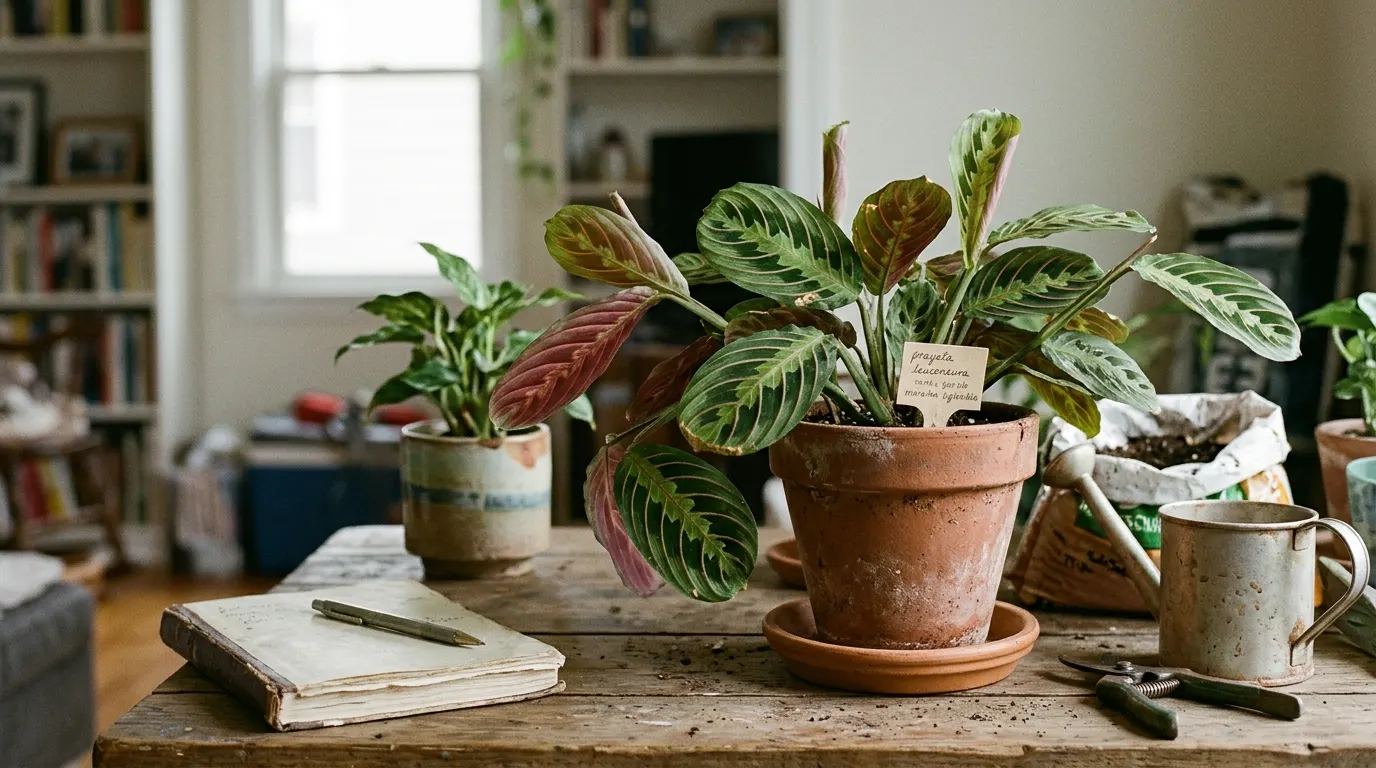
To care for a prayer plant (Maranta) indoors, give it bright, indirect light, keep the potting mix evenly moist but never soggy, and hold temperatures between 18°C and 27°C (65°F to 80°F). Aim for humidity above 50% and water with distilled, rain or filtered water to prevent curling leaves and brown tips.
Prayer plants (Maranta leuconeura) are lovely, but they are fussy about water quality, dry air and harsh sun. The leaves fold upward at night and relax by day, and that movement tells you a lot about how the plant feels. This guide covers light for both hemispheres, watering, temperature, humidity, fixing curled or brown leaves, and propagation.
What Does a Prayer Plant Need to Thrive Indoors?
A prayer plant needs bright, indirect light, evenly moist potting mix, warmth between 18°C and 27°C (65°F to 80°F), and humidity above 50%. It also needs low-mineral water. Get those four things steady and most problems never start.
Maranta belongs to the Marantaceae family and grows naturally on shaded tropical forest floors. That tells you what it wants indoors: filtered light, warm air, steady moisture and no big swings. Think of it as a plant that dislikes extremes of any kind.
The leaves move through a daily cycle called nyctinasty. They lie flat in daylight and rise at night, driven by small joints at the leaf base called pulvini. A healthy plant does this reliably.
Tip: If your plant stops raising its leaves in the evening, treat it as an early warning. It often shows up before any discolouration appears, so check light, soil moisture and humidity.
Where Should You Place a Prayer Plant for Light?
Place a prayer plant in bright, indirect light, a few steps back from a window or behind a sheer curtain. In the Northern Hemisphere, use east-facing windows. In the Southern Hemisphere, use east-facing windows too. Avoid unfiltered midday sun, which bleaches the leaf patterns.
The sun sits in a different part of the sky depending on where you live, so the same window direction does not behave the same way in both hemispheres.
- Northern Hemisphere (US, UK, Canada): South-facing windows are brightest and can scorch leaves, so keep the plant 1 to 2 metres (3 to 6 ft) back or use a sheer curtain. West windows get hot afternoon sun. North windows are gentler but can be dim in winter.
- Southern Hemisphere (Australia, NZ): North-facing windows are the brightest and need the same diffusing. West windows get harsh afternoon sun in summer. South-facing windows are the dimmest and gentlest.
- Both hemispheres: East-facing windows give soft morning light and are the safest choice.
Signs of too much light include faded, washed-out patterns, crisp pale patches and leaves that curl tight during the day. Signs of too little light include leggy stems, small new leaves and slow growth.
Prayer plants can grow under a full-spectrum grow light if natural light is poor. Keep it about 30 to 45 cm (12 to 18 in) above the foliage for 10 to 12 hours a day.
How Often Should You Water a Prayer Plant?
Water thoroughly when the top 2.5 cm (1 inch) of potting mix feels dry, then let excess drain away. Use distilled, reverse-osmosis, filtered or rainwater at room temperature. Marantas are sensitive to the salts, chlorine and fluoride in many tap supplies.
There is no fixed schedule. In a warm room in summer, that might mean every 5 to 7 days. In winter it can stretch to 10 to 14 days. Always check the soil with a finger first.
- Push your finger into the mix to the first knuckle.
- If it feels dry, water slowly until water runs from the drainage holes.
- Let the pot drain for 10 minutes.
- Empty the saucer so roots never sit in water.
A standard carbon jug filter does not reliably remove fluoride or dissolved salts. If your plant keeps browning at the tips despite good care, switch to rainwater, distilled or reverse-osmosis water. Collecting rain in a clean container is a cheap fix.
For more on technique, see our guide to watering houseplants.
What Temperature and Humidity Does a Maranta Like?
Keep a Maranta between 18°C and 27°C (65°F to 80°F) and never below 15°C (60°F). Humidity should sit at 50% to 60% or higher. Keep the plant away from air-conditioning vents, heaters and cold window glass.
Cold drafts cause sudden leaf drop and curling. Hot dry air from heaters and vents pulls moisture from the leaves faster than the roots can replace it.
Ways to raise humidity:
- Run a small humidifier near the plant, which is the most reliable method.
- Group plants together so they share moisture.
- Place the pot on a tray of pebbles with water below the pebble tops, keeping the pot base dry.
- Keep the plant in a brighter bathroom or kitchen if light allows.
A cheap digital hygrometer takes the guesswork out. Misting gives only a brief lift and does little for long-term humidity.
If you also grow other humidity-lovers, our Calathea care guide covers very similar needs.
How Do You Fix Curled or Brown Prayer Plant Leaves?
Inward curling usually means thirst, dry air, heat or too much sun. Crispy brown tips and edges usually mean mineral build-up from tap water, fertiliser salts or humidity below 40%. Yellow leaves with soft stems point to overwatering and root rot.
Curling and browning look related but have different causes, so diagnose before you act.
Leaves curling inward
- Check the soil. If it is dry below 2.5 cm (1 inch), water thoroughly.
- Move the plant out of direct sun.
- Lift humidity above 50%.
- Check the room is not above 27°C (80°F) or near a heater.
Curled leaves usually relax within a few days once the cause is fixed.
Crispy brown tips and margins
- Switch to distilled, rain or reverse-osmosis water.
- Flush the pot by running water through it for a couple of minutes to wash out salts, then drain fully.
- Reduce fertiliser strength or frequency.
- Raise humidity.
- Trim the brown edges with clean scissors, following the leaf shape. The damage does not reverse.
See also our general guide on brown and crispy indoor plant leaves.
Yellowing leaves with soft stems
Stop watering and slide the plant from its pot. Healthy roots are pale and firm. Dark, mushy roots mean rot. Cut away damaged roots with sterile shears and repot into fresh mix with about 30% perlite in a pot with drainage holes. Our root rot guide walks through the process.
Warning: Do not water a plant with rotting roots again until it is repotted into fresh, airy mix.
What Soil, Pot and Feeding Routine Works Best?
Use a light, moisture-retentive but free-draining mix, such as peat or coco coir with perlite and a little pine bark, in a pot with drainage holes. Feed monthly at half strength in the growing season and stop in the cool months.
Prayer plants have shallow, spreading roots, so choose a pot only 2 to 5 cm (1 to 2 in) wider than the root ball. Repot every year or two when roots circle the pot. Plastic or glazed pots hold moisture a little longer than unglazed terracotta.
Feed with a balanced liquid houseplant fertiliser diluted to half strength, once a month while growing. That means spring and summer in each hemisphere, so roughly September to March in Australia and NZ, and March to September in the US, UK and Canada. In the cool months, water less and skip fertiliser.
How Do You Propagate a Prayer Plant?
Take a stem cutting 1 cm below a node with 2 to 3 leaves, place it in clean water or moist perlite at 20°C to 24°C (68°F to 75°F) in indirect light, and pot it into soil once roots reach 3 to 5 cm (1 to 2 in).
The easiest time is during active growth. Division at repotting also works well and is the more reliable option for beginners.
- Choose a healthy stem with at least two leaves and a visible node.
- Cut about 1 cm below the node with sterilised shears.
- Place the cutting in a clean glass with the node submerged and the leaves clear of the water.
- Set it in bright, indirect light and keep the water fresh, changing it every few days.
- Wait for roots, which usually appear in 2 to 4 weeks.
- Pot into moist, airy mix once roots are 3 to 5 cm (1 to 2 in) long.
- Cover loosely with a clear bag for the first week or two to hold humidity, venting it daily.
To divide, tip the plant out in the growing season, tease the root clump into sections that each have stems and roots, and pot each one separately. For other methods, see our piece on rooting mediums beyond soil and water.
What Tools and Supplies Make Care Easier?
A small kit keeps conditions steady: a hygrometer, a pot with drainage, an airy potting mix, sterile shears and a supply of low-mineral water. None of it is expensive, and each item targets a common cause of trouble.
- Digital hygrometer and thermometer
- Sterilised pruners or scissors
- Clean glass jar for water rooting
- Peat or coco coir mix with perlite and pine bark
- Pot with drainage holes and a saucer
- Distilled, reverse-osmosis or rainwater
- Small humidifier if your air is dry
Expert Tips for a Fuller, Healthier Plant
Pinch back long, leggy stems just above a node to encourage bushy growth, rotate the pot a quarter turn weekly, and wipe leaves with a damp cloth to keep them clean. Check the undersides regularly for pests.
- Use the evening leaf movement as a daily health check.
- Keep the plant away from winter window glass, which can be much colder than the room.
- Dry air and spider mites go together. If you see fine webbing or stippled leaves, read our guide to houseplant pests and diseases.
- Water slowly and evenly so the whole root ball is wetted.
Frequently Asked Questions
Why are my prayer plant leaves turning yellow?
Yellow leaves most often come from overwatering, which suffocates roots, especially if the base of the stems feels soft. Other causes include very low light, cold drafts or an old leaf naturally dying off. Check the roots and drainage first, then adjust watering and placement.
Why has my prayer plant stopped folding its leaves at night?
A plant that stops raising its leaves at night is usually stressed. Common causes are too little light, dry soil, low humidity or a recent move. Very dim rooms can also dull the movement. Check conditions and give it a few weeks in a stable spot to recover.
Can prayer plants tolerate low light or grow lights?
Prayer plants tolerate moderate light but become leggy and lose colour in deep shade. They do well under a full-spectrum grow light placed 30 to 45 cm (12 to 18 in) above the leaves for 10 to 12 hours daily. A bright spot away from direct sun is still best.
How often should I fertilise an indoor Maranta?
Feed once a month during the growing season with a balanced liquid houseplant fertiliser diluted to half strength. Stop feeding in the cool months when growth slows. Over-feeding builds salts in the mix and causes brown leaf tips, so less is safer.
Can I use tap water on a prayer plant?
Sometimes, but many prayer plants develop brown tips from the salts, chlorine and fluoride in tap water. Letting tap water sit overnight does not remove fluoride or dissolved minerals. If browning keeps happening, switch to rainwater, distilled or reverse-osmosis water.
Is a prayer plant toxic to pets?
Prayer plants are generally considered non-toxic to cats and dogs, but chewing any plant can upset a pet's stomach. If your pet eats a large amount and seems unwell, contact your vet.
Why are my prayer plant leaves curling?
Curling leaves usually signal dry soil, humidity below 50%, heat or direct sun. Check the soil first, then move the plant to filtered light and raise the humidity. Once conditions improve, leaves normally relax within a few days.
Summary and Next Steps
Prayer plant care comes down to steady, gentle conditions. Fix the environment and the plant usually recovers without fuss.
Key takeaways:
- Give bright, indirect light, using east-facing windows in either hemisphere.
- In the Northern Hemisphere, diffuse south and west light; in the Southern Hemisphere, diffuse north and west light.
- Water when the top 2.5 cm (1 inch) is dry, using low-mineral water.
- Keep temperatures at 18°C to 27°C (65°F to 80°F) and humidity above 50%.
- Curling points to moisture, humidity or light stress; brown tips point to water quality, salts or dry air.
- Propagate by stem cutting or division during active growth.
Immediate actions:
- Check the soil with your finger today and note how dry it is.
- Place a hygrometer near the plant to see your real humidity.
- Start collecting rainwater or buy distilled water for your next watering.
With light, water and humidity sorted, your prayer plant should keep raising its leaves each evening, which is the best sign you are doing it right.