
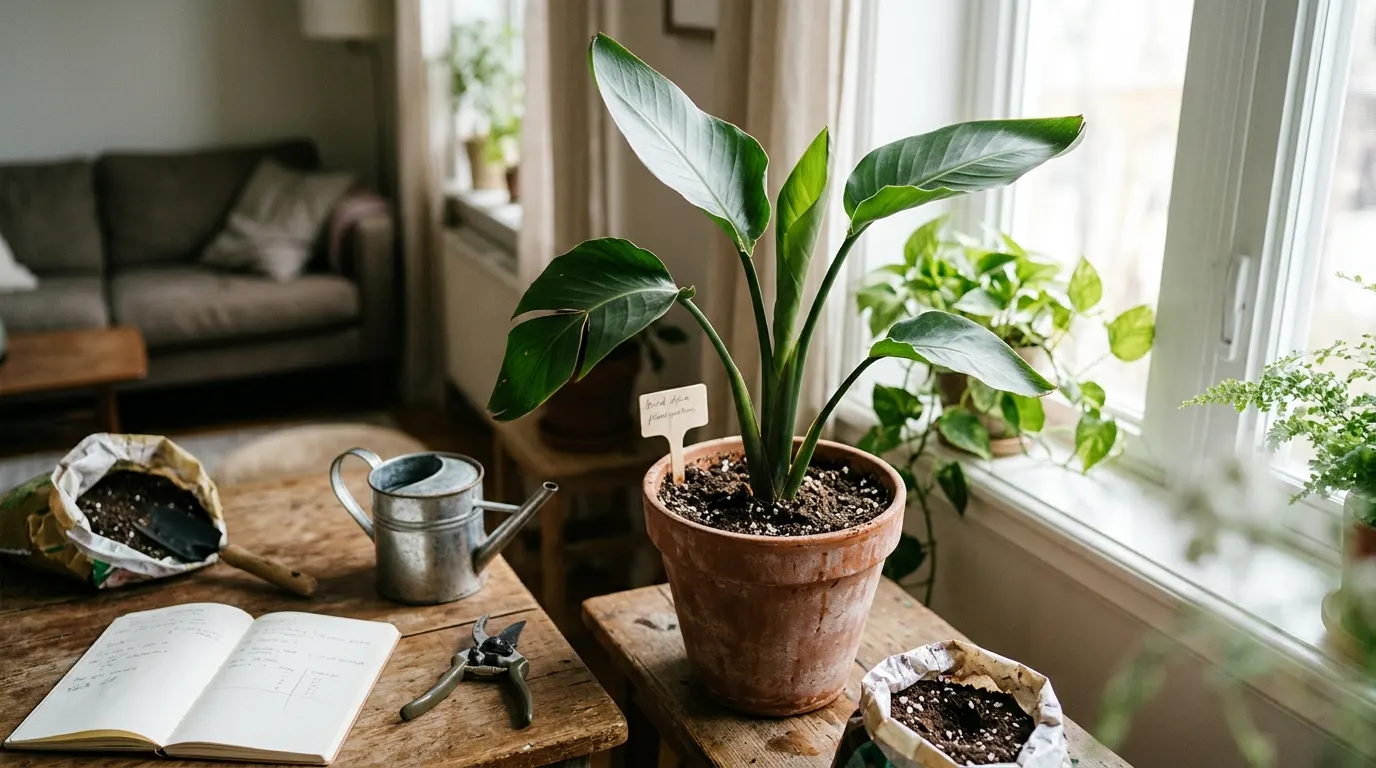
To care for a bird of paradise plant indoors, give it 4 to 6 hours of direct sun daily, keep it between 18°C and 29°C (65°F to 85°F), and never let it drop below 15°C (60°F). Water deeply when the top 5 cm (2 inches) of soil is dry, use a well-draining mix, and repot every 2 to 3 years.
Bird of paradise (Strelitzia reginae and the taller Strelitzia nicolai) is a bold, forgiving houseplant, but it throws up the same few puzzles: leaves that split, leaves that curl, and a stubborn refusal to flower. This guide covers light by hemisphere, watering, temperature, leaf problems, repotting and blooming, with timing for both the Northern and Southern Hemisphere.
Light Requirements: Which Window Direction Is Best?
Bird of paradise needs 4 to 6 hours of direct sun plus bright light for the rest of the day. East-facing windows suit both hemispheres. The sunniest window is south-facing in the Northern Hemisphere and north-facing in the Southern Hemisphere.
Many guides tell everyone to use a south-facing window. That only works north of the equator. In Australia, New Zealand and South Africa, the sun tracks across the northern sky, so a south-facing window stays shaded most of the day.
- East-facing (both hemispheres): gentle morning sun, low risk of scorching. A safe default.
- Northern Hemisphere: south-facing is the brightest. West-facing is the next best.
- Southern Hemisphere: north-facing is the brightest. West-facing is the next best.
- The shady side: north-facing in the Northern Hemisphere and south-facing in the Southern Hemisphere will give weak, leggy growth and no flowers.
If you move a plant from a dim spot into strong sun, do it over 2 weeks. Sudden exposure can bleach or scorch the leaves, especially behind glass in summer. A sheer curtain between 11am and 3pm in midsummer solves most scorching.
Tip: Rotate the pot a quarter turn each week so the plant grows evenly instead of leaning toward the glass.
If your light is poor, a full-spectrum LED grow light placed about 30 to 60 cm (1 to 2 feet) above the foliage for 10 to 12 hours a day can fill the gap.
Watering Guidelines: How Often and When to Cut Back
Water when the top 5 cm (2 inches) of soil is dry, roughly every 7 to 10 days in the growing season. In the cooler months, stretch that to every 14 to 21 days. Soak until water drains out, then empty the saucer.
The finger test beats any calendar. Push a finger into the soil to the second knuckle. If it feels dry, water. If it is cool and damp, wait. A moisture meter helps with large pots where the bottom stays wet long after the top dries.
A simple routine:
- Check the top 5 cm (2 inches) of soil.
- Water slowly around the whole pot until water runs from the drainage holes.
- Let it drain for 10 minutes.
- Empty the saucer or cache pot.
Use room-temperature water. Cold water straight from the tap can shock roots in winter. Soggy soil is the fastest way to lose a bird of paradise, so if you suspect it, read our guide to root rot in houseplants. For the general method, see how to water houseplants.
Seasonal timing:
- Northern Hemisphere: active growth March to October, slower growth November to February.
- Southern Hemisphere: active growth September to April, slower growth May to August.
Feed monthly with a balanced liquid fertiliser at half strength during active growth. Stop feeding completely in the winter rest period.
Temperature and Humidity Ranges
Keep bird of paradise between 18°C and 29°C (65°F and 85°F) and never below 15°C (60°F). Aim for 50% to 70% humidity. Cold draughts, heaters and air conditioners cause the most damage indoors.
These plants come from warm, frost-free regions. Anything under 10°C (50°F) can cause lasting damage, and a cold window at night in winter is a common culprit. Pull the pot a little way back from the glass on cold nights.
Humidity matters for leaf quality. Dry air crisps the edges and speeds up splitting. To raise it:
- Run a humidifier nearby and check it with a digital hygrometer.
- Group plants together.
- Use a pebble tray, keeping the pot base above the water line.
- Keep the plant away from heating and cooling vents.
Wiping the leaves with a damp cloth every few weeks removes dust and helps the plant photosynthesise. It also lets you spot pests early. If you find any, our houseplant pests and diseases guide covers treatment.
Why Are Leaves Splitting and Curling?
Splitting is mostly natural. The leaves evolved to tear along the veins so wind passes through without snapping the stems. Curling is a moisture signal: inward curling points to thirst, dry air or heat, while downward curling often suggests overwatering.
Split leaves
A few clean splits running with the veins are normal, especially on Strelitzia nicolai. They do not harm the plant. Excessive splitting, with brown ragged edges, usually comes from low humidity, brushing against walls or doorways, or blasts from vents.
- Do not cut healthy split leaves. The remaining tissue still photosynthesises.
- Trim only fully brown or dead sections with clean shears.
- Move the plant out of high-traffic spots and raise humidity toward 60%.
Curling leaves
Leaves roll inward along the midrib to reduce water loss.
- Inward curling: check the soil. If dry more than 5 cm (2 inches) down, give a deep soak. If the air is under 45% humidity, add a humidifier. Also check for hot afternoon sun or a nearby heater.
- Downward curling with yellowing: the soil is probably too wet. Let it dry, check drainage and look at the roots.
- Brown crispy tips: see our brown and crispy leaves guide.
Warning: Do not water a curled plant on reflex. Always check the soil first, because overwatered plants can curl too.
How to Repot an Indoor Bird of Paradise
Repot every 2 to 3 years in early spring: March to May in the Northern Hemisphere, September to November in the Southern Hemisphere. Go up only 5 to 7 cm (2 to 3 inches) in pot width and use a chunky, free-draining mix.
Signs it needs repotting include roots circling the drainage holes, water running straight through, or the pot bulging or tipping. Do not repot just because the plant is mature. Slightly snug roots are good for flowering.
What you need: a pot with drainage holes, tropical potting mix blended with perlite and coarse orchid bark, clean shears and gloves. For pot choices, see the best pots for indoor plants.
- Water the plant the day before so the root ball slides out easily.
- Lay the pot on its side and ease the plant out. Tap or squeeze the pot if it sticks.
- Loosen the outer roots gently and trim any black, mushy ones.
- Add a layer of mix so the crown sits at the same depth as before.
- Set the plant in the centre and fill around the roots, firming lightly.
- Water well, let it drain, and return it to bright light.
A large plant may be heavy, so ask for help. If the plant is too big to go up a size, scrape off the top 5 cm (2 inches) of soil and replace it with fresh mix, or divide the clump at repotting time.
How to Get a Bird of Paradise to Flower Indoors
Indoor flowering needs a plant at least 4 to 6 years old, 6 or more hours of strong direct sun, snug roots and a cooler winter rest of about 15°C to 17°C (60°F to 63°F) with less water. Without these, most stay leafy.
Strelitzia reginae flowers indoors far more readily than Strelitzia nicolai, which needs very bright light and plenty of size. Here is what tips the balance:
- Maturity: young plants will not bloom no matter what you do.
- Light: place it in your sunniest window for your hemisphere, or add a grow light.
- Root restriction: an oversized pot sends energy into roots and leaves instead of flower spikes. Resist upgrading too soon.
- Winter rest: keep it cooler and water less from November to February in the Northern Hemisphere, or May to August in the Southern Hemisphere. No fertiliser during this time.
- Spring push: resume regular watering and feeding as growth restarts.
Patience is part of the process. Even well-grown plants may take a season or two to produce a bloom, and some never will in a dim home.
Tools and Supplies
- Soil moisture meter
- Well-draining tropical mix (peat or coco coir, perlite, coarse orchid bark)
- Clean bypass pruning shears
- Pot with drainage holes, 5 to 7 cm (2 to 3 inches) wider than the old one
- Digital hygrometer and humidifier
- Balanced liquid fertiliser
Expert Tips
- Choose the window by hemisphere, not by habit.
- Use the finger test and moisture meter together in large pots.
- Avoid over-potting. A slightly tight pot flowers better.
- Keep leaves dust-free for better light capture.
- Compare with other bold foliage plants like the fiddle leaf fig, which has similar light and drainage needs.
Frequently Asked Questions
Can a bird of paradise flower completely indoors?
Yes, but it is not easy. Strelitzia reginae can bloom indoors when it is at least 4 to 6 years old, gets 6 or more hours of direct sun, stays slightly root-bound and has a cooler winter rest. Strelitzia nicolai rarely flowers inside unless it is very large and in exceptional light.
Should I cut off split bird of paradise leaves?
No, leave healthy split leaves alone. Splitting is a natural wind adaptation and the leaf still feeds the plant. Only trim sections that are fully brown and dry, cutting along the natural edge with clean shears so you do not damage the green tissue.
Why are my bird of paradise leaf tips turning brown and crispy?
Brown crispy tips usually come from dry air, irregular watering, or a build-up of salts from fertiliser or hard water. Raise humidity toward 60%, water deeply and evenly, and flush the soil with plain water every few months. Trim the brown tips lightly if they bother you.
How do I know if my bird of paradise is root-bound?
Look for roots pushing out of the drainage holes, water racing through without soaking in, or a pot that bulges or tips over. Slide the plant out to check. A dense mat of circling roots means it is ready. Remember that mild root-bound conditions help flowering.
What is the ideal window placement in the Southern Hemisphere?
A north-facing window is the sunniest in the Southern Hemisphere and gives the 4 to 6 hours of direct sun this plant wants. East-facing is the gentlest option, and west-facing works as a backup. South-facing windows stay too shaded for good growth or flowering.
How often should I repot a bird of paradise?
Every 2 to 3 years is usually enough. Repot in early spring, March to May in the Northern Hemisphere and September to November in the Southern Hemisphere. Choose a pot only 5 to 7 cm (2 to 3 inches) wider so the plant stays snug enough to flower.
Summary and Next Steps
Caring for a bird of paradise plant indoors comes down to strong light, steady warmth, careful watering and not rushing to a bigger pot.
Key takeaways:
- Give 4 to 6 hours of direct sun, using the correct window for your hemisphere.
- Keep temperatures between 18°C and 29°C (65°F and 85°F), never below 15°C (60°F).
- Water when the top 5 cm (2 inches) of soil is dry, and less in the cooler months.
- A few leaf splits are natural, while curling is a moisture clue.
- Repot every 2 to 3 years in early spring, going up only a small size.
- Flowering needs maturity, intense light, snug roots and a cool winter rest.
Do these next:
- Check which way your window faces and move the plant to the sunniest suitable spot.
- Do the finger test today and adjust your watering routine.
- Check the roots to see if the plant is due for repotting this season.