
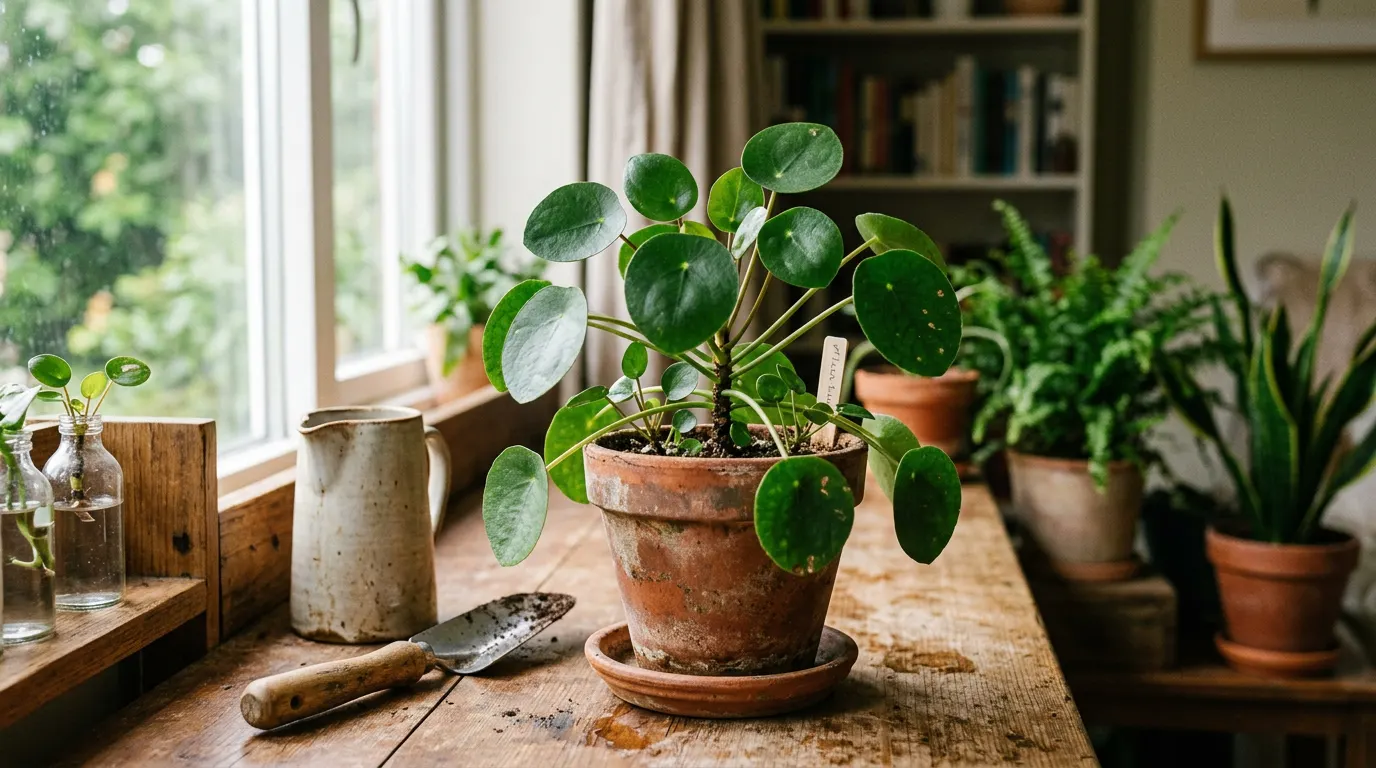
To care for a Chinese money plant (Pilea peperomioides) indoors, give it bright, indirect light and rotate the pot a quarter-turn each week. Water thoroughly only when the top 1 to 2 inches of soil feel dry. Use a loose, perlite-rich mix in a pot with drainage holes, keep it at 60°F to 75°F (15°C to 24°C), and repot or remove pups in spring.
Chinese money plant care looks simple, but most questions come down to leaves: drooping, curling, yellowing or sprouting odd white dots. This guide covers light, watering, soil, repotting and pup propagation, and includes a symptom table so you can match what you see to a fix.
What Light Does a Chinese Money Plant Need?
A Chinese money plant grows best in bright, indirect light, such as near an east- or west-facing window. Keep it out of hard midday sun, which scorches the leaves, and rotate the pot a quarter-turn weekly so the stems grow evenly instead of leaning.
Pilea peperomioides grows toward the strongest light source, so a plant left in one position soon leans and develops a lopsided canopy. A weekly quarter-turn keeps the round, symmetrical shape the plant is known for.
Good placement options include:
- An east-facing windowsill, which gives gentle morning sun.
- A spot 1 to 3 feet back from a west-facing window, where afternoon light is filtered by a sheer curtain.
- A bright room with a north-facing window in the Southern Hemisphere (south-facing in the Northern Hemisphere), as long as the plant sits close to the glass.
If stems become tall and stretched with small, sparse leaves, the plant is not getting enough light. Move it closer to the window. If leaves look bleached, dome upward or develop crispy brown patches, the light is too harsh.
Tip: Hold your hand a foot above the leaves at midday. A soft, blurry shadow means good indirect light. A sharp, dark shadow means the light is probably too strong.
How Often Should You Water a Chinese Money Plant?
Water a Chinese money plant when the top 1 to 2 inches of soil feel dry, then soak until water runs freely from the drainage holes. Empty the saucer within about 15 minutes. In most homes this works out to roughly once a week in summer and every two to three weeks in winter.
The soil, not the calendar, should decide. Push a finger or a wooden skewer into the pot. If it comes out clean and dry for the top inch or two, it is time to water. If damp soil clings to it, wait a few days.
A reliable watering routine:
- Check the soil with a finger or skewer.
- Water slowly around the base until water drains from the bottom.
- Let the pot drain fully in a sink for a few minutes.
- Return it to its saucer only once it stops dripping.
This plant has fairly thick, fleshy stems and holds some moisture, so it tolerates a short dry spell better than constant wet feet. Soggy soil is the more common cause of decline. For a deeper look at the technique, see this houseplant watering guide.
If you use hard tap water, you may notice white mineral deposits on the soil surface or leaf undersides. Letting water sit out overnight does not remove minerals, but occasional flushing of the pot with plenty of water helps prevent buildup.
What Is the Best Soil and Pot for Pilea Peperomioides?
Use a loose, fast-draining mix, such as 60% quality potting soil, 30% perlite and 10% coco coir. Choose a pot with drainage holes that is only slightly wider than the root ball. Terracotta dries faster and forgives overwatering; plastic holds moisture longer.
Pilea roots are fine and shallow, so they need air as much as water. Dense, heavy soil stays wet and invites rot. Perlite, pumice or coarse sand opens up the mix and lets excess water escape.
Pot choice matters too:
- Terracotta: Breathable and good for heavy-handed waterers.
- Plastic or glazed ceramic: Keeps soil moist longer, better for dry homes or forgetful waterers.
- Oversized pots: Avoid them. Extra soil stays wet for too long around a small root system.
For more on matching containers to plants, read about the best pots for indoor plants.
Temperature, Humidity and Feeding
Chinese money plants are comfortable at normal household temperatures of 60°F to 75°F (15°C to 24°C) with moderate humidity around 40 to 60%. Avoid cold drafts, heaters and air conditioning vents. Feed lightly during the growing season only.
Keep the plant away from radiators, heat vents and cold glass in winter. Sudden swings stress the leaves and can trigger curling or leaf drop.
For feeding:
- Use a balanced liquid houseplant fertiliser at half strength every 3 to 4 weeks in the growing season (spring to early autumn).
- Stop feeding in autumn and winter, when growth slows.
- Never fertilise a dry or newly repotted plant.
Winter growers should also water less. Soil takes much longer to dry in cool, low-light months, so check it before every watering instead of sticking to a routine.
Why Are My Chinese Money Plant Leaves Drooping or Curling?
Drooping or curling leaves usually point to a watering or light problem. Limp stems with down-curling leaves suggest thirst, while yellowing and drooping lower leaves suggest overwatering. Domed or cupped leaves often mean too much light or heat, and outward curling suggests too little light.
Check the soil first, then the plant's position. The direction of the curl is a useful clue.
| Symptom | Likely cause | Fix |
|---|---|---|
| Leaves curl downward, stems limp, soil dry | Underwatering | Water deeply, or bottom water for about 20 minutes |
| Lower leaves yellow and droop, soil wet | Overwatering or poor drainage | Let soil dry, check roots, repot in fresh mix if needed |
| Leaves dome or cup inward, convex shape | Too much light, heat or dry air | Move 2 to 3 feet back from the window, away from vents |
| Leaves curl outward or stems stretch | Not enough light | Move to brighter indirect light and rotate weekly |
| Drooping after repotting | Transplant stress | Keep in stable light, water lightly, give it 1 to 2 weeks |
| White dots under leaves | Mineral deposits from the plant's pores | Wipe gently; not a pest |
Entire plant drooping
Push a finger into the soil. If it is bone dry, water thoroughly. If it is soggy, stop watering, tip the plant out and inspect the roots. Healthy roots are pale and firm. Trim any black, mushy roots and repot in fresh, airy mix. The guide to root rot in houseplants explains the process in detail.
Yellow leaves
Older lower leaves yellowing occasionally is normal as the plant sheds old growth. Widespread yellowing, especially with wet soil, points to overwatering. See yellow leaves on houseplants for a wider checklist.
Warning: Do not water a drooping plant automatically. Always check the soil first, because overwatering and underwatering look alike from a distance.
How Do You Repot a Chinese Money Plant?
Repot every 1 to 2 years in early spring, using a pot 1 to 2 inches wider than the root ball. Use a mix of about 60% potting soil, 30% perlite and 10% coco coir, and water lightly afterwards. Spring means March to May in the Northern Hemisphere and September to November in the Southern Hemisphere.
Repot when roots circle the pot or poke from the drainage holes, or when water runs straight through without wetting the soil.
- Water the plant a day before to ease it out of the pot.
- Tip the plant sideways and gently slide out the root ball.
- Loosen the outer roots and trim any that are dark or mushy.
- Add a layer of fresh mix to the new pot so the plant sits at its previous depth.
- Fill around the roots, pressing lightly to remove large air pockets.
- Water lightly and place in bright, indirect light.
Some drooping for a week or two after repotting is normal. Keep conditions stable and avoid fertiliser until new growth appears.
How Do You Propagate Chinese Money Plant Pups?
Wait until a pup is 2 to 3 inches tall, then cut it away from the main stem or runner with a clean, sharp blade, keeping some root or stem attached. Root it in water for 2 to 3 weeks until roots reach about 1 inch, or pot it directly into moist, airy mix.
Pups appear at the base of the plant or along underground runners, sometimes popping up through the soil. Small pups often fail when separated too early, so patience helps.
To propagate in water:
- Wipe a knife or shears with rubbing alcohol.
- Follow the pup's stem down to where it joins the parent or runner.
- Cut cleanly, keeping as much of the pup's base as possible and any roots already present.
- Place the cutting in a small jar so only the base is submerged.
- Set it in bright, indirect light and change the water every few days.
- Pot it up when roots are about 1 inch long.
To propagate in soil, plant the pup straight into a small pot of moist, airy mix and keep it lightly damp, never wet. Roots often establish in a few weeks.
If you enjoy trying different methods, rooting mediums beyond soil and water covers other options. Pups also make good gifts, which is how this plant earned the nickname pass-it-on plant.
Tools and Supplies
You need only a few basics for healthy Pilea care:
- A pot with drainage holes and a saucer.
- Well-draining potting mix plus perlite, pumice or coarse sand, and coco coir.
- A wooden skewer or moisture meter to check the soil.
- Clean shears or a hobby knife for pups and root trimming.
- Small jars for rooting pups in water.
- A balanced liquid fertiliser, used at half strength.
Expert Tips for a Fuller, Healthier Plant
- Rotate weekly from the day you bring it home. This is the single easiest habit for symmetrical growth.
- Wipe dust off leaves with a damp cloth so they absorb light efficiently.
- Pot up only one size at a time to avoid wet, oversized soil.
- Remove pups from crowded pots to keep the mother plant vigorous.
- Inspect leaf undersides when you water. If you suspect pests, see identifying houseplant pests and diseases.
Frequently Asked Questions
Why are the leaves on my Chinese money plant turning yellow?
Yellow leaves are most often caused by overwatering or poor drainage, especially if the soil stays wet and the lower leaves yellow first. Occasional yellowing of the oldest leaf is normal. Check the roots, let the soil dry, and make sure the pot drains freely.
What are the white dots under my Pilea leaves?
Small white or cream dots on the underside are usually mineral deposits left when the plant releases excess water through tiny pores. They are not pests. Hard water can make them more noticeable. Wipe them off gently, or ignore them, as they do not harm the plant.
Can you grow a Chinese money plant in low light?
It survives in low light but will not thrive. Stems stretch, leaves shrink and growth slows. For compact, full growth, place it in bright, indirect light, such as near an east-facing window, and rotate it weekly to keep it balanced.
How fast do Chinese money plants grow indoors?
With good light and regular feeding in the growing season, a healthy plant can grow steadily and produce pups within its first year or two. Growth slows in winter or in low light. Rotating and repotting every 1 to 2 years supports consistent growth.
Are Chinese money plants toxic to cats and dogs?
Pilea peperomioides is generally considered non-toxic to cats and dogs, but chewing any plant can cause mild stomach upset. If your pet eats a large amount and seems unwell, contact your vet. Placing the plant on a shelf can also protect the leaves.
Why is my Chinese money plant drooping after repotting?
Drooping after repotting is usually transplant stress, especially if roots were disturbed. Keep it in stable, bright indirect light, water only when the top inch dries, and avoid fertiliser. Most plants recover within one to two weeks.
Summary and Next Steps
Good Chinese money plant care depends on a few consistent habits. Light, drainage and watering matter most, and leaf shape tells you which one needs adjusting.
Key takeaways:
- Provide bright, indirect light and rotate the pot a quarter-turn weekly.
- Water thoroughly only when the top 1 to 2 inches of soil are dry.
- Use an airy, perlite-rich mix in a pot with drainage holes.
- Read the leaf curl: down-curling and limp suggests thirst, yellowing suggests too much water, domed leaves suggest too much light or heat.
- Repot every 1 to 2 years in spring and separate pups once they reach 2 to 3 inches.
- Treat white dots as mineral deposits, not pests.
Immediate actions:
- Check the soil with a skewer today, and water only if the top 1 to 2 inches are dry.
- Move the plant to bright, indirect light and give it a quarter-turn.
- Look at the base for pups and plan to separate them in spring.
Following these steps will help your Chinese money plant care routine stay simple, and your Pilea peperomioides will reward you with round, glossy leaves and plenty of pups to share. If symptoms persist, visit the Plant Clinic on wilting for more troubleshooting help.