
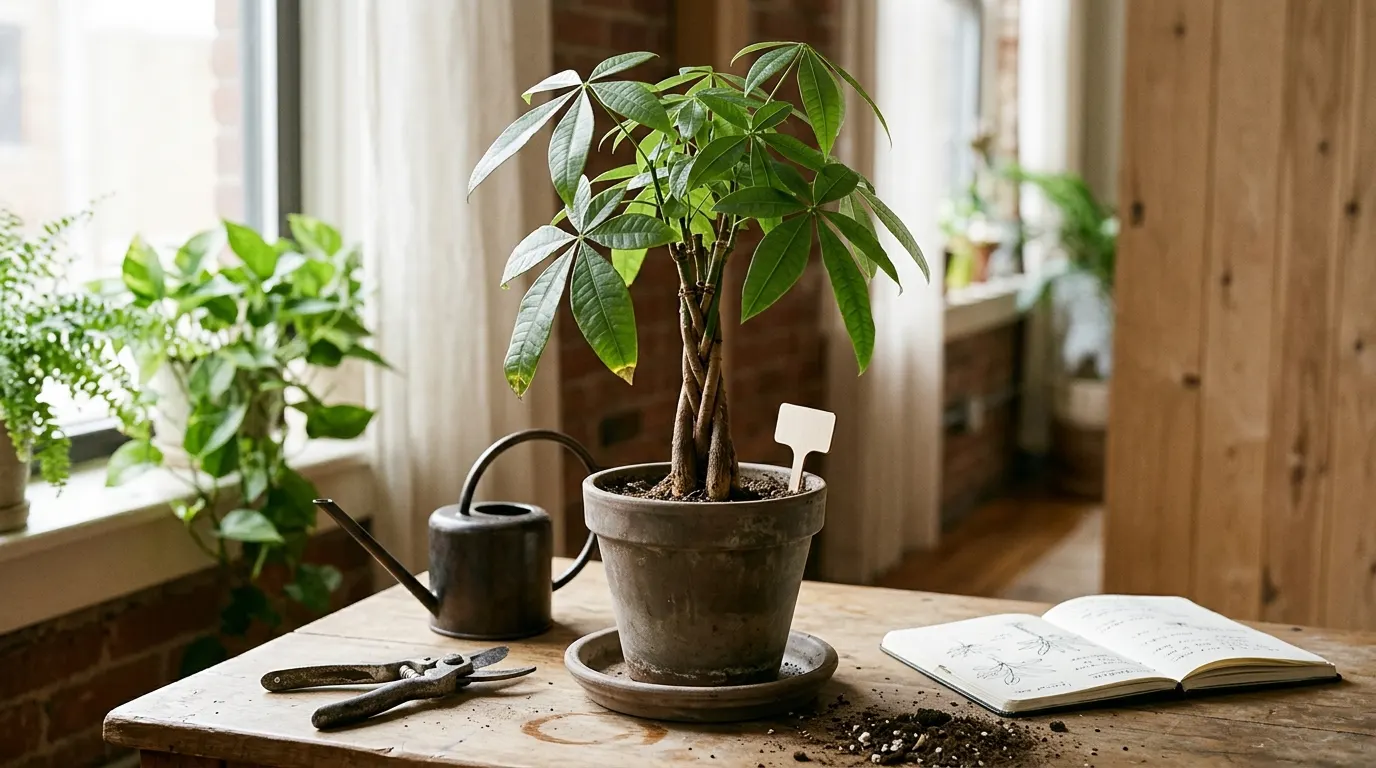
To care for an indoor money tree (Pachira aquatica), give it bright, indirect light, steady temperatures of 65°F to 80°F (18°C to 27°C), and humidity above 50%. Water deeply only when the top 2 to 3 inches (5 to 7 cm) of soil are dry, and check braided trunks for hidden nursery bands under the soil line.
Money trees are easy to buy and surprisingly easy to lose. Most deaths come from two things: watering too often and a rubber band or tape wrapped around the trunks that nobody knew was there. This guide covers light, watering, leaf problems, braided trunks, pruning and repotting, with a diagnostic approach for when things go wrong.
What Light and Temperature Does a Money Tree Need?
Place your money tree 3 to 6 feet from an east- or south-facing window (north-facing in the Southern Hemisphere) with a sheer curtain. Keep temperatures between 65°F and 80°F (18°C to 27°C). Avoid cold drafts below 50°F (10°C) and hot direct sun, which bleaches leaves.
A money tree tolerates a range of light, but it grows best in bright, filtered conditions. In low light it stretches, drops lower leaves and becomes more prone to rot because the soil stays wet longer.
- Good: bright room, sun visible nearby but not hitting the leaves for hours.
- Acceptable: medium light, with slower growth and less frequent watering.
- Poor: dim corners, hallways, or spots more than 6 feet from a window.
Direct midday sun through glass can leave pale, scorched patches on the palmate leaves. Morning sun is fine.
Keep the plant away from air conditioner outlets, heating vents and exterior doors. Money trees react to sudden temperature swings by dropping leaves.
Tip: Rotate the pot a quarter turn every couple of weeks so the canopy grows evenly instead of leaning toward the window.
How Often Should You Water a Money Tree?
Water thoroughly until liquid runs out of the drainage holes, but only when the top 2 to 3 inches (5 to 7 cm) of soil are completely dry. Never leave the pot standing in water. Overwatering is the most common cause of root rot in money trees.
Pachira aquatica grows wild along riverbanks and floodplains, so many guides say it loves wet feet. In a pot indoors, that advice kills plants. The base of the trunk is swollen and stores water, and potted roots sitting in dense, soggy mix run out of oxygen quickly.
Use the soak-and-dry method:
- Push a finger or a wooden skewer 2 to 3 inches into the soil. If it comes out damp or with soil clinging to it, wait.
- When it is dry, water slowly around the whole pot until water drains freely from the bottom.
- Let the pot drain for 10 to 15 minutes, then empty the saucer.
- Wait for the top few inches to dry again before the next watering.
In a bright room in warm weather this is often every 1 to 2 weeks. In winter, expect to water roughly 30 to 50% less often because growth slows and the soil dries more slowly. Winter means December to February in the Northern Hemisphere and June to August in the Southern Hemisphere.
For a broader look at technique, see our houseplant watering guide.
Why Are Money Tree Leaves Turning Yellow or Dropping?
Yellow leaves usually point to overwatering, poor drainage or low humidity. Green leaves dropping suddenly usually means environmental shock from relocation, a cold draft or a big light change. Check soil moisture first, then check the plant's surroundings before changing anything else.
Use this quick diagnostic:
- Several lower leaves yellow, soil damp: Overwatering. Stop watering, let the soil dry well below 2 inches, and make sure the pot drains.
- Green leaves dropping after a move or purchase: Acclimation stress. Pick a stable spot with bright, indirect light and leave it there.
- Leaves dropping near a vent or door: Cold or hot drafts. Move the plant.
- Yellowing with dry, crispy edges: Low humidity or irregular watering.
- Brown tips on leaves: Dry air, salt buildup from fertiliser, or long gaps between waterings. See our guide to brown and crispy leaves.
If yellowing is widespread, tip the plant out of its pot and look at the roots. Healthy roots are pale and firm. Rotten roots are brown or black, soft and smell sour. Our root rot guide walks through treatment.
Warning: Do not respond to yellow leaves by watering more. It is the most common mistake, and it makes rot worse.
What Is the Hidden Problem With Braided Money Tree Trunks?
Commercial growers often wrap rubber bands, electrical tape or ties around the braided trunks, sometimes 1 to 2 inches below the soil line. As the trunks thicken, these fasteners cut into the stem. Remove them early to prevent girdling, dieback and rot in individual trunks.
This is one of the most overlooked causes of a money tree that declines for no obvious reason. The band is buried, so you never see it. Over a year or two it squeezes the layer under the bark that moves water and sugars, and one trunk may suddenly turn soft or wilt.
To check:
- Water lightly the day before so the soil is slightly moist and easy to move.
- Gently scrape away the top 1 to 2 inches of soil around the trunks.
- Feel and look for rubber, tape, wire or plastic ties.
- Snip the band with small scissors, taking care not to nick the bark.
- Replace the soil and water as normal.
If a trunk has a groove or bulge where the band was, it may still recover. Do not unbraid the trunks to fix this; the stems are often fused or tightly pressed and can snap.
What to do about a squishy trunk
A soft, wrinkled or hollow-feeling trunk is rotting and will not recover. Unpot the plant, cut the soft trunk off at the base with sterilised pruners, and discard it. Trim any brown roots, wipe the tools with 70% isopropyl alcohol, and repot the remaining healthy trunks in fresh, dry mix. Water sparingly afterwards.
How Do You Prune and Shape a Money Tree?
Prune leggy or unruly growth in the active growing season, spring and summer. Cut about 1/4 inch above an outward-facing leaf node at a 45-degree angle with sterilised shears. This encourages new branching and a denser, more compact canopy.
Growing season is March to August in the Northern Hemisphere and September to February in the Southern Hemisphere.
- Sterilise bypass shears with 70% isopropyl alcohol.
- Choose stems that are long, bare or crossing the canopy.
- Cut just above a node that faces the direction you want growth to go.
- Remove no more than about a third of the canopy at once.
- Take off any yellow, damaged or dead stems at their base.
New shoots usually appear from just below the cut. Pruned tips can be rooted, though it is slower than with many houseplants. See rooting mediums beyond soil and water for options.
The braided trunk will not stay braided as it grows taller. The braid sits at the base, and new growth above is straight. That is normal.
When and How Should You Repot a Money Tree?
Repot every 2 to 3 years in spring, into a pot about 2 inches wider than the old one. Use a loose, well-draining mix such as 60% peat moss or coco coir, 20% perlite and 20% orchid bark, in a container with drainage holes.
Signs it is time: roots circling the drainage holes, water running straight through without wetting the soil, or a top-heavy plant that tips over.
- Water lightly a day before so the root ball holds together.
- Slide the plant out and loosen the outer roots gently.
- Trim any dark, mushy roots with clean shears.
- Place a layer of fresh mix in the new pot, set the plant at the same depth as before, and fill around it.
- Check for hidden bands while the roots are exposed.
- Water lightly, then return to the normal soak-and-dry rhythm.
Terracotta pots dry faster and suit people who tend to overwater. Plastic nursery pots hold moisture longer. Our indoor pot guide compares options.
Tip: Do not choose a pot much bigger than needed. Excess soil stays wet and invites rot.
What Tools and Supplies Do You Need?
You need only a few basics: a moisture meter or wooden skewer, sterilised bypass shears, potting ingredients, a pot with drainage holes and a way to raise humidity. Having them ready makes rescue jobs much quicker.
- Moisture meter or wooden probe for checking soil depth.
- Bypass pruning shears and 70% isopropyl alcohol.
- Peat moss or coco coir, perlite and coarse orchid bark.
- Terracotta or nursery pot with bottom drainage.
- Spray bottle, pebble tray or cool-mist humidifier for dry heated rooms.
Feed with a balanced liquid houseplant fertiliser at half strength every 4 to 6 weeks in the growing season. Stop feeding in the cooler months, October to February in the Northern Hemisphere and April to August in the Southern Hemisphere.
Expert Tips for a Healthier Money Tree
A few habits prevent most problems. Keep the routine consistent, check the base of the trunks, and adjust to the season rather than to a calendar.
- Water by soil dryness, not by schedule.
- Flush the pot with water every few months to clear fertiliser salts.
- Wipe leaves with a damp cloth so they absorb light well.
- In winter, keep humidity above 50% with a pebble tray or humidifier, but keep the plant away from heaters.
- Inspect leaf undersides for pests; see houseplant pests and diseases.
If you like the braided look but want a lower-maintenance plant, a ZZ plant tolerates dry spells even better.
FAQ
Is a money tree (Pachira aquatica) safe for cats and dogs?
Pachira aquatica is listed as non-toxic to cats and dogs by animal poison control authorities. Chewing leaves may still cause mild stomach upset in some pets, and the plant can be damaged. If your pet eats a lot of it and seems unwell, contact your vet.
Can a dead or squishy braided trunk be saved?
No. A soft, wrinkled trunk has rotted from the base and will not recover. Cut it out at the soil line with sterilised pruners, remove any brown roots, and repot the healthy trunks in fresh, dry mix. Water lightly until new growth appears.
How do I keep my money tree trunk braided as it grows taller?
You cannot extend the braid. Braiding is done on young, flexible stems at the nursery. As the plant grows, new stems grow straight. Leave the existing braid alone, because forcing it can snap the trunks, and prune the top for shape instead.
Why are the tips of my money tree leaves turning crispy brown?
Crispy brown tips usually come from dry air, irregular watering or fertiliser salt buildup. Raise humidity above 50%, water deeply when the top 2 to 3 inches are dry, and flush the soil every few months. Trim the brown tips if you like.
Should I remove the tape or rubber band on my braided money tree?
Yes. Dig down 1 to 2 inches around the trunks and cut away any rubber bands, tape or ties. They tighten as trunks thicken and can cut into the stems, causing dieback and rot. Cut carefully so you do not nick the bark.
How much light does a money tree need indoors?
Bright, indirect light is ideal, such as 3 to 6 feet from an east- or south-facing window with a sheer curtain. It tolerates medium light but grows slowly and needs less water. Hot direct sun through glass can scorch the leaves.
Why is my money tree dropping green leaves?
Green leaf drop usually means stress from a move, a cold draft under 50°F (10°C) or a sudden change in light. Put the plant in a stable, bright spot away from vents and doors, keep watering consistent, and give it a few weeks to adjust.
Summary and Next Steps
Caring for a money tree indoors comes down to bright, indirect light, steady warmth and disciplined watering.
- Water only when the top 2 to 3 inches of soil are dry, and drain fully.
- Yellow leaves point to overwatering; sudden green leaf drop points to shock or drafts.
- Check 1 to 2 inches below the soil for nursery rubber bands or tape on braided trunks.
- A squishy trunk is rotted and must be cut out.
- Prune in the growing season and repot every 2 to 3 years in a peat-perlite-bark mix.
- Cut watering by 30 to 50% in winter and pause feeding.
Immediate actions:
- Scrape back the top inch or two of soil and remove any hidden bands.
- Test the soil with a skewer before your next watering.
- Move the plant away from drafts to a bright, steady spot.
With those habits in place, your money tree care routine will stay simple and the plant should stay full and green.