
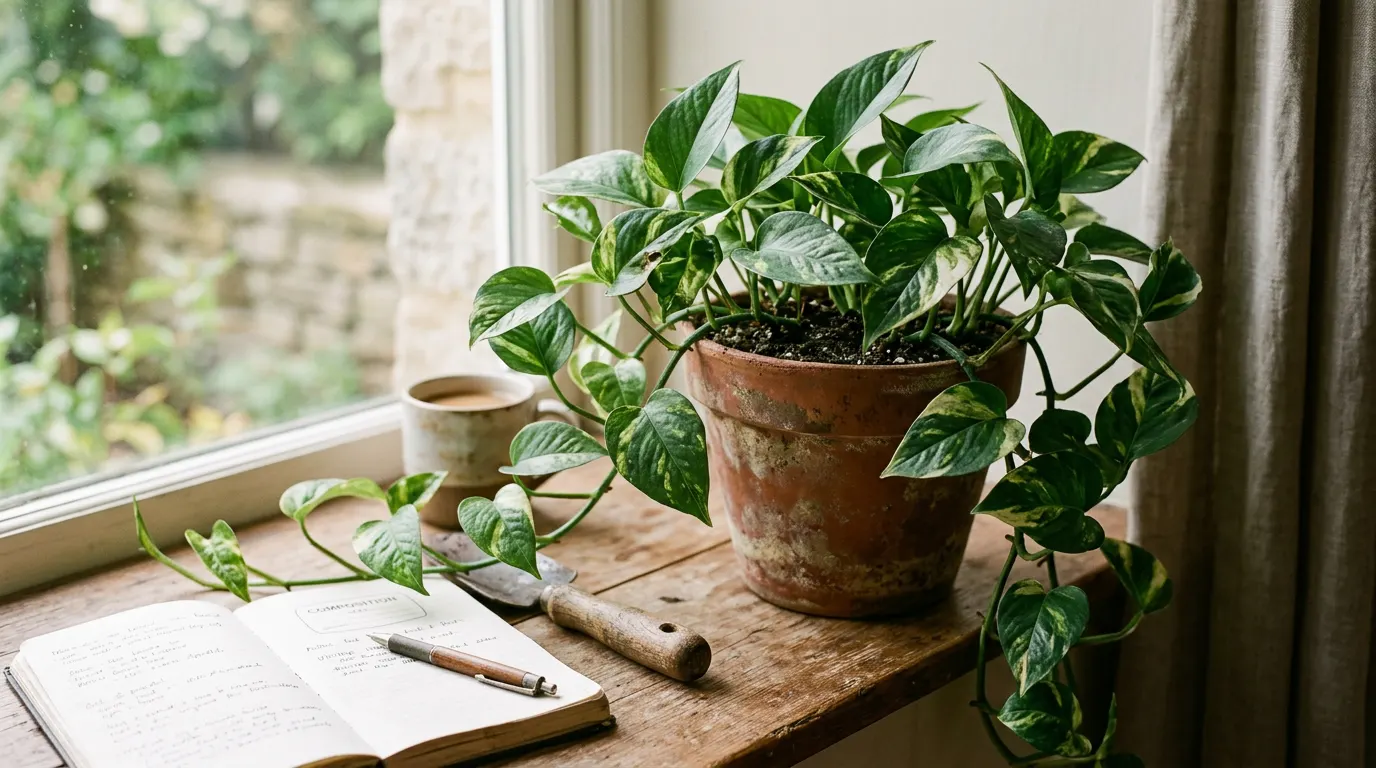
Give pothos bright, indirect light and water it only when the top 1-2 inches of soil feel dry, roughly every 1-2 weeks in the growing season and less in winter. Use a pot with drainage holes and keep it at 65-85°F. Yellow leaves usually mean overwatering. To propagate, cut below a node and root it in water or moist mix.
Pothos (Epipremnum aureum, also called devil's ivy) is one of the most forgiving houseplants, but advice on it often conflicts. Some guides say water weekly, others say wait until half the pot is dry. This article gives one clear rule, explains why the timing shifts, and covers yellow leaves and propagation step by step.
What Light Does a Pothos Need Indoors?
Pothos grows best in medium to bright indirect light. It tolerates low light, but growth slows and variegated types such as Marble Queen fade toward green. Direct afternoon sun can scorch leaves, so filter strong south or west light (north-facing in the Southern Hemisphere) with a sheer curtain.
A good test is your shadow. If you hold your hand over the plant and see a soft but visible shadow, the light is about right. A sharp, dark shadow means direct light; no shadow at all means it is too dim for steady growth.
Different cultivars have different needs:
| Cultivar | Light needed to keep its look |
|---|---|
| Golden pothos | Medium to bright indirect; tolerates lower light |
| Neon | Medium to bright; stays lime-coloured with good light |
| Marble Queen | Bright indirect; fades to green in low light |
| Manjula | Bright indirect; the pale patterning needs more light |
If a room is dim, a basic grow light on a timer for 10-12 hours a day works well. Offices with no windows are a common use for this.
Tip: Move a plant toward brighter light gradually, over a week or two. A sudden jump from a dim corner to a sunny sill can bleach or burn the leaves.
How Often Should You Water a Pothos?
Water when the top 1-2 inches of soil are dry, usually every 7-14 days in the growing season and every 3-4 weeks in winter. Water until it drains from the bottom, then empty the saucer. Pot size, light and pot material change the timing.
The calendar is only a guide. The finger test is the rule:
- Push your finger into the soil up to the second knuckle.
- If it feels dry, water thoroughly until water runs out of the drainage holes.
- If it feels damp, wait a few days and test again.
- Tip out any water left in the saucer after 15 minutes.
This is why advice varies. A small pot in bright light dries in a week. A large pot in a dim room can take three. Terracotta dries faster than glazed ceramic or plastic. For a deeper look at the technique, see our houseplant watering guide, and the choice of container matters too, as covered in the best pots for indoor plants.
| Season | Typical interval | Why |
|---|---|---|
| Growing season (spring-summer) | 7-14 days | Active growth, warmer, brighter |
| Autumn | 14-21 days | Slowing growth |
| Winter | 21-28 days | Low light, cool, little growth |
Pothos is more forgiving of a missed watering than a soggy pot. A drooping, limp plant with dry soil recovers within hours of a good drink.
Why Are My Pothos Leaves Turning Yellow?
Overwatering is the most common cause: yellow lower leaves on damp soil. Other causes include underwatering, poor drainage, temperature extremes, too much light, nutrient shortage and being rootbound. Check soil moisture and roots first. Older leaves also yellow naturally as the plant ages.
Use this table to narrow it down:
| What you see | Soil condition | Likely cause | First action |
|---|---|---|---|
| Yellow lower leaves, soft stems | Wet, heavy | Overwatering or root rot | Stop watering, check roots |
| Yellow and crispy, curling | Bone dry | Underwatering | Soak thoroughly |
| Pale, washed-out leaves | Normal | Too much direct sun | Move back from the window |
| Overall pale, slow growth | Normal | Low nutrients | Feed at half strength |
| Yellowing with roots circling the pot | Dries very fast | Rootbound | Repot one size up |
| One old leaf yellows now and then | Normal | Natural ageing | Remove it |
What to do if the soil is wet
- Stop watering and tip the plant out of its pot.
- Healthy roots are firm and pale. Rotten roots are brown, mushy and may smell sour.
- Trim mushy roots with clean scissors.
- Repot in fresh, airy mix in a pot with drainage holes.
- Water only when the top 1-2 inches are dry.
Our guides on root rot in houseplants and yellow leaves on houseplants go further if the problem is severe.
Tip: A yellow leaf will not turn green again. Once you have fixed the cause, remove it so the plant puts energy into new growth.
How to Propagate Pothos Cuttings (Step by Step)
Cut a healthy stem just below a node with a clean, sharp tool. Keep at least one node and a leaf or two. Place it in water or moist mix in bright indirect light. Move water cuttings into soil once the roots are a few inches long.
A node is the small brown bump on the stem where a leaf joins. Roots grow from nodes, so a cutting without one will not root.
- Choose a healthy vine and find a section with two or three leaves.
- Cut about a quarter inch below a node using clean scissors.
- Remove any leaf that would sit underwater.
- Put the cutting in a clear jar of room-temperature water, with the node submerged.
- Place it in bright indirect light and change the water weekly, or sooner if cloudy.
- When roots are 2-3 inches long, plant the cutting in moist, airy mix.
- Keep the soil lightly moist for the first few weeks while the roots adjust.
For soil propagation, place the cutting straight into moist mix with the node buried and keep it evenly damp. Roots in water usually appear within a few weeks, and soil cuttings often take a little longer. Warmth and light speed things up; a cool, dim windowsill slows them down.
If you want to compare other options, see rooting mediums beyond soil and water.
Warning: If a cutting is not rooting, check that it has a node, the water is clean, and the light is bright enough. Mushy, blackened stems mean rot and the cutting should be recut higher up.
What Soil, Fertilizer and Pruning Does Pothos Need?
Use an airy, well-draining houseplant mix. Feed with half-strength balanced liquid fertilizer every 3-4 weeks during the growing season and skip winter. Prune just above a node to encourage bushier growth.
A standard indoor potting mix with a handful of perlite added suits pothos well. Repot every 1-2 years, or when roots circle the inside of the pot, going up only one pot size.
Feeding runs from spring through early autumn: March to September in the Northern Hemisphere, and September to March in the Southern Hemisphere. Too much fertilizer causes salt build-up and brown tips, so flush the pot with plain water every few months. If you prefer a homemade option, see DIY natural fertilizers.
For bigger leaves, give the vines something to climb. A moss pole or trellis encourages larger, more mature foliage than a plant left trailing from a shelf.
Tools and Supplies
- Clean, sharp scissors or snips
- A pot with drainage holes and a saucer
- Airy houseplant mix with perlite
- A clear glass jar for water cuttings
- Balanced liquid fertilizer
- A moss pole or trellis for climbing
- A grow light for dim rooms (optional)
- A moisture meter (optional)
Common Problems and Troubleshooting
Why does my pothos have brown crispy tips?
Usually the cause is underwatering, dry air or fertilizer salts. Soak the pot thoroughly, flush it with plain water, and ease off feeding. See our brown crispy leaves guide for more.
Why are my pothos leaves small?
Small leaves come from low light or trailing growth with no support. Move the plant to brighter light and let it climb a pole.
Why is my variegated pothos turning green?
The plant is making more chlorophyll to cope with low light. Move it to brighter indirect light and the new growth should show more colour.
Expert Tips
- Take cuttings in the growing season for the fastest rooting.
- Prune long, bare vines back to a node and root the pieces for a fuller pot.
- Pot several rooted cuttings together for a dense plant.
- Check the underside of leaves regularly for pests such as mealybugs; our guide to houseplant pests and diseases shows what to look for.
- Keep plants away from cold drafts and heating vents.
FAQ
Can pothos survive in low light?
Yes, pothos survives in low light, but it grows slowly, produces smaller leaves and loses variegation. Plain green types such as Golden cope best. If the room is very dim, add a grow light for 10-12 hours a day to keep the plant healthy and full.
Should I cut off yellow pothos leaves?
Yes. A yellow leaf will not recover, so trim it at the base of the leaf stem with clean scissors. First find the cause, usually overwatering, so more leaves do not follow. If many leaves are yellowing at once, check the roots.
How long do pothos cuttings take to root in water?
Most cuttings show roots within a few weeks in warm, bright indirect light. Cool or dim conditions can double that time. Wait until the roots are 2-3 inches long before planting in soil, and change the water weekly.
Why is my variegated pothos losing its variegation?
Low light is the usual reason. Variegated pothos such as Marble Queen make more green pigment to capture energy when light is poor. Move it closer to a bright window, out of hot midday sun, and new leaves should show more pattern.
Is pothos safe for cats and dogs?
No. Pothos contains calcium oxalate crystals that can irritate the mouth and stomach of cats and dogs, causing drooling, vomiting and pawing at the face. Keep it out of reach, and call your vet if your pet chews it.
Can a pothos cutting without a node grow roots?
No. Roots form from the node, so a leaf or stem piece without one will not grow into a new plant. It may stay green for a while in water, but it will not root. Always cut just below a node.
Do pothos need fertilizer?
Pothos grows fine with little feeding, but a half-strength balanced liquid fertilizer every 3-4 weeks in the growing season boosts growth. Skip it in winter, when the plant is resting, and flush the pot occasionally to prevent salt build-up.
Summary and Next Steps
Pothos care indoors comes down to light, water and drainage. Get those right and the plant is easy to keep and easy to multiply.
Key takeaways
- Give pothos bright, indirect light; low light slows growth and fades variegation.
- Water when the top 1-2 inches are dry, and always let excess drain away.
- Yellow leaves on wet soil usually mean overwatering; check the roots.
- Cut just below a node to propagate, in water or moist mix.
- Feed at half strength in the growing season only.
- Pothos is toxic to cats and dogs, so keep it out of reach.
Do these next
- Do the finger test on your pothos today and adjust your watering to what the soil says, not the calendar.
- Check your pot has drainage holes and empty any standing water in the saucer.
- Take two or three node cuttings and start them in a jar to make a free, fuller plant. If you also keep other easy plants, our snake plant care guide is a good companion read.