
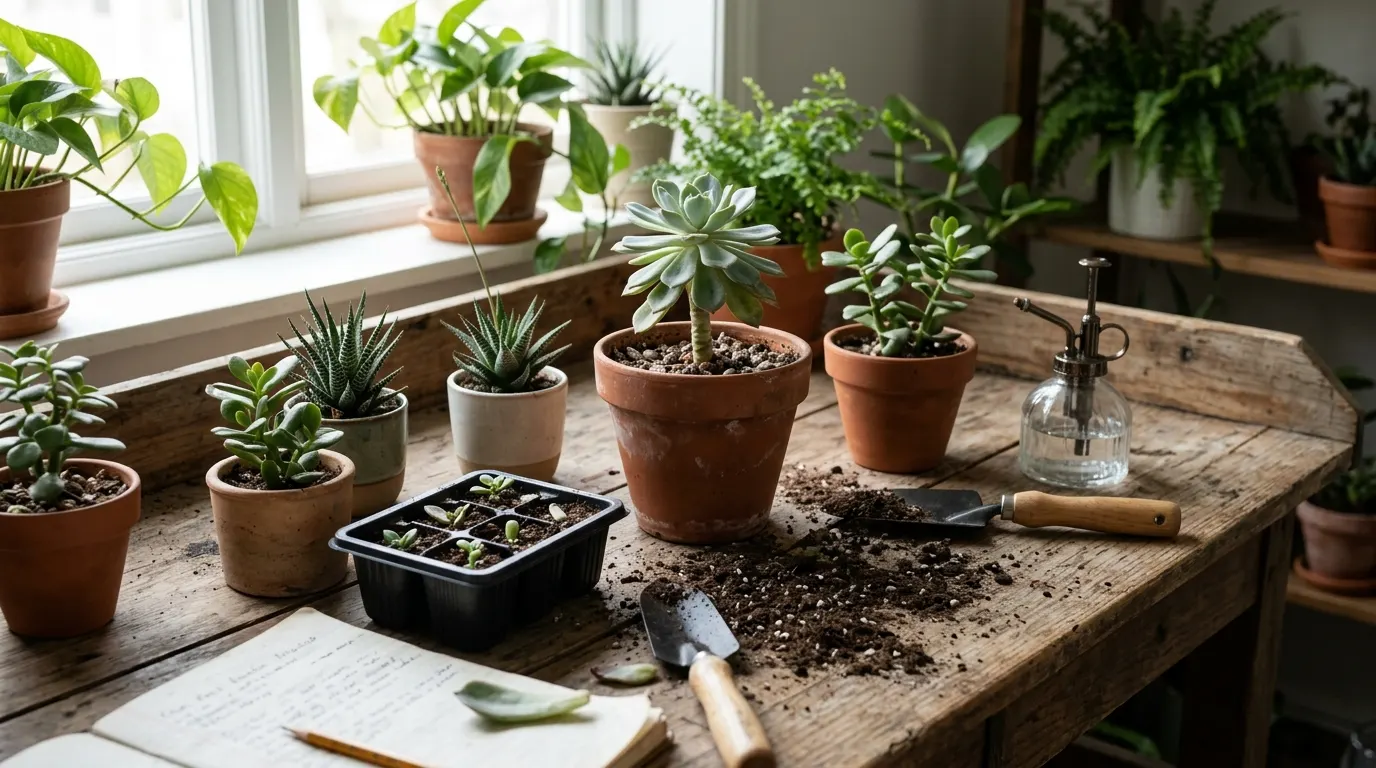
Care for indoor succulents by giving them at least 4 to 6 hours of bright light, watering deeply only when the soil is completely dry (usually every 2 to 3 weeks), and planting them in gritty, fast-draining mix in pots with drainage holes. Fix stretching with more light, and mushy stems by cutting back to healthy tissue.
Most succulents die indoors from too much kindness: frequent watering, heavy soil and dim corners. This guide covers light, watering, soil and pots, fixing stretched or mushy plants, propagation from leaves and offsets, and repotting, so you can keep rosettes tight and roots healthy.
What Do Indoor Succulents Actually Need?
Indoor succulents need strong light, infrequent deep watering, sharp drainage and a pot that dries out quickly. Get those four things right and most other problems disappear. They are desert and rocky-habitat plants, not typical houseplants.
Think of the plant as a water tank. Thick leaves and stems store moisture, so the roots only need a drink after the soil has dried completely. The mistake is treating them like a pothos or peace lily, which prefer steadier moisture (see our pothos care guide for the contrast).
The basics at a glance:
- Light: a bright window, ideally with some direct sun.
- Water: deep soak, then dry out fully.
- Soil: gritty, mineral-heavy mix.
- Pot: drainage hole, snug fit, often terracotta.
- Temperature: comfortable room temperatures; protect from frost and cold glass.
How Much Light Do Indoor Succulents Need?
Most succulents need 4 to 6 hours of bright light daily, ideally from a north-facing window in the Southern Hemisphere or a south-facing window in the Northern Hemisphere. Weak light causes stretching, pale colour and slow growth.
Echeveria, sedum, graptopetalum and jade plants want the brightest spot you have. Haworthia, gasteria and snake plants tolerate less. Our snake plant guide is useful if your room is dim.
Signs your light is wrong:
- Too little: elongated stems, wide gaps between leaves, rosettes flattening or leaning toward the window.
- Too much, too fast: bleached or brown, crispy patches on leaves facing the glass.
Tip: Rotate the pot a quarter turn every week or two so growth stays even. If you move a plant from a dim room to a sunny sill, introduce it over 7 to 10 days to avoid sunburn.
In winter, light drops sharply. Move plants right up to the glass, clean the window, or add a full-spectrum grow light 15 to 30 cm (6 to 12 inches) above the plants for 10 to 12 hours a day.
How Often Should You Water Succulents Indoors?
Water succulents only when the soil is completely dry through the whole pot, typically every 2 to 3 weeks in the growing season and every 4 to 6 weeks in winter. Soak thoroughly until water drains out, then empty the saucer.
A calendar is a poor guide. Pot size, light, airflow and season all change drying time. Check by pushing a wooden skewer to the bottom of the pot: if it comes out clean and dry, water.
How to water well:
- Confirm the soil is dry all the way down.
- Water slowly around the soil, not over the rosette.
- Keep going until water runs freely from the drainage hole.
- Let the pot drain fully, and never leave it standing in water.
Soft, wrinkled lower leaves usually mean thirst. Translucent, yellowing or mushy leaves mean too much water. For general technique, see the houseplant watering guide.
Warning: Frequent small sips keep the top damp and the roots stressed. A rare deep soak is safer than regular light watering.
What Soil and Pots Are Best for Succulents?
Use a gritty mix of roughly one-third to one-half mineral material (pumice, coarse sand or perlite) blended with potting mix, in a pot with a drainage hole. Terracotta is forgiving because it wicks moisture from the soil.
Standard potting mix holds too much water for succulents. You can buy cactus and succulent mix, but improving it with extra pumice or grit usually gives better results indoors.
Simple recipe:
- 2 parts cactus or general potting mix
- 1 part pumice or perlite
- 1 part coarse sand or fine grit
Pot tips:
- Choose a pot only 1 to 2 cm (about half an inch to 1 inch) wider than the root ball.
- Avoid decorative pots without drainage holes. If you must use one, keep the succulent in a plastic nursery pot inside it and lift it out to water.
- Shallow pots suit rosette types; deeper ones suit jade and aloe.
Our indoor pot guide compares materials in more detail.
How Do You Fix a Stretched Succulent?
Stretched (etiolated) succulents cannot return to their compact shape, but you can fix the cause and reset the plant. Move it to brighter light, then behead the rosette and re-root it for a compact new plant.
Stretching is the plant reaching for light. The elongated growth stays elongated, even in good light, though new growth will be tight.
Steps to reset an Echeveria or similar rosette:
- Cut the stem with clean scissors just below the lowest healthy leaves, leaving a short stem.
- Remove a few lower leaves to expose about 2 to 3 cm of stem.
- Let the cut dry for several days until callused.
- Set it on dry gritty mix, then water lightly only once roots form.
- Keep the old stump in bright light; it often sprouts new baby rosettes.
For trailing or branching types, simply prune back to a node and place in brighter light.
How Do You Save a Mushy or Rotting Succulent?
Cut away all soft, brown or black tissue, let the healthy remainder dry for several days, then replant in fresh dry gritty mix. Rot spreads quickly, so act the moment leaves turn translucent or the stem feels squishy.
Mushy succulents are almost always overwatered, sometimes combined with cold or poor drainage. Compare symptoms with our root rot guide.
Rescue steps:
- Unpot the plant and shake off all soil.
- Trim rotted roots and stem back to firm, clean, pale tissue.
- If the stem is rotten, cut above the damage and treat the top as a cutting.
- Dry the plant in shade for 3 to 7 days.
- Repot in fresh, dry, gritty mix and wait about a week before a light watering.
Tip: A firm stem with a black base can still be saved. A fully liquid plant cannot, but any intact healthy leaves can be propagated.
How Do You Propagate Succulents from Leaves and Offsets?
To propagate from leaves, twist off a whole healthy leaf, let it callus for a few days, lay it on dry gritty mix and mist lightly once roots or pink babies appear. Offsets are separated and potted directly.
Leaf propagation works well with Echeveria, Graptopetalum, Sedum and Pachyphytum. It is slower and less reliable with plants such as Haworthia and some Aloes, where offsets are easier.
Leaf method:
- Gently wiggle a lower leaf sideways so it comes away cleanly, with no torn base.
- Leave it in a dry, bright spot for 2 to 4 days.
- Place on top of gritty mix in bright indirect light.
- Mist the soil lightly every few days once tiny roots show.
- Remove the mother leaf only after it shrivels naturally.
Offset method:
- Wait until the pup has a few leaves and is about a quarter of the parent's size.
- Gently tease it free with a bit of root, or cut with a clean knife.
- Let the cut dry for a day or two.
- Pot in dry gritty mix and water after about a week.
For more on rooting approaches, see rooting mediums beyond soil and water.
When and How Should You Repot a Succulent?
Repot succulents every 1 to 2 years, in the start of the growing season (spring in most places, or when active growth resumes), when roots circle the pot or the plant outgrows it. Use dry soil and wait a few days before watering.
Signs it is time: roots out the drainage hole, the plant tipping over, soil that dries almost instantly, or compacted old mix that stays wet.
Steps:
- Let the soil dry fully before you start.
- Slide the plant out and gently remove old soil.
- Trim dead or mushy roots.
- Set it in a pot one size up with fresh gritty mix, keeping the base of the rosette at soil level.
- Top-dress with fine grit if you like, and wait 5 to 7 days before watering.
Wear gloves for spiny plants, or fold a towel around them.
What Tools and Supplies Make Succulent Care Easier?
You need very little: a drainage-hole pot, gritty soil, clean scissors, a skewer for checking moisture and a bright window. A grow light is useful in low-light homes or winter.
- Terracotta or ceramic pots with drainage holes
- Pumice, perlite or coarse grit
- Small watering can with a narrow spout
- Soft brush for dust and for removing pests
- Tweezers or tongs for spiny plants
- Optional: grow light on a timer
Feed lightly. A diluted, balanced fertiliser at quarter to half strength once or twice in the growing season is plenty. Homemade options are covered in our DIY natural fertilizer guide.
Common Problems and Troubleshooting
Most succulent problems trace back to light or water. Match the symptom to the cause, then change one thing at a time.
Why are the lower leaves shriveling?
Old bottom leaves drying and crisping is normal. If many leaves are wrinkled and soft, the plant is thirsty; give a deep soak.
Why are leaves translucent and yellow?
That is overwatering. Stop watering, check the roots and repot into dry mix if needed.
Why are white cottony spots appearing?
That is likely mealybug. Dab with a cotton bud dipped in rubbing alcohol and repeat weekly. See houseplant pests and diseases and our DIY pest sprays.
Why is my succulent losing its colour?
Fading or greening usually means too little light. Stress colour (pink or red edges) appears with bright light and slightly dry conditions.
Expert Tips and Advanced Techniques
- Water in the morning so the soil dries during the day.
- Use a bottom-watering tray occasionally for tightly planted dish gardens, then drain fully.
- Keep plants away from heaters, and away from cold window glass on frosty nights.
- Group plants with similar needs; do not mix Haworthia with sun-loving Echeveria in one dish.
- Provide airflow with an open window or a gentle fan to reduce rot and pests.
- Let plants rest in winter: less water, no fertiliser, maximum light.
FAQ
How often should I water indoor succulents?
Water when the soil is completely dry, usually every 2 to 3 weeks in warm, bright months and every 4 to 6 weeks in winter. Check with a skewer rather than a calendar, and always soak until water drains out.
Can succulents live in a room with no direct sun?
Some, like Haworthia, gasteria and snake plant, tolerate bright indirect light. Most will stretch and fade without direct sun, so add a grow light for 10 to 12 hours daily if your room is dim.
What is the best soil for succulents indoors?
A fast-draining mix with about one-third to one-half pumice, perlite or coarse grit mixed into potting soil. It should drain within seconds of watering and dry out within a week or two.
Why is my succulent stem soft and black?
That is rot from excess moisture. Cut above all discoloured tissue, dry the healthy section for several days, and replant in dry gritty soil. If the roots are fine, adjust watering and check drainage.
Can I propagate a succulent from a single leaf?
Yes, for many rosette types such as Echeveria and Sedum. Twist off a clean leaf, let it callus, then lay it on dry gritty mix in bright indirect light. Roots and tiny rosettes appear in a few weeks.
When is the best time to repot a succulent?
Repot at the start of the active growing season, usually spring in the Northern Hemisphere (March to May) and spring in the Southern Hemisphere (September to November). Avoid repotting during winter dormancy unless rot forces it.
Do succulents need fertiliser?
Only lightly. Use a diluted fertiliser once or twice during the growing season. Overfeeding causes weak, leggy growth, so skip it in winter.
Summary and Next Steps
Caring for succulents indoors comes down to bright light, rare deep watering, gritty soil and good drainage. Fix problems at the cause: more light for stretching, drier conditions for rot.
Key takeaways:
- Give 4 to 6 hours of bright light, and supplement with a grow light in winter.
- Water only after the soil is fully dry, then soak thoroughly.
- Use gritty mix and pots with drainage holes.
- Stretched plants can be beheaded and re-rooted; mushy ones need cutting back to healthy tissue.
- Leaves and offsets are easy, free ways to make more plants.
- Repot every 1 to 2 years at the start of active growth.
Immediate actions:
- Test your soil with a skewer today and hold off watering if any dampness remains.
- Move your plants to the brightest window and rotate them weekly.
- Check every pot for a drainage hole and swap in gritty mix for any plant sitting in dense soil.
With these habits, your indoor succulent care routine stays simple and your plants stay compact and healthy.