
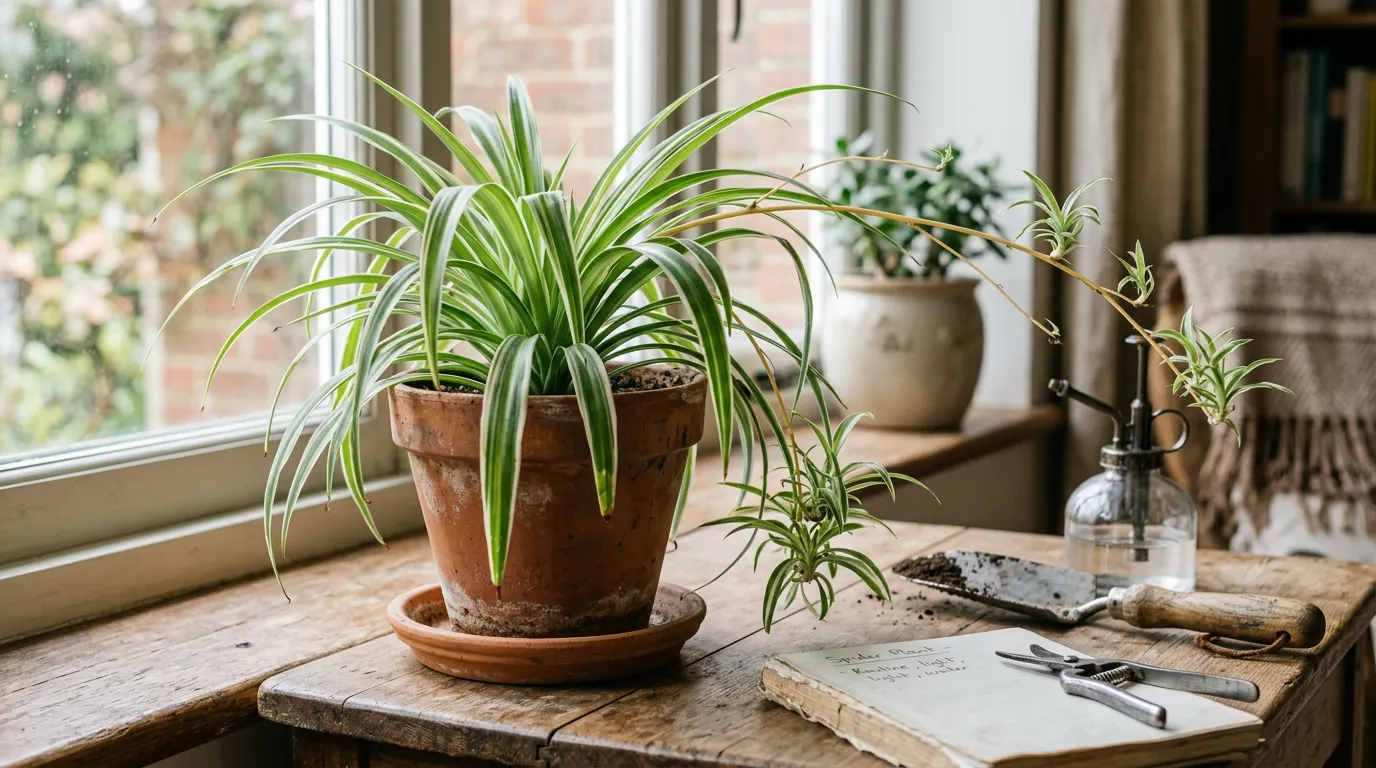
Care for an indoor spider plant by giving it bright, indirect light and watering when the top inch or two of soil is dry. Use well-draining potting mix in a pot with drainage holes. Brown tips usually come from tap water minerals, dry air or uneven watering, while yellow leaves usually point to overwatering. Pot up or root the babies for free new plants.
Spider plant care is simple once you understand how the plant stores water and what it dislikes. Most problems, including brown tips and yellow leaves, trace back to a handful of causes you can check in a few minutes. This guide covers light, watering, diagnosis, repotting and propagating spider plant babies, with a quick symptom table you can use straight away.
What Light Does a Spider Plant Need Indoors?
Spider plants grow best in bright, indirect light, such as near an east or north-facing window in the Northern Hemisphere, or a south or east-facing window in the Southern Hemisphere. They tolerate lower light but grow slowly and make fewer babies. Direct afternoon sun can scorch the leaves and fade the stripes.
A good test is to hold your hand over the leaves at midday. If you see a soft, blurry shadow, the light is about right. A sharp, dark shadow means direct sun, which is fine for an hour of gentle morning light but risky later in the day.
Variegated types, with a white or cream stripe down the leaf, need a little more light to keep their pattern. Plain green and curly types cope with slightly dimmer spots.
Signs the light is wrong:
- Too little: pale, floppy growth, long gaps between leaves and no plantlets.
- Too much: bleached patches, crisp tan marks and leaves that curl inward.
Tip: Turn the pot a quarter turn each time you water so the plant grows evenly rather than leaning toward the window.
How Often Should You Water a Spider Plant?
Water when the top inch or two of soil is dry, usually about once a week in spring and summer and less often in cooler months. The thick, fleshy roots store water, so slight dryness is safer than soggy soil.
Those pale, tuberous roots are the key to the plant's habits. They act like small water tanks, which is why a spider plant forgives a missed watering but sulks in a pot that stays wet.
A simple routine:
- Push a finger into the soil to the second knuckle.
- If it feels dry, water slowly until it runs out of the drainage holes.
- Let the pot drain fully, then empty the saucer.
- If the soil is still damp, wait a few days and check again.
In cooler months, growth slows and the soil takes longer to dry, so you may water every two to three weeks. Always go by the soil, not the calendar. For a deeper look at technique, see our houseplant watering guide.
Warning: Never let the pot sit in a saucer of water. Constantly wet roots are the fastest route to rot.
What Soil and Pot Does a Spider Plant Need?
A spider plant needs a well-draining potting mix and a pot with drainage holes. A standard indoor mix with a handful of perlite or coarse sand added works well. Choose a pot only slightly larger than the root ball, because oversized pots hold excess moisture.
Terracotta dries faster and suits people who tend to overwater. Plastic holds moisture longer and suits people who forget. Hanging baskets show off the plantlets best, since they dangle on long runners. Our guide to the best pots for indoor plants compares the options.
Why Are My Spider Plant Tips Turning Brown?
Brown tips are most often caused by minerals or fluoride in tap water, low humidity, fertilizer salt buildup or irregular watering. Switch to filtered or rainwater, flush the soil, water consistently and trim the brown ends.
Spider plants are known for reacting to what is in the water. Over time, minerals and salts collect in the soil and the leaf tips are where they show damage first.
Causes and fixes:
- Water quality: Use filtered or rainwater, or let tap water sit in an open jug overnight. Standing water helps with chlorine but may not remove fluoride or dissolved minerals.
- Salt buildup: Every few months, flush the pot by running water through the soil for a couple of minutes and letting it drain completely. White crust on the soil surface is a warning sign.
- Over-fertilizing: Feed lightly, and only in spring and summer.
- Dry air: Keep the plant away from heating vents, heaters and air conditioners. Grouping plants together raises humidity slightly.
- Uneven watering: Alternating bone dry and soaked soil stresses the leaf tips.
To tidy the damage, trim brown tips with clean scissors at an angle, leaving a thin edge of green so you do not cut into healthy tissue. Brown tips will not turn green again, so judge progress by new leaves. For wider causes, see why indoor plant leaves go brown and crispy or the Plant Clinic page on brown leaf tips.
Why Are My Spider Plant Leaves Turning Yellow?
Yellow leaves most often mean overwatering or poor drainage. Other causes are a root-bound pot, too little light or old leaves dying naturally. Check the soil moisture, check the roots for rot and adjust your watering.
Work through the checks in this order:
- Soil: Is it wet several days after watering? If so, water less often.
- Roots: Slide the plant out of the pot. Healthy roots are firm and pale. Mushy, dark or smelly roots mean rot.
- Water type and feeding: Rule out salt buildup by flushing the soil.
- Light: Dim spots can cause pale, yellowing growth.
If you find rot, cut away soft roots with clean scissors, repot into fresh mix in a clean pot and water sparingly for a few weeks. Our guide to root rot in houseplants walks through the rescue in detail.
One or two yellow outer leaves on an otherwise healthy plant is normal ageing. Remove fully yellow leaves at the base. For other causes across houseplants, see yellow leaves on houseplants.
How Do You Propagate Spider Plant Babies?
Snip a plantlet that has small root nubs, then set it in water or press it into moist potting mix. Keep it bright and warm. Roots develop in a few weeks, after which you can pot it up.
Spider plants send out long runners with plantlets at the ends. These are small clones of the parent and are the easiest way to make new plants.
What you need: clean scissors, a glass jar or small pots, fresh potting mix and filtered or rainwater.
Rooting in water
- Choose a plantlet with small root nubs at its base.
- Cut the runner close to the plantlet.
- Place it in a jar so only the base touches the water, keeping the leaves dry.
- Set the jar in bright, indirect light and change the water every few days.
- When roots are a few centimetres (about an inch or two) long, usually in two to four weeks, pot it into moist mix.
Rooting in soil
- Fill a small pot with moist, well-draining mix.
- Press the plantlet's base into the surface, or pin it down while still attached to the parent.
- Keep the mix lightly moist and the pot warm and bright.
- Once you feel resistance when giving a gentle tug, new roots have formed. Cut the runner if it is still attached.
Water-rooted plantlets are fun to watch, but their roots can take a little time to adjust to soil. Soil-rooted plantlets skip that step. Plantlets do not need to be rooted before planting, as the nubs will root once in contact with moist mix. For other methods, see rooting mediums beyond soil and water.
Tip: Spring and summer are the best times to propagate, because warmth and light speed up rooting.
When and How Should You Repot a Spider Plant?
Repot when roots crowd the pot or push out of the drainage holes, ideally in spring or summer. Choose a pot one size larger, use fresh well-draining mix and water lightly afterward.
Spider plants like a snug pot, and being slightly root-bound often encourages plantlets. Repot only when the plant dries out very quickly, the roots circle tightly or the pot bulges.
- Water the plant a day before to ease it out.
- Tip the plant out and loosen the outer roots gently.
- Trim any soft or dead roots.
- Place it in a pot one size up with fresh mix at the same depth as before.
- Water lightly and keep it out of harsh sun for a week.
Spring and summer repotting means Northern Hemisphere gardeners work roughly from March to August, and Southern Hemisphere gardeners from September to February.
Spider Plant Quick Troubleshooting Table
Match the symptom to the cause. Brown tips point to water quality or dry air. Yellow leaves point to overwatering. Pale, floppy growth points to low light. Few babies point to a young plant, low light or a pot that is too large.
| Symptom | Likely cause | Fix |
|---|---|---|
| Brown tips | Tap water minerals, dry air, fertilizer salts | Use filtered water, flush soil, feed less |
| Yellow leaves | Overwatering, poor drainage | Water less, check roots, repot |
| Pale, floppy growth | Low light | Move to brighter indirect light |
| Scorched patches | Direct sun | Move back from the window |
| No babies | Young plant, low light, oversized pot | Add light, wait, let it get snug |
| Mushy base | Root rot | Cut rot, repot in fresh mix |
For pests such as sticky residue or tiny insects on the leaves, see how to identify houseplant pests and diseases.
Seasonal Care and Feeding Tips
In spring and summer, water more often, feed lightly and do your repotting and propagating. In the cooler months, growth slows, so water less and stop feeding. Keep plants away from cold drafts and heating vents all year.
A balanced liquid houseplant fertilizer at half the label strength, once a month in spring and summer, is plenty. More feeding does not mean more babies and often leads to brown tips.
If your plant has no babies, check three things: is it mature, is the light bright enough and is the pot slightly snug?
Frequently Asked Questions
Are spider plants safe for cats and dogs?
Spider plants are generally regarded as non-toxic to cats and dogs, but chewing can still upset a pet's stomach. Cats are often drawn to the dangling leaves and may nibble them. If your pet eats a lot and seems unwell, contact your vet for advice.
Can spider plants grow in low light?
Spider plants survive in low light but do not thrive there. Growth slows, leaves can turn pale and floppy, and the plant is unlikely to produce babies. Bright, indirect light gives fuller, healthier growth and keeps variegated stripes sharp.
Should I cut off brown tips on my spider plant?
Yes, trimming is purely cosmetic and safe. Cut at an angle with clean scissors, leaving a thin edge of green so you do not damage healthy tissue. Brown tips will not recover, so also fix the cause, usually water quality or dryness.
Is tap water bad for spider plants?
Tap water can cause brown tips in some homes because of fluoride, chlorine or dissolved minerals. If your plant has browning tips despite good watering, switch to filtered or rainwater for a few months and flush the soil. New growth should stay greener.
Why is my spider plant not producing babies?
The usual reasons are youth, low light or a pot that is too large. Mature plants in bright, indirect light and a slightly snug pot produce plantlets most readily. Light feeding in spring and summer can help, but too much fertilizer does not.
Do spider plants like being root-bound?
They tolerate it and often flower and make babies when slightly snug. Repot when roots break the pot, circle tightly or the soil dries out within a day or two. Severely compacted roots will restrict growth and cause yellowing.
How fast do spider plants grow?
Growth is steady in spring and summer in bright light, and slower in cooler months. A healthy plant can fill a pot and send out runners within a year. Low light, cold rooms and heavy shade all slow it down noticeably.
Can I root spider plant babies while they are still attached?
Yes. Set the pot of moist mix beneath the runner and press the plantlet's base into it while it stays attached to the parent. Once it resists a gentle tug, roots have formed and you can snip the runner.
Summary and Next Steps
Good spider plant care indoors comes down to light, water and a little observation.
Key takeaways:
- Give bright, indirect light and avoid harsh afternoon sun.
- Water when the top inch or two of soil is dry, and always let the pot drain.
- Brown tips usually mean water minerals, dry air, salt buildup or uneven watering.
- Yellow leaves usually mean overwatering, so check the roots for rot.
- Propagate plantlets in spring and summer, in water or straight into moist soil.
- Repot only when the plant is crowded, and go up just one pot size.
Immediate actions:
- Check the soil with your finger today and adjust your watering to what it tells you.
- Flush the pot with plenty of water, let it drain, and switch to filtered or rainwater if tips are browning.
- Snip one healthy plantlet and start it in water or soil for a free new plant.
If you enjoy easy, forgiving plants, our guides to pothos care and snake plant care are good next reads.